A 49-yuan MiFi tears down to an ASR1803 Cat.4 board with a one-time clip shell
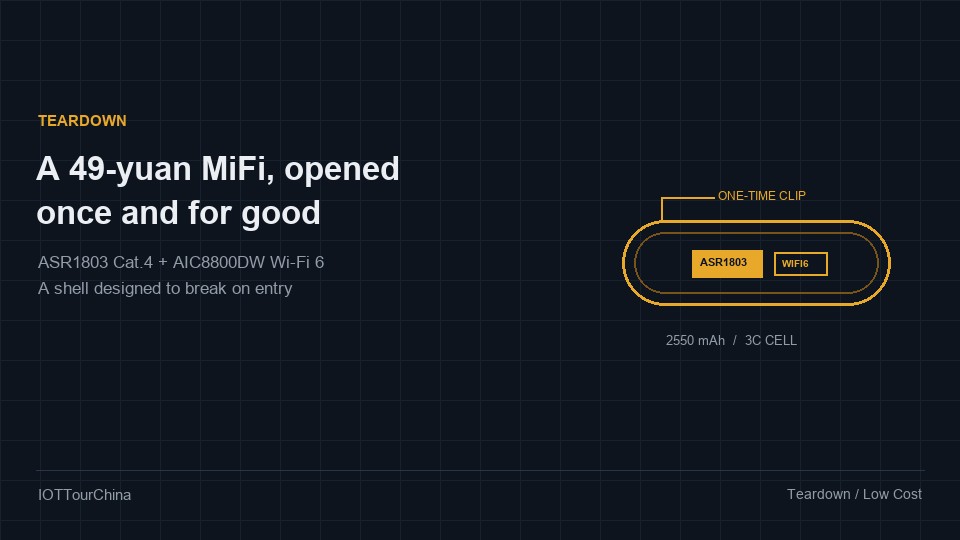
A budget portable Wi-Fi hotspot is a compact way to see how a cellular gateway is actually built, because the board has to fit a modem, a radio and a battery into a pocket-sized shell. The Feimao M1, marked FM_M1 and sold as a TD-LTE wireless data terminal, does it on a single board. The unit examined here is a 49 yuan retail model with a 3C marking on both the terminal and its battery. This article reports what the teardown photographs show and what the chip makers publish; no electrical testing was performed.
One board, two radios and a platform chipset
Removing the two shields exposes a compact layout. The largest package carries a silkscreen reading ASR1803. ASR Micro describes the ASR1803 as a 22 nm LTE Cat.4 baseband and RF integrated chip with an ARM Cortex-A7 application processor, integrated DDR and support for RTOS or Linux. Its stated applications include MiFi and CPE terminals, which matches this product form exactly.
Around it sit the companion parts of the same platform. A PM802S power management chip is the standard supply companion for the ASR1803. A ZB25VQ64CTJG serial flash, whose package marking reads 25VQ64CTJG, provides 64 M-bit of storage for firmware and configuration. An ASR5601C adds Bluetooth Low Energy on its own, and an AIC8800DW supplies a single-band 2.4 GHz Wi-Fi 6 link. The split is worth noting: cellular, Wi-Fi and BLE are three separate chips, not one combined SoC.
Several smaller devices are labelled only by unclear markings in the photographs. Their functions are not asserted here.
Antennas, battery and the built-in SIM
The plastic frame holds three antenna contacts for Wi-Fi, main 4G and diversity. The battery is rated at 2550 mAh and carries its own 3C marking; the pack is built by Phoenix New Energy of Huizhou around an EVE ICR18650/26V cell, with a separate protection board. Charging is through a Type-C port.
The SIM is not user-replaceable in the usual sense. It sits in a socket on the board and is a custom card printed with the Feimao logo. This is the commercial point of the design: the card and the data plan are bound together, so swapping the card would remove the revenue stream that subsidises the hardware price.
A shell that does not go back together
The enclosure uses no screws and relies entirely on clips. Opening it breaks a clip at a deliberately thinned root, a stress concentration that makes the first separation clean and repeatable but means the shell cannot be closed and reopened. The teardown attributes this to the operator's interest in keeping the subscriber card and plan attached to the device.
The practical consequence is straightforward. The electronic content is serviceable in principle, but the enclosure makes non-destructive repair impossible. A cracked clip is not a cosmetic fault; it is the designed result of opening the case.
What the part list is good for
For an integrator, this board is a reference for a low-cost Cat.4 gateway rather than a product to buy for its own sake. It shows a complete 4G plus Wi-Fi 6 plus BLE signal chain from one domestic modem vendor and its power companion, with a separate Wi-Fi chip where the modem has no integrated WLAN. The flash, battery and protection arrangement are equally ordinary and equally informative.
The trade-off is equally clear. A 49 yuan price buys a certified battery and a tidy board, but it buys a case that must be destroyed to inspect and a data plan tied to a custom SIM. Cheap hardware can be well built and still be disposable by design.
Reading the chip markings with care
Teardown reports on low-cost gear often over-read silkscreen. In this case the two largest markings are legible in the photographs and can be checked against vendor pages: the modem marking matches ASR Micro's own ASR1803 description, and the flash marking matches the ZB25VQ64 family. The smaller devices are a different matter. Where a marking is blurred or ambiguous, this report leaves the part unidentified rather than guessing a function from its position on the board.
That discipline matters because a single wrong part number in a teardown tends to be copied into later summaries and taken as fact. A board with a clearly identified modem and a handful of deliberately unidentified passives is a more useful reference than one with a confident but invented bill of materials. The conclusion here rests on the parts that can actually be read and corroborated.