Espressif guides to 32 to 35 percent revenue growth as ESP32 demand moves past smart home
Espressif announced its preliminary third-quarter results on 13 October 2026. Revenue is guided at RMB 880 to 900 million and net profit at RMB 211 to 229 million. Against the same quarter last year that is a 32 to 35 percent increase in revenue and an 83 to 98 percent increase in profit. The figures are unaudited, and the final numbers will appear in the quarterly report.
The revenue line is the one to read carefully. Growth was 18.9 percent in the first half and 21.1 percent in the second quarter. The third quarter is guided at 32 to 35 percent. Demand accelerated through the year while the company's oldest market stood still.
The numbers
| Metric | Q3 2026 guidance | Q3 2025 | Change |
|---|---|---|---|
| Revenue | RMB 880-900 million | RMB 666.7 million | +31.99% to +34.99% |
| Net profit attributable to shareholders | RMB 211-229 million | RMB 115.5 million | +82.68% to +98.27% |
| Net profit excluding non-recurring items | RMB 200-218 million | RMB 109.0 million | +83.54% to +100.06% |
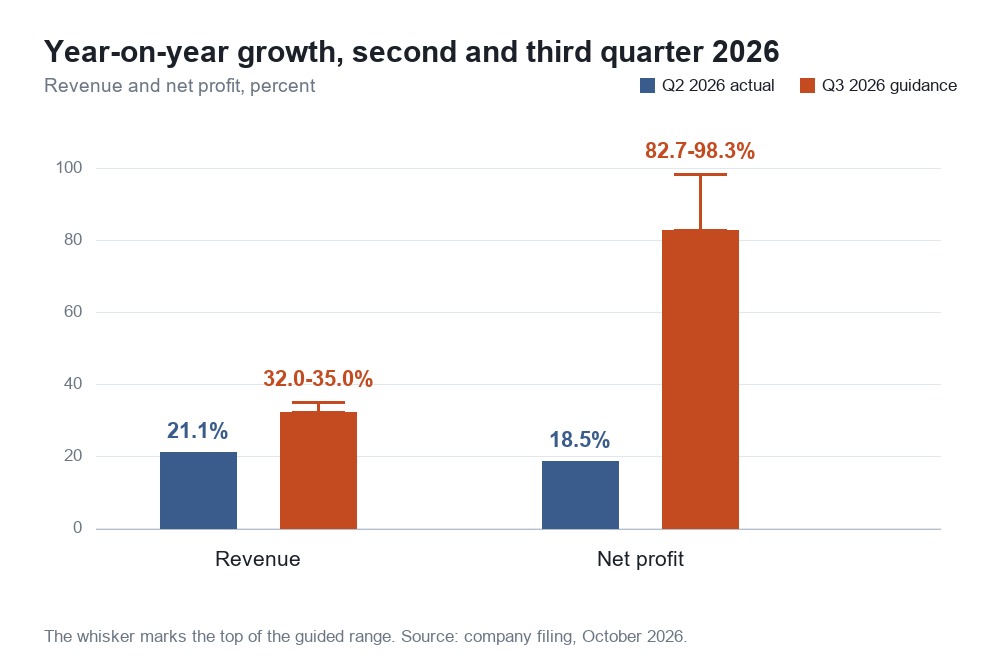
The earlier quarters give the curve. The first half closed at RMB 1.48 billion of revenue, up 18.9 percent, with a gross margin of 49.3 percent. The second quarter on its own was the company's first quarter above RMB 800 million, at RMB 833 million and up 21.1 percent, with the margin reaching 50.0 percent.
| Period | Revenue | Year on year | Gross margin |
|---|---|---|---|
| First half 2026 | RMB 1.48 billion | +18.9% | 49.3% |
| Q2 2026 | RMB 833 million | +21.1% | 50.0% |
| Q3 2026 guidance | RMB 880-900 million | +32.0% to +35.0% | no figure given |
Profit grew much faster than revenue in the third quarter because revenue grew faster than operating expenses. That is operating leverage rather than a price change, and the company flags it as such. Its own margin guidance for the quarter is only that the level should stay good.
What the announcement says is driving it
One sentence carries the story. Smart home demand was broadly steady in the quarter, applications outside smart home kept growing, and the high-performance product line is benefiting from rising demand for device interaction. The same paragraph notes a diversified customer base and the pricing ability that comes with it.
The company has been more specific in its investor sessions. In July and August it described smart home growth this year as single digit, and named the segments growing instead: industrial automation, smart agriculture, energy management, and the newer developer market that AI tooling has widened. Its half-year report makes the same argument from another direction, stating that growth was not driven by a single product cycle but by a wider product portfolio and a growing developer ecosystem.
Two structural numbers sit underneath. Modules and development kits were 64.5 percent of first-half revenue against 34.9 percent for chips, so a design that lands on a module is worth more than one that buys silicon alone. And direct overseas revenue grew 34.1 percent in the second quarter against 15.9 percent at home, which makes the quarter a broader story than one domestic consumer cycle.
The three parts carrying the shift
| Part | Role | What it brings |
|---|---|---|
| ESP32-S3 | Volume workhorse | Dual-core Xtensa LX7 at 240 MHz, 2.4 GHz Wi-Fi, Bluetooth 5 LE, 45 GPIOs, and vector instructions that accelerate neural network work through the ESP-DSP and ESP-NN libraries |
| ESP32-P4 | Compute without a radio | High-performance microcontroller with no integrated wireless, aimed at vision, display and edge processing, normally paired with a connectivity part |
| ESP32-S31 | Multi-protocol gateway class | Dual-core RISC-V at 320 MHz with a 128-bit data path and SIMD, 512 KB SRAM, 250 MHz DDR PSRAM expansion, 60 GPIOs, Wi-Fi 6, Bluetooth 5.4 with LE Audio, IEEE 802.15.4 for Zigbee and Thread, and a gigabit Ethernet MAC |

The S31 entered mass production on 27 July 2026. Espressif's own developer FAQ describes it as technically able to replace the S3 outright, and still recommends the S3 wherever a product does not need several protocols at once or the higher compute, because it costs less.
That is the mechanism behind the phrase device interaction. A smart plug needs a radio and a relay. A voice endpoint needs a microphone array, a display interface and enough compute to run a wake word locally, and it sells for more, which raises the value of the module inside it. The same logic explains why the company now talks about smart home hubs, smart speakers and edge AI devices rather than about connected bulbs.
What the guidance does not say
It says nothing about whether any particular development board is in stock, and it should not be read that way. Posts circulating in Chinese maker channels about boards selling out and prices about to rise are seller-side commentary. The company's own statement points the other way: it reports high inventory held deliberately, which is not what a company-level shortage looks like.
Retail board prices are set by the board vendors rather than by Espressif, and the hobby board market is a small slice of module volume. Buying one board and running a module programme are two different markets, and this announcement describes the second one.
What it does describe is a mix moving up. More of the revenue comes from devices that need more memory, more radio and more compute than a plug, and that shift is what turns unit growth into revenue growth.
What to take away if you are specifying hardware
- For a sensor node, a plug or a simple controller, nothing here changes the choice. The S3 remains the reference part and the cheapest supported target for most open firmware.
- For a product that has to speak several protocols at once, or bridge Zigbee and Thread to a wired uplink, the S31 is shipping and Espressif positions it as the S3 replacement. Budget the higher part cost and design the antenna once.
- For vision, display or HMI work that needs no radio, the P4 plus a connectivity companion is the intended combination, and it is where the half-year report places its new-market discussion.
For pricing signals, watch gross margin and inventory in the final report. Both are disclosed, dated and comparable between quarters. Forum posts about shortages are none of those things.
This is editorial coverage of a published disclosure, not investment advice and not an endorsement. Figures are the company's own preliminary guidance for the third quarter of 2026, announced on 13 October 2026 and unaudited at the time of writing; final results appear in the quarterly report.