An ESP32-S3 and an AS7265X triad make an 18-channel spectrometer from 410 to 940 nm
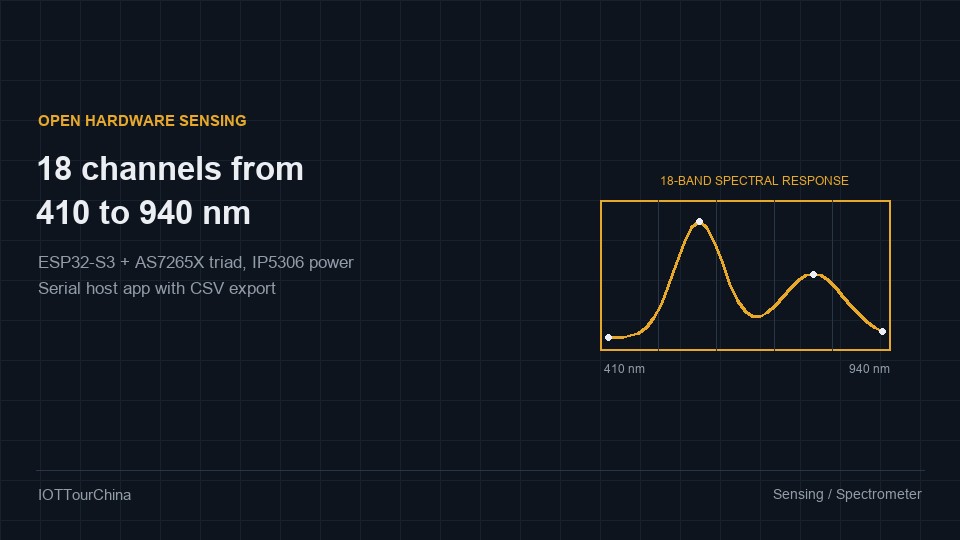
An eight-channel spectral sensor gives eight points, not a spectrum; the lines between them are interpolation. A DIY handheld project makes that limitation explicit and then addresses it by moving from an AS7341 to an AS7265X. The result is a battery-powered spectrometer with 18 channels from 410 to 940 nm, an ESP32-S3 controller, a colour display and a serial host application. The build is documented in a maker article with board photographs; the design was not reproduced or measured by us.
Three chips, eighteen wavelengths
The AS7265X is not one sensor but a triad: AS72651 for ultraviolet, AS72652 for visible and AS72653 for near-infrared. SparkFun, which sells a Qwiic board built around the triad, specifies 18 channels spanning 410 to 940 nm, with onboard 405 nm UV, 5700 K white and 875 nm IR LEDs and a fixed I2C address of 0x49. The published accuracy is plus or minus 12 percent at 28.6 nanowatts per square centimetre per count.
That specification explains the upgrade. The earlier eight-channel AS7341 build covered 415 to 680 nm and cost under 100 yuan in parts. Adding near-infrared means paying more for the sensor and accepting a wider set of discrete bands, but it makes changes beyond the visible range observable. The project text is careful to say the curve is a set of 18 sampled points, not a continuous spectrum.
Power, controller and display
The board splits into power, controller and sensor sections. An IP5306 handles lithium battery charging and boost conversion, chosen because the builder had parts on hand and because it integrates charge management, boost and state-of-charge indication in one package. A TLV62569 synchronous buck converts the IP5306 output down to 3.3 V at up to 2 A for the controller, sensor, fill LEDs and display, with lower conversion loss than a linear regulator.
An ESP32-S3 reads the AS7265X over I2C, controls gain, integration time and the fill lamps, draws the curve on a 240 by 320 ST7789 TFT used in landscape, and streams measurements to a host over USB serial. The photographs show a Windows serial interface at 115200 baud with channel values, a peak readout and a temperature field.
The host application is where the instrument becomes usable
The on-device screen is enough for a quick reading. The host application is what makes the tool practical for comparison: it plots all 18 channels at once and exposes gain, integration time, sampling interval and lamp state without reflashing firmware. The stated rule is conventional and correct: raise gain or integration time in dim conditions, lower them in bright conditions to avoid saturating a channel.
History storage and CSV export let a measurement be opened in Excel or Python later. For a low-cost sensor this matters as much as the hardware, because raw channel values from a triad are only useful when they can be compared across sources and samples.
Why this is a reasonable catalogue entry
The project does not claim laboratory grade spectroscopy, and its own documentation keeps the distinction between sampled bands and a continuous curve. What it does show is a complete and reproducible signal chain: three commercial spectral sensors on one bus, a battery power path with a defined 3.3 V budget, a controller that handles both acquisition and display, and a host tool that makes the data exportable.
For an integrator the transferable points are the power budgeting, the decision to control exposure through gain and integration rather than hardware changes, and the habit of shipping the acquisition parameters with the data. Those apply to any multichannel sensing build, whether or not near-infrared is the goal.
What the design does not settle
A triad of spectral sensors with a stated accuracy of plus or minus 12 percent is a qualitative instrument, not a calibrated one. The board photographs show a bare sensor on a carrier and a fill-light arrangement with no optical bench, no slit and no reference path. That is sufficient to compare a lamp, a leaf or a coloured surface and to watch a band rise or fall, but it cannot support an absolute irradiance measurement or a reflectance value traceable to a standard.
The project itself keeps this boundary explicit. Curves are presented as channel values joined for readability, and the near-infrared extension is framed as adding observable bands rather than as turning the device into a laboratory spectrometer. Anyone planning to reuse the design for measurement work would have to add a calibration source and a fixed optical geometry first, and would then be designing a different instrument. As a teaching and exploration platform the chain is coherent; as a metrology tool it is deliberately out of scope.