Btai 1: Open Waveguide AR Glasses at 900 RMB, With the Rail Sequencing Written Down
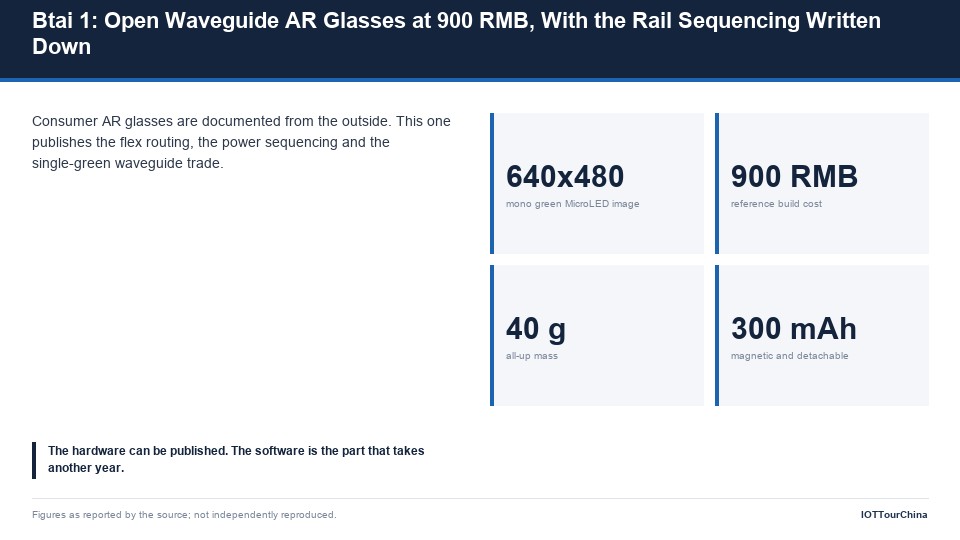
Smart glasses are a system-integration problem before they are an optics problem: display, camera, audio, power, radio and structure all have to fit into a frame that a person will wear. Btai 1, published on the OSHWHub open hardware platform, is an attempt to make that whole stack inspectable — and, at a stated reference cost of about 900 RMB, reproducible.
The configuration
| Item | Btai 1 |
|---|---|
| Display | MicroLED plus waveguide, mono green, 640 × 480 |
| Light engine | JBD013 |
| SoC | Allwinner V821_WBX |
| Storage | Samsung KLM-series eMMC |
| Audio coprocessor | JieLi JL7016G8 |
| Camera | Sony IMX219, 8 MP |
| Interaction | Stereo speakers, linear motor, temple buttons |
| Battery | Detachable magnetic, 300 mAh |
| All-up mass | About 40 g |
| Stated build cost | About 900 RMB, project material as the reference |
How a waveguide puts an image in front of the eye
The lens does not emit light. It carries it. A micro light engine forms the image, couples it into the glass, the light propagates inside the substrate by total internal reflection, and a coupling-out structure delivers it to the eye region at the right angle.
The whole chain is: MicroLED image → couple in → total internal reflection → couple out at the eye.
Two consequences follow, and both matter more than the resolution figure. First, the waveguide's design constrains what can be displayed, so the 640 × 480 mono green image is a property of this optical design rather than a display limit. Second, the exit pupil is small — the eye has to be in the right place, which is why waveguide glasses are sensitive to fit in a way that a phone screen is not.
Getting a full Linux system into a temple
The electronics are split across boards and joined with board-to-board connectors and flex, which is the only way to keep the frame thin.
The Allwinner V821_WBX runs the system; eMMC holds the OS and data; the JieLi JL7016G8 is an audio coprocessor. Using two chips for compute and audio means the audio path has to be merged afterwards through a channel-select circuit — the kind of detail that decides whether the design is buildable by anyone without an audio lab.
The camera is an IMX219 on a 2-lane MIPI interface. The project documentation flags the two things that will break a first-time copy: high-speed pairs need length matching and impedance control, and the SoC has multiple supply rails with a defined power-up order. Neither is visible in a schematic review, and both are why "just solder the parts on" fails.
PCB, flex and mechanical design
The main board is a multilayer stack with board-to-board connectors. The temple button board is held to roughly 6 mm wide to fit the arm, which forces 0201 passives — a real constraint on anyone planning to hand-assemble.
To keep the front frame slim, the design uses a set of separate flex circuits: signal, waveguide, main power, touch module, and speaker leads. The author also produced a V2.0 single-eye waveguide flex to reduce prototyping cost, which is the kind of revision that tells you the first version was expensive to build.
The enclosure is 3D printed, with folding temples and a metal hinge. The battery sits at the end of one temple and is magnetically detachable, using a small custom PCB, a mechanical retainer and pogo pins. That choice is doing two jobs: it makes the glasses look like glasses, and it moves the one component with a predictable service life out of a sealed assembly.
Software, and what is actually finished
The system runs Linux on the V821. The companion app is written in Flutter and, per the documentation, is Android-only. It covers device pairing and management, an app list and store, file transfer and a user profile.
The demo material shows a menu, an AI dialogue screen, real-time translation and phone linkage. The author is explicit that parts of the software are still under development, and that the screenshots should not be read as finished product capability. That caveat is worth taking at face value: on a device like this, the hardware is the part that can be published, and the software is the part that takes another year.
What the project ships
Nine STEP files covering the frame, temples, temple covers, battery bay and buttons; firmware images for the V821 main SoC and the JL7016G8 audio coprocessor; hardware design files, structure models and the software material. Project page at oshwhub.com/sgsax/project_tiqnqiyt, with a demo video linked from it.
The licence is CC BY-NC-SA 4.0 — non-commercial, share-alike. The project documentation says study, exchange and research only. Anyone planning to build one for sale should read the licence before the BOM.
Four things that decide whether it is for you
Development difficulty is high. Linux on the SoC, multiple power rails with sequencing, MIPI high-speed layout, audio and display drivers. This is not a weekend project even for someone comfortable with ESP32-class work.
Assembly and structure are the bottleneck. 0201 parts, a 6 mm PCB, flex-to-board connections and miniature printed structure: the tooling matters as much as the design.
Forty grams is heavier than it sounds. People who already wear glasses adapt faster than first-time wearers, and a waveguide's small exit pupil makes fit less forgiving.
The 900 RMB figure is a reference, not a quote. Prototype runs, part sourcing, rework and tooling all move it, usually upward.
The reason to read the project is not to build one pair. It is that consumer AR glasses are documented almost entirely from the outside, and this is one of the few places where the inside — the rail sequencing, the flex routing, the pogo-pin battery, the single-green waveguide trade — is written down.