An OmniHand runs 72 production steps in 8.5 minutes, 30 seconds behind the human
The manufacture of a dexterous hand is an odd place to test a dexterous hand, which is exactly why the demonstration is worth reading. At a forum attached to AgiBot's innovation day in Shanghai on 29 October, AGILINK, the hand company spun out of AgiBot earlier this year, live-linked a production base it runs with Wolong in Shangyu, Shaoxing. The job on the stand was the whole-hand performance test that every unit passes before it ships. One OmniHand did the testing. The unit clamped in the fixture was another OmniHand.
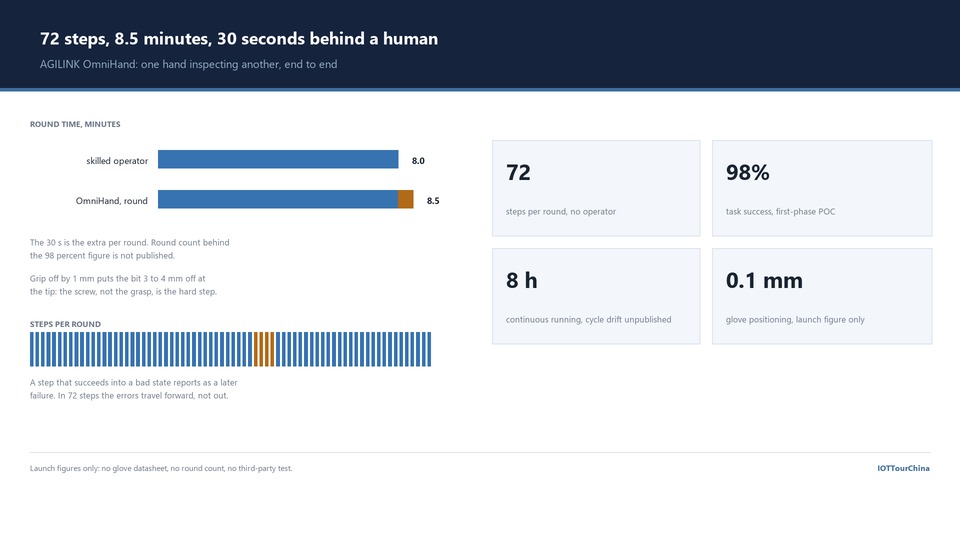
Seventy-two steps, no operator. Load the unit, scan its code, clamp it, pick up a screw gun, drive the fasteners, start the test rig, back the screws out, return the unit. The first phase of the proof of concept reports 98 percent task success, 8.5 minutes per round against eight minutes for a skilled operator, and eight hours of continuous running.
The 30-second gap is the number the launch leaned on. It is the least informative one in the set.
What a 72-step round actually implies
If a round is 72 steps and completes 98 percent of the time, then with independent failures each step has to succeed about 99.97 percent of the time, which is 0.98 to the power of 1/72. Single-step success rates are what every demonstration reports and the one number that says nothing here. A hand that lands a grasp four times in five is a demo. A hand that finishes a 72-step round 98 times in a hundred is doing something categorically different, because the arithmetic leaves it almost no room to fail at any individual step.
The figure also has an unpublished denominator. Ninety-eight percent is 49 rounds out of 50, or 98 out of 100, or 980 out of 1,000, and those three mean very different things about how close this is to a line. Eight hours of continuous running is the same kind of half-fact. It says the cell never stopped. It does not say the cycle time still held at hour six.
AGILINK concedes part of this itself. A single station at 98 percent is, in the company's framing, an engineering starting point and not a permit for fleet deployment. Skill reuse, on-site commissioning cost and consistency across operating conditions are named as the harder problems that come after. That list is honest, and it is also the list that decides whether a cell replicates.
The hard step is the screw, not the grasp
Screw driving is where the cell earns or loses its numbers, and the reason is mechanical before it is algorithmic. The reusable captive screws on the fixture have millimetre-scale play in their holes. The gun brings its own weight and a cable pulling against it. Tightening adds recoil at the moment of contact. A grip that is off by one millimetre puts the bit three to four millimetres off at the tip, which is several times the alignment tolerance the task needs.
During the demonstration the operators injected three disturbances on purpose: pushing the arm so the gun body shifted, moving the fixture base so the holes no longer lined up, and changing the lighting. The hand corrected its posture from vision and tactile feedback. When a drive failed, it identified the failure, rolled back to the step, re-aligned and carried on without stopping the cell.
There is a general lesson buried in that recovery, and it travels well beyond this vendor. Completing a motion is not passing a step. If the screw is not torqued or the part is not seated, the later test step reports a failure that has nothing to do with the test. In a 72-step job the errors do not stay where they were made. They move forward and surface as false negatives three steps later. A cell that cannot tell a failed step from a step that succeeded into a bad state cannot be debugged at all, and that distinction is what separates an assembly line from a sequence of demos.
What runs the cell
Two pieces of software sit under the demonstration. The single skill is trained with reinforcement learning on the real hand, and the company reports that alignment became more direct and needed fewer corrections than teleoperation, at two to three times the speed. One account of the same briefing puts the gain above four times. The two-to-three figure appears in three others.
Scheduling is handled by an agent framework the company calls Omni-Maestro, assembled from a step checker, a scheduler and context management. It verifies that a step is done, rewinds to the failed step when it is not, and keeps the station state synchronised so a retry does not begin from a stale understanding of the fixture.
Above both sits DUET 2.0, a two-layer architecture. The upper layer decides where to go and in what order. The lower layer does contact force control from tactile sensing. The two can run coupled, with intent passed down and touch fed back up, or separately, so the upper layer generates motion for a different hand geometry while the lower layer closes the loop on touch alone. The argument for splitting them is a real engineering argument rather than a slide: planning and force control live at different time scales on different data distributions, and compressing both into one end-to-end model hides the mismatch inside a demo while exposing it in a long task, where one coarse decision leaves the lower layer in a contact state no camera can recover.
The glove, and the datasheet that is not there
The data problem the launch spent most of its time on is the familiar one. Teleoperated robot data is accurate, expensive and does not scale, because it needs a robot, an operator and a site. First-person human video is cheap and wide-ranging and stays in pretraining, because centimetre-level tracking error and the absence of contact information make it unusable for fine work. The gap between the two is what AGILINK is selling with OmniGlove Pro, a data glove that began volume delivery at the same event.
The stated design is magnetic field tracking plus inertial sensing at each fingertip, which is what makes the glove indifferent to the visual occlusion that defeats camera-based hand tracking. The launch figures are 0.1 mm positioning accuracy, 746 tactile points and 3 mm tactile spatial resolution, with hand pose and contact recorded on one clock so a human demonstration can be retargeted and replayed on the robot without teleoperating it on site.
Those are launch figures and nothing more. The vendor's site lists five products and the glove is not among them. There is no datasheet, no sampling rate, no output format and no stated operating time. The accounts of the briefing also disagree with one another: at least one gives the glove 1 mm positioning and 1.5 degrees of orientation instead of 0.1 mm, and adds a 0 to 20 N force range at 0.1 N resolution, which happens to be the palm sensor specification of OmniHand 3 rather than anything published for a glove. Until a datasheet appears, 0.1 mm is a claim rather than a specification.
The competitive framing deserves the same caution. One version of the briefing calls the glove the only mass-produced unit that combines magnetic tracking, inertial sensing and full-palm touch. The other versions call it rare. That is a self-assessment, and no third party has tested it.
What is actually shipping, and what the CEO conceded
The product ladder is specific enough to be useful to an integrator. OmniHand 3 is the volume model: 16 degrees of freedom split into 10 active and 6 passive, 510 g, 180 by 85 by 38.5 mm, more than 300 tactile points across fingertips, palm and back of hand, a quoted 5 kg of grip force, plus or minus 0.3 mm repeatability and 0.5 s to close. The Ultra is the direct-drive flagship at 21 active degrees of freedom in 630 g, plus or minus 0.2 mm, 3 kg rated and 8 kg stable grasp, with 300 palm taxels resolving 0.1 N over a 0 to 30 N range and vision-based fingertips at 0.005 N and 0.04 mm spatial resolution, validated to 500,000 cycles. The Ultra-T is a 25-degree-of-freedom tendon design with a 0.3 s response. Lite is a 350 g unit for small platforms, and OmniPicker 3 is the industrial gripper at 140 N with 0.1 N fingertip sensing.
For anyone integrating rather than benchmarking, the interfaces matter more than the degrees of freedom. OmniHand 3 offers CAN FD and RS-485 and is documented for ROS, with Python as the secondary-development path. The Ultra's datasheet adds EtherCAT and lists a C++ SDK alongside Python, with MuJoCo, Gazebo and NVIDIA Omniverse as supported simulation targets. That is the difference between a hand that can go onto a robot this month and a hand that has to be modelled first.
The concession is the more valuable part of the briefing. The hand actually entering deployment is the linkage design, not either flagship, because linkage is the transmission whose reliability has been proven. Direct drive is more precise and tendon drive is more compliant, but on cycle life both sit around 100,000 cycles against an industrial requirement that runs from 100,000 to over a million. Hands above 20 active degrees of freedom, in the chief executive's own assessment, are not yet reliable enough to deploy. A buyer reading the ladder from the top down will get the wrong idea about what is on the market today.
Production figures need the same care. The launch says AGILINK passed 15,000 hands and grippers in 2026 through October, a figure it compares to about 80 percent of China's entire 2025 dexterous hand output. The vendor's site separately claims more than 20,000 units shipped cumulatively. Those are different windows covering different product mixes, and they should not be added together. The reliability curve the company reports runs from roughly 10 percent failure at first integration to under 0.5 percent now. It is a real improvement if true, and it is also a number from the party that benefits from it.
A commercial deployment is running in parallel, and it is the more patient test. OmniHand 3 units at Chimelong in Zhuhai handle bean grabbing, block stacking and bottle opening for visitors, which the company says exceeds 10,000 interactions a day. That workload has a different failure profile from a screw gun and no throughput target, and it will be settled by time rather than by a demonstration.
The Shaoxing cell remains a self-administered examination. The stand belongs to the vendor, the workpiece is the vendor's own product, and the operating data is the vendor's. What it does establish is narrower and more durable than the launch framing: that a 72-step job built around a millimetre-scale fastening step can be run end to end by one hand, with recovery, without a human. The number that decides whether this is a product is not in the demonstration at all. It is whether the same 98 percent turns up on somebody else's line.