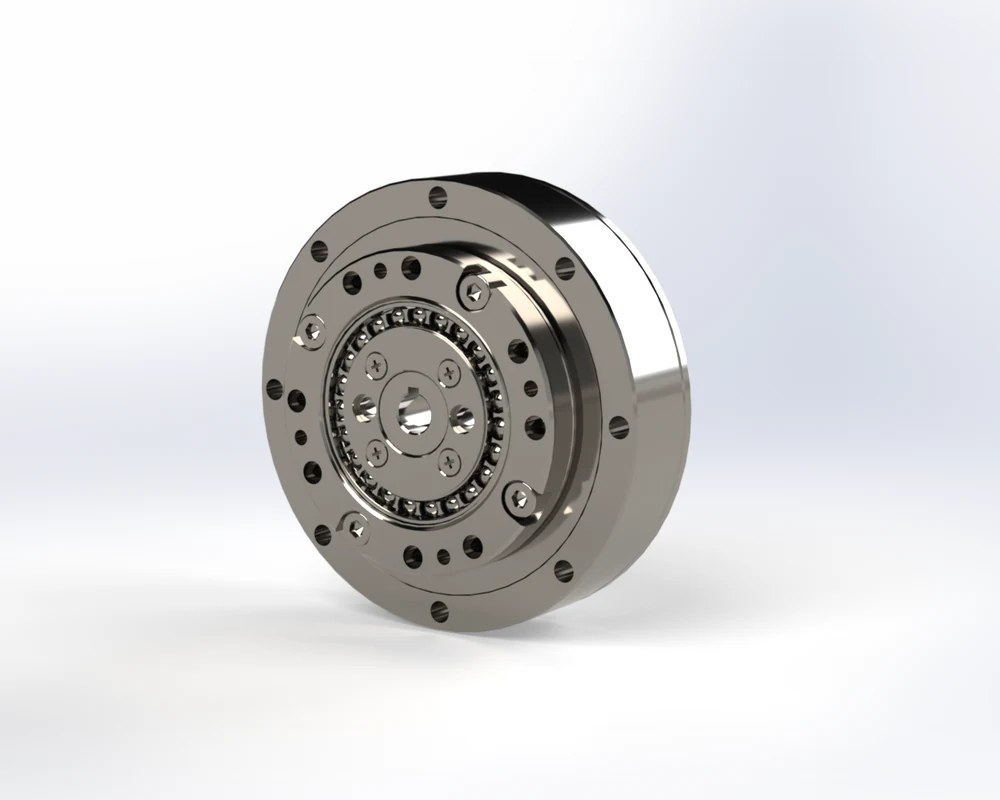
Harmonic Reducers
LHS / LHSG Strain Wave Gears
Hat-type strain wave gears with a hollow flanged flexspline, so cables and services can run straight through the middle of the joint.
Capabilities below are vendor-documented. We have not tested this device or its integrations.
Sources checked:
Also known as: LHS harmonic reducer, LHSG hollow-shaft hat-type, 绿的谐波 LHS 系列
Suitable projects
- Robot wrists and rotary axes that must route cables through the centre.
- Joints that need a flat front face with the flexspline flange as the output.
- Applications that want the extra torque of LHSG in the same envelope.
Before you buy
- The through-bore sets a hard limit on the cable bundle and shaft diameter.
- Same coaxial alignment and mounting-flatness requirements as the cup-shaped series.
- Component set and unit type are separate order lines.
Official resources
- LHS product introduction manual and drawings, ZIP
- LHSG product introduction manual and drawings, ZIP
- LHS 3D model, ZIP
- LHS product page
Related guides
- Frame sizes
- 14 / 17 / 20 / 25 / 32 / 40 / 45 / 50 / 58
- Reduction ratios
- 30:1 to 160:1
- Rated torque
- 4 to 176 N·m (LHS) / 7 to 969 N·m (LHSG)
- Peak torque at start/stop
- 9 to 1020 N·m (LHS) / 23 to 2392 N·m (LHSG)
- Max backlash
- ≤10 arcsec
- Max input speed
- 3000 to 8500 r/min
- Flexspline
- Hollow flanged barrel with a through-bore
Choosing Leaderdrive LHS / LHSG Strain Wave Gears
This profile is based on official documentation, not our own device testing.
The LHS family is a hat-type strain wave gear with a hollow flanged flexspline. Cables and services can run straight through the middle of the joint. LHS is the standard version and LHSG is the high-torque version.
What the series is for
- Robot wrists and rotary axes that must route cables through the centre.
- Joints that need a flat front face with the flexspline flange as the output.
- Applications that want the extra torque of LHSG in the same envelope.
The through-bore is the reason to pick this series over a cup-shaped one. Where the joint needs no passage through the centre, a cup-shaped gear is the simpler fit.
Standard and high-torque versions
- LHS covers a rated torque of 4 to 176 N·m.
- LHSG covers a rated torque of 7 to 969 N·m in the same frame sizes.
- Peak torque at start/stop runs 9 to 1020 N·m for LHS and 23 to 2392 N·m for LHSG.
Both versions are listed with a maximum backlash of ≤10 arcsec.
Series envelope
The figures below apply to the whole series. They are the safe reading when no per-frame row is published.
| Item | LHS / LHSG envelope |
|---|---|
| Frame sizes | 14 / 17 / 20 / 25 / 32 / 40 / 45 / 50 / 58 |
| Reduction ratios | 30:1 to 160:1 |
| Rated torque | 4 to 176 N·m (LHS) / 7 to 969 N·m (LHSG) |
| Peak torque at start/stop | 9 to 1020 N·m (LHS) / 23 to 2392 N·m (LHSG) |
| Max backlash | ≤10 arcsec |
| Max input speed | 3000 to 8500 r/min |
| Output | Hollow flanged flexspline with a through-bore |
This page does not publish a torque figure for each frame. The official page splits its frame and ratio matrix in a layout that could not be parsed reliably, so the envelope above stands in place of a per-frame table. Confirm the exact frame and ratio on the official page before ordering.
How frame size maps to torque
Frame size is the main scaling axis, as in the cup-shaped series. A larger frame carries more torque at the same ratio. The envelope above spans the whole series, from frame 14 to frame 58.
Choosing a frame and ratio
- Frames run from 14 to 58, the same list as the cup-shaped series.
- Ratios run from 30:1 to 160:1 across the series.
- The through-bore sets a hard limit on the cable bundle and the shaft diameter.
- Confirm the frame and the ratio on the official page, because a per-frame table is not published here.
Reading the figures
- Rated torque applies at the rated input speed listed in the parameter table.
- Maximum backlash is ≤10 arcsec for both versions.
- Maximum input speed spans 3000 to 8500 r/min across the series.
- The envelope above is a series range, not a figure for a single frame.
- The two versions share frames, mounts and the hollow output.
Check before ordering
- Decide between a component set and a unit type. The two are separate order lines.
- Note that a motor, encoder and brake are not included in either form.
- Confirm the bore will pass the cable bundle and the shaft with clearance.
- Plan for coaxial input and output, with the housing carrying the reaction load.
- Keep the input speed inside the listed 3000 to 8500 r/min range.
- Confirm maximum backlash: ≤10 arcsec.
Next step
The official parameter page for this series is listed under Official resources on the overview tab of this device page.
Read the quick start tab before the part reaches the bench. A general selection guide for harmonic reducers is linked from this page.
Quick Start — Leaderdrive LHS / LHSG Strain Wave Gears
This is an untested reference for first assembly. Confirm the frame, ratio and coupling option against the official leaderdrive.com page for this series.
1. Check what arrived
The reducer ships as a component set or as a unit type, and the two are separate order lines. A motor, encoder and brake are not part of either. Confirm the frame and ratio on the label against the order.
2. Prepare the mounting surface
Both faces that carry the reducer seat on machined flats. Remove paint, burrs and swarf before fitting. Input and output must stay coaxial, and the housing carries the reaction load.
3. Route the cable bundle
The hollow flanged flexspline has a through-bore for cables and services. The bore sets a hard limit on the bundle diameter. Leave enough slack for full travel and add a sleeve so the bundle cannot rub on the bore edge.
4. Lubricate the gear set
Strain wave gears run on a specified grease. The extracted parameter tables do not list the grade, so take it from the official page for the exact model and do not mix greases. Keep the tooth contact and the built-in bearing greased, and avoid overfilling.
5. Mount the output flange
Seat the output flange on its pilot before the bolts go in. Start every bolt by hand. Do not use the bolts to pull a cocked flange flat.
6. Tighten the bolts in a cross pattern
Tighten in stages, working across the bolt circle rather than around it. Bring the bolts to the grade and torque that the flange and bolt supplier specifies. The extracted tables do not list bolt torques.
7. Couple the input
Fit the servo or the stepper so its shaft runs concentric with the input. Keep runout low and do not force the coupling onto the shaft. The input coupling option for this series is not listed in the extracted tables, so confirm it on the official page.
8. Check backlash after assembly
Lock the input, fix the housing, and measure rotation at the output flange. Maximum backlash is ≤10 arcsec. If the reading is larger, re-check the flange seating and the bolt torque before looking at the gear set.
9. First run
Run at low speed first and listen for uneven noise. Stay inside the listed 3000 to 8500 r/min input range. Stop and re-check if noise or temperature rises quickly.
Mistakes that ruin a reducer
- Pulling a flange flat with the bolts.
- Forcing a coupling onto the shaft.
- Pushing axial load through the output bearing.
- Routing a cable bundle that rubs on the bore edge.
- Running above the maximum input speed.
- Mixing greases.
FAQ — Leaderdrive LHS / LHSG Strain Wave Gears
What is the difference between LHS and LHSG?
Both are hat-type strain wave gears on the same frame sizes. LHS is the standard version, rated 4 to 176 N·m, and LHSG is the high-torque version, rated 7 to 969 N·m. Peak torque at start/stop is 9 to 1020 N·m for LHS and 23 to 2392 N·m for LHSG.
What is the hollow flexspline for?
The flexspline is a hollow flanged barrel with a through-bore. Cables, air lines and other services can pass straight through the middle of the joint. The through-bore sets a hard limit on the cable bundle and the shaft diameter.
Which frame sizes does the series cover?
The series runs from frame 14 to frame 58. The full list is 14, 17, 20, 25, 32, 40, 45, 50 and 58. The list matches the cup-shaped series.
Which reduction ratios can be ordered?
Ratios run from 30:1 to 160:1 across the series. The available list differs by frame. Confirm the frame and ratio on the official page, because a per-frame table is not published here.
What torque range does the series cover?
Rated torque is 4 to 176 N·m for LHS and 7 to 969 N·m for LHSG. Peak torque at start/stop is 9 to 1020 N·m for LHS and 23 to 2392 N·m for LHSG. These are series figures, not a figure for a single frame.
What backlash should be expected?
Maximum backlash is ≤10 arcsec. Mounting quality affects the measured value at the output. Measure with the input locked and the housing fixed.
What is the maximum input speed?
The series is listed across 3000 to 8500 r/min. The ceiling differs by model. Confirm the value for the exact frame and ratio on the official page.
Does the reducer include a motor or an encoder?
No. The series is sold as a component set or as a unit type. A motor, encoder and brake are separate. Check which form is on the order line.
Why is there no per-frame torque table here?
The official page splits its frame and ratio matrix in a layout that could not be parsed reliably, so this page states the series envelope instead. Treat the envelope as a range and confirm the frame figure on the official page.