USB cameras and MIPI CSI-2 solve two different image pipeline problems
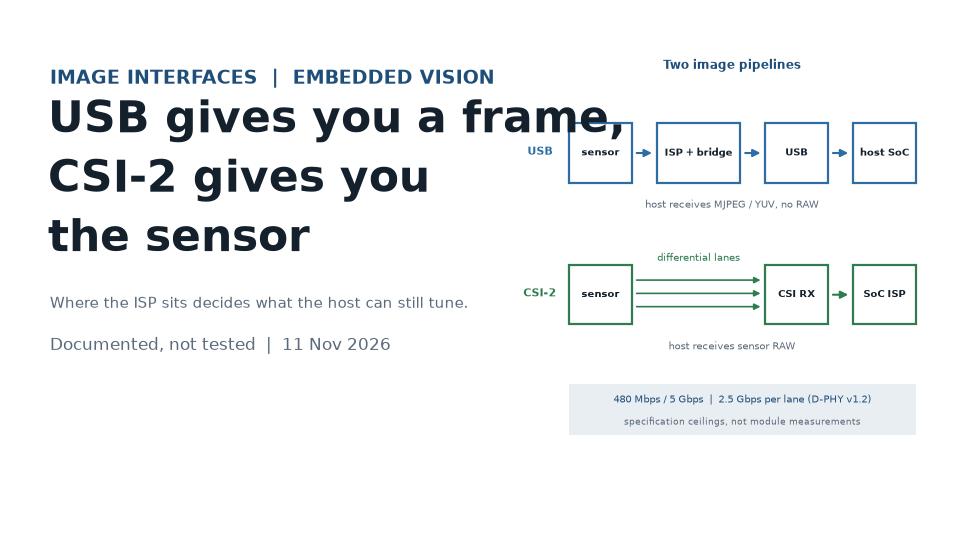
A USB camera arrives at the host as a finished frame. A MIPI CSI-2 camera arrives as a sensor. The distinction has little to do with which connector is newer and a great deal to do with where image processing happens, and therefore with what the host processor is allowed to control. That is the part of the decision that follows a prototype into a product.
Two different data paths
| Stage | USB camera module | MIPI CSI-2 module |
|---|---|---|
| Sensing | Image sensor inside the module | Image sensor on the module |
| Processing | On-module ISP and USB bridge | Host SoC ISP or downstream software |
| Host receives | MJPEG or YUV frames | Sensor RAW over differential lanes |
| Bus role | Host-polled general peripheral bus | Point-to-point board-level link |
| Typical reach | External cable | Short board or flex connection |
A USB camera module carries its own image signal processor and a USB bridge. The sensor produces RAW readings, the module converts them into compressed or formatted frames, and the host receives the result. There is no way to recover the original sensor values afterwards. A MIPI CSI-2 module usually exposes the sensor directly over one to four differential data lanes into a CSI receiver inside the host SoC. Exposure, white balance, demosaic and denoise remain decisions the integrator can make in software.
Both paths are valid. They simply hand authority to different places.
What the specification numbers actually say
| Interface | Published ceiling | Scope of the figure |
|---|---|---|
| USB 2.0 | 480 Mbps | Bus specification, bandwidth shared with other devices |
| USB 3.0 | 5 Gbps | Bus specification, bandwidth shared with other devices |
| CSI-2 over D-PHY v1.2 | 2.5 Gbps per lane, 10 Gbps over four lanes | MIPI Alliance specification brief |
These are specification ceilings, not measurements of any module on sale. The 2.5 Gbps per lane figure belongs specifically to D-PHY v1.2, an older physical layer revision. Later D-PHY revisions raise the per-lane ceiling, and CSI-2 also runs over C-PHY, where rates are counted per trio instead of per lane. Presenting 2.5 Gbps as the upper limit of CSI-2 is therefore out of date. For a real design the binding number is the rate that both the chosen sensor and the CSI receiver in the chosen SoC actually support.
Why a faster USB bus does not settle it
USB 3.0 has enough raw bandwidth for high-resolution video, but the architecture does not change. The bridge and the on-module ISP are still present, the host still receives processed frames, and the bus is still a shared, host-polled general peripheral link with its own protocol overhead. Those are the properties that show up as latency, power and electromagnetic design work in a small battery-powered product.
The inverse mistake is to assume MIPI guarantees better image quality. It does not. Image quality is set first by the sensor and the optics. What MIPI changes is access: the host can work from RAW data and tune the pipeline, so the ceiling on algorithmic correction is higher. A USB module with the same sensor may look just as good out of the box while offering far less room to adjust it.
PCB and EMI consequences
Both interfaces use high-speed differential pairs and both need controlled impedance, length matching and a clean reference plane. USB is designed to leave the enclosure through a cable, so its signalling and compliance burden assume an external peripheral. MIPI CSI-2 is a short, point-to-point board-level link between a sensor and a processor that sit centimetres apart. That makes the routing problem narrower but less forgiving of ad hoc layout, and it requires a host with a CSI receiver and a working sensor driver. There is no plug-and-play equivalent of UVC on this path.
Where each one belongs
USB fits early prototypes, PC or industrial-host attachments, long cable runs, simple preview, and small batches where a custom driver is not worth the effort. MIPI fits a production embedded design with a fixed sensor, a battery budget, RAW-dependent algorithms, high frame rates, or tight end-to-end latency.
The useful selection question is not which interface has the larger headline number. It is whether the product will still need control over the image pipeline after the first working frame. Prototypes often answer no; products often answer yes, and the cost of changing the answer later is a board revision.
This is an interface and integration comparison built from published specifications. It contains no measurement of current draw, frame rate or image quality from any specific camera module, and it does not report results from hardware testing.