The 35-yuan ESP32-CAM viewer costs 55 to 65 once you pick the variant with a camera
A short video of a home-made remote camera went around Chinese social feeds in September with 7,492 likes and 375 comments, and the detail that sold it was not the build. The creator walked downstairs, out of range of his own Wi-Fi, switched the phone to mobile data, and watched his living room. The comments asked for the code. The answer was a promise to open-source it later.
The code still has not appeared, but the build does not depend on it. What it does depend on is a price, and that is where the interesting part of the story sits: a Chinese electronics creator went through the listings and re-priced every build by its actual specification, because the number on a marketplace card and the number for the variant you need are rarely the same number. The result is that a build advertised at 35 yuan comes to 55 to 65 yuan, and the gap is almost entirely one option in a dropdown.
Four parts, in catalogue terms
The creator's own list is four items: a camera, an ESP32, a power base, and a 32 GB memory card. Translated into parts a developer can order:
| Item | What it actually is |
|---|---|
| Controller plus camera | ESP32-CAM or ESP32-S3-CAM, a board with a camera connector and an OV2640 sensor |
| Power base | A carrier with USB in, sometimes with a USB-serial chip for flashing |
| Storage | 32 GB microSD, Class 10 or better, recording locally |
| Enclosure and wiring | Optional, a few yuan |
There is no algorithm in the build. The chain is three steps: the ESP32 drives the OV2640 to expose a frame, the sensor returns hardware JPEG, and the board serves that JPEG over HTTP on the local network. The page on the phone is a small web server running on the board itself, which is why changing resolution or starting a recording is a page action rather than a firmware change.
The price ladder
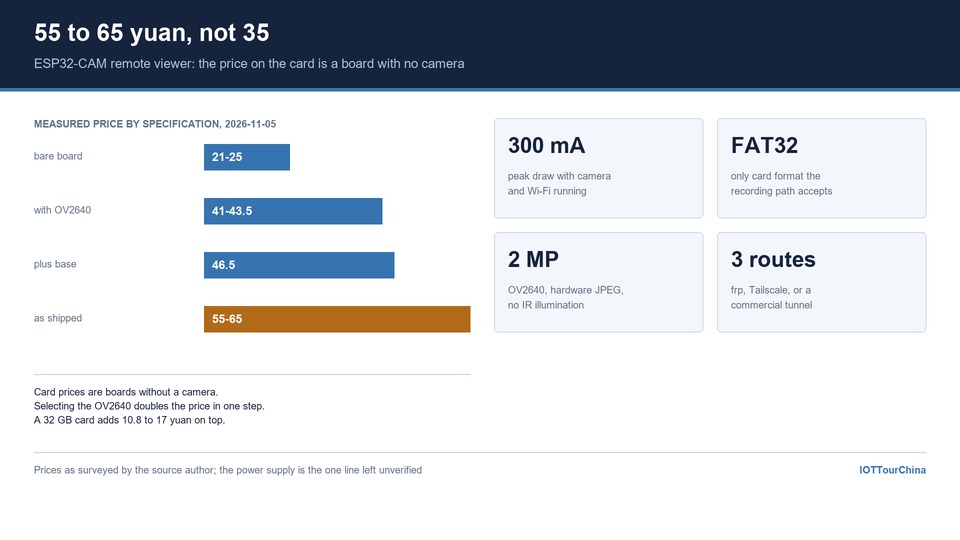
The low prices on the listing card belong to the bare board, with no camera fitted. Selecting the OV2640 variant moves the price immediately. The creator's survey, taken on 2026-11-05 across two high-volume sellers:
| Configuration | Measured price | Note |
|---|---|---|
| ESP32-S3-CAM N16R8, bare board | 21 to 25 yuan | The figure on the listing card |
| Same board with OV2640 fitted | 41 to 43.5 yuan | Two sellers, 41 and 43.5 |
| Same, plus a flashing base | 46.5 yuan | Saves wiring a USB-serial adapter |
| Classic AI-Thinker ESP32-CAM with OV2640 and base | 41 yuan | 800+ buyers on one listing |
| 32 GB microSD, Class 10 | 10.8 to 17 yuan | The 12.8 yuan tier has 5,000+ buyers |
| Power supply | Not verified | The part most likely to cause reboots |
| Total | About 55 to 65 yuan | Against a claimed 35 |
The 35-yuan figure is plausible in three ways, and all of them are timing. Old-stock classic ESP32-CAM boards were 15 to 20 yuan a few years ago; a builder who already owns a USB-serial adapter does not buy the flashing base; and promotional pricing exists. None of those is the configuration someone buying today will land on.
Five steps to a working local viewer
Flash the Arduino CameraWebServer example with the board's own Wi-Fi credentials and the correct sensor model, select the board and port, and upload. The classic ESP32-CAM has no on-board USB, so uploads go through a base with a serial chip or an external adapter, and IO0 has to be pulled low for download mode.
The serial monitor prints an address in the 192.168 range. A phone on the same network opens it, and resolution, still capture, and recording all live in that page. Recordings write to the card, which must be FAT32; exFAT is not recognised and recording fails silently as a result.
The fifth step is the one the video was actually about. A local address stops working the moment the phone leaves the network, so the build needs a path in from outside.
Three ways in from outside, and what each costs
frp is the open-source option: a server component on a cloud host the builder already owns, a client on a router or small machine, and port 80 of the ESP32 mapped outward. It is free at the margins and fully under the builder's control, at the price of running a server and editing configuration files.
Tailscale puts the phone and the home device into one virtual network, so the internal address keeps working from anywhere. There is nothing to configure beyond installing the client, and the free tier covers personal use, but the phone needs the app and an account.
Commercial tunnelling services in the Peanut Shell and NAT123 class are the third route, aimed at people who do not want to touch configuration at all. The free tiers throttle bandwidth and traffic, and long-term use means a subscription.
The ordering matters more than the choice: get the local viewer working first, because a tunnel in front of a broken camera only hides the fault.
Seven failure modes, in order of how often they bite
Power comes first and is not close. Camera capture and Wi-Fi transmission overlap, and the peak current passes 300 mA. A thin USB cable or an undersized supply drops enough voltage to reset the board, which the user experiences as a camera that disconnects every three minutes. A 5 V 2 A supply and a short, thick cable fix it.
The FPC ribbon has a direction. The gold contacts face away from the board on the ESP32-CAM carrier, and inserting it the other way, or plugging it in live, damages the sensor.
The card must be FAT32. The antenna must not sit against metal, because a steel box or aluminium foil beside the PCB antenna halves the range and makes the remote view worse than the local one. The OV2640 has no IR illumination, so a night view is black, and the only fixes are an external illuminator or accepting daytime use.
The privacy boundary is legal rather than technical: the camera belongs inside the owner's own home or yard. Pointing it at a corridor, a neighbour's door or a shared area is unlawful and will not pass platform review.
The last one is a supply-chain warning worth keeping. One buyer reported a classic AI-Thinker ESP32-CAM whose chip carried an ESP32-S3-CAM label. Reading the chip marking and the seller's reviews before ordering is cheaper than discovering the substitution after assembly.
What the exercise is worth
The project spread because it turned a category that usually costs hundreds of yuan into a parts list under a hundred. The engineering is unremarkable; the failure modes are not, and all three that matter are procurement decisions rather than code: which variant includes the camera, which supply can hold 300 mA of peak current, and what carries the stream out of the house.
For anyone building on Espressif hardware, the useful transferable detail is the price structure. The ESP32-S3-CAM module with 16 MB of flash and 8 MB of PSRAM is a 21-yuan part, and the camera is roughly half the cost of the assembly. That ratio is why camera-less listings dominate search results, and why the specification has to be selected rather than assumed.