echOpen has been building an open-source ultrasound probe for years — the reason it is not in hospitals is not the electronics
There is a category of project whose GitHub star count is a poor proxy for its ambition. echOpen is one: open hardware plus community collaboration, building a low-cost ultrasound probe that plugs into a smartphone. The stated target is not a hobbyist toy — it is hospitals, general practitioners, and regions where imaging capacity is scarce.
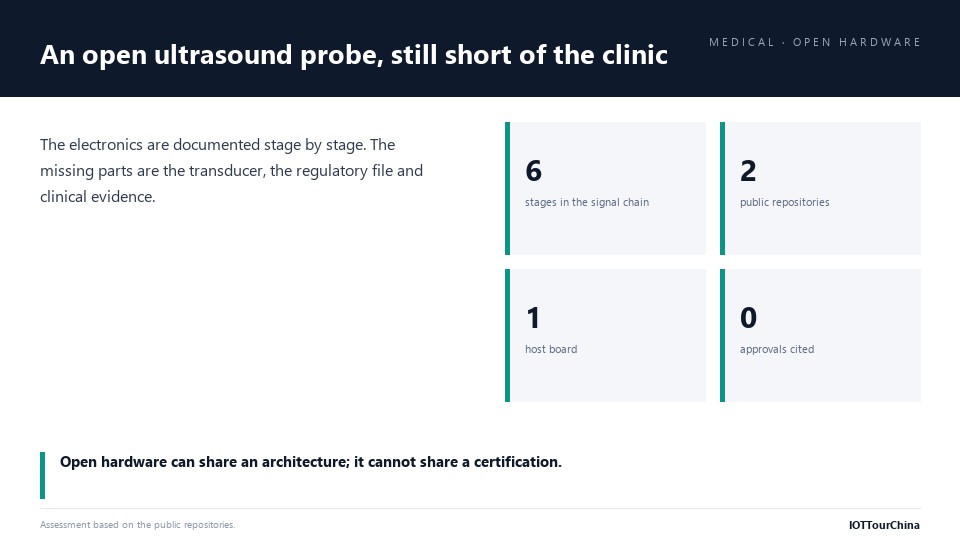
The direction is obviously right. The public evidence is less encouraging. echOpen_starterkit sits at 25 stars with its last commit in 2017. PRJ-medtec_kit is at 19 stars, also 2017. The Android app is at 50 stars, 2020. The project website returned 403 when this was written.
So the useful question is not "does this work" but "where did it stop, and why".
What it was actually trying to be
The self-description is specific: an open, collaborative project and community of multidisciplinary experts, designing a low-cost open-source electronic-stethoscope-style ultrasound probe that connects to a smartphone, to change diagnostic pathways in hospitals, general practice and under-resourced areas.
Four words carry the weight:
- Low cost — not a cheaper version of a commercial scanner, but cost controlled from component selection upward.
- Open — hardware, software and documentation open enough that a community can modify them.
- Smartphone — display and compute delegated to the phone; the probe handles transmit, receive and front-end processing only.
- Diagnostic pathway — it targets a clinical workflow, not a demonstration.
That last point is what separates it from ordinary open hardware. The moment you claim a diagnostic pathway, you inherit reliability, safety and regulatory obligations.
Delegating display and compute to the phone is the rational choice for cost: the expensive parts of an ultrasound system are the front end and the transducer, and a phone already has a good screen and a capable processor. Probe transmits and receives; phone images and interacts. That division is the whole economic argument.
The signal chain is textbook
PRJ-medtec_kit splits the experimental kit into six blocks — configuration, electronics, installation, licensing, mechanics, miscellaneous — and the prototyping repository breaks the bench prototype into modules so different parts of the community can contribute separately.
The chain itself is what any ultrasound imager uses:
- Transducer. Piezoelectric element converting between electrical and acoustic energy.
- High-voltage pulse. Excites the transducer into emitting an ultrasound pulse.
- TGC + LNA. Time-gain compensation plus low-noise amplification, bringing weak echoes up to a range an ADC can sample.
- Anti-alias filter + ADC. Digitisation.
- Processing. Beamforming, envelope detection, imaging on a Raspberry Pi, RedPitaya or phone.
- Display. The B-mode image.
Nothing here differs from a commercial machine in principle. The difference is implementation: commercial systems use highly integrated application-specific chips and closed firmware; echOpen uses purchasable modules, open code and interfaces a community can read.
The kit has appeared at several universities — Université libre de Bruxelles, UPMC in Paris, Universidad Simón Bolívar in Colombia — which means it cleared the "runs in a lab" bar.
The six-block split is not arbitrary either. Configuration decides which modules are used, electronics is board-level design, installation is the software environment, mechanics is enclosure and mounting, licensing and miscellaneous are the collaboration rules. The intent is that another university can take the kit and reproduce it from documentation rather than oral tradition.
The three gates it did not pass
The blocker was never "can you get an echo". It was "can you safely put this on a person".
The probe. A medical ultrasound transducer is not a piezoelectric disc. Centre frequency, bandwidth, impedance matching, element-to-element consistency, acoustic lens and matching layers each affect the image. An open project can source used probes, teardown probes or single-element probes, but cannot easily guarantee batch consistency or long-term reliability.
The front end. Echo dynamic range is roughly 100–110 dB, far beyond what a general-purpose ADC covers, which is why TGC exists at all. The TGC curve, gain staging, noise floor and anti-alias filtering determine whether the image is usable. echOpen's modular design lowers the barrier to research and simultaneously means every module's error accumulates.
Clinical validation. A medical device is not usable because it produces an image. It needs regulatory clearance, human trials, quality control and a responsible legal entity. An open project can open the principles and the hardware; it cannot easily assume the compliance and after-sales liability of a medical device.
The awkward part is that everyone involved knows the blocker is clinical validation, and nobody can solve it with a GitHub repository. Open source can produce a prototype. It cannot produce a liable entity.
That is also the most misread thing about echOpen. It is an open research and education platform, not a registered medical product. Treat it as "build your own scanner" and the expectation is wrong. Treat it as a textbook on how an ultrasound system is assembled and it is genuinely valuable.
echOpen is not echomods
The two get conflated. Both do open ultrasound, on different routes:
- echOpen starts from clinical need, builds a complete kit and a community, and aims at a low-cost diagnostic tool.
- echomods starts from hardware hacking, builds modular ultrasound building blocks, and aims to let researchers, makers and students open up every stage of the chain.
One wants into the hospital; the other wants you to understand the machine. They are complementary, not the same project — echomods' own README states it is not part of echOpen.
What it left behind
Even with slow commits, the residue is useful:
- A modular decomposition of an ultrasound system: probe, transmit, TGC/LNA, ADC, processing, display.
- A body of public documentation, kit configuration and community experience.
- One important reminder: open hardware lowers the barrier, and does not substitute for clinical validation.
If you read the docs, start with the starter kit and PRJ-medtec_kit, then the prototyping notes. Do not begin with the PCB.
Which half of the problem open source solves
echOpen's story is a compressed version of open hardware in medicine generally.
Open source addresses the knowledge barrier and the cost barrier: more people can understand ultrasound, afford the components, and modify the code. It does not address the clinical barrier: regulation, validation, liability, after-sales. Those are not things a repository carries.
So echOpen not reaching hospitals is not a failure, and not evidence of community laziness. It is the normal shape of medical hardware. Taking the ultrasound machine apart into readable modules is already more than most projects manage.