Xingguang 4N: a 125-yuan, fully open-source desktop laser engraver you assemble yourself
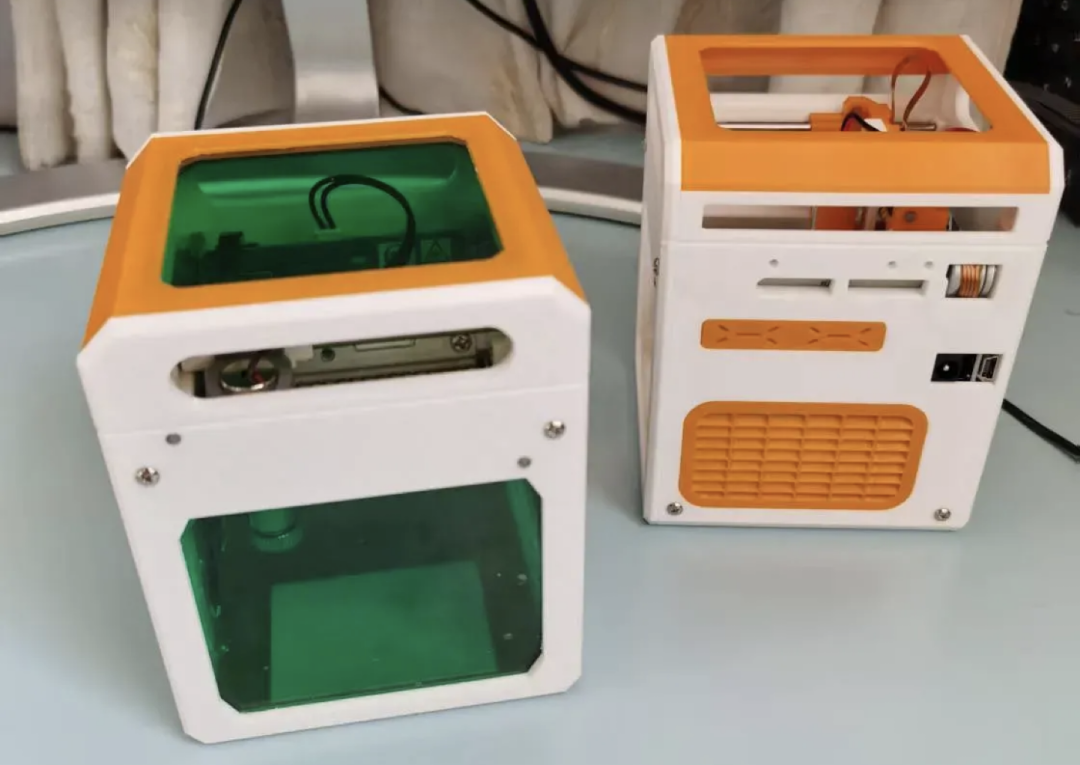
Xingguang 4N is a palm-sized, fully open-source desktop laser engraver that you can assemble yourself for roughly 125 yuan. It engraves card stock, leaves, thin wood, plastic, leather and acrylic, and it is built to do one playful job well: put a personal logo on the small objects you already own — including the 3D-printed figures that come off a Bambu Lab printer.
A laser engraver focuses a high-energy-density beam onto the surface of a material, so the spot instantly melts, vaporizes or chemically changes it and leaves a permanent mark. That principle scales from industrial marking to a machine that fits in your hand.
Three kinds of laser engraver
Engravers are usually grouped by their laser source, and each type suits different materials:
| Type | Best for | Strengths | Limits |
|---|---|---|---|
| CO2 | Non-metals — wood, acrylic, leather, paper, glass, fabric | Many power options (tens to hundreds of watts), relatively low cost, good cutting | Struggles with metal |
| Fiber | Marking stainless steel, aluminium, brass and some plastics | High precision, fast, long life, low maintenance | Usually for marking rather than deep cutting |
| Diode | Wood, leather and some plastics | Cheap, compact, relatively safe — good for home and hobby use | Lower power and slower; hard to cut thick material |
The Xingguang 4N sits in the diode camp, which is what makes a low-cost, palm-sized, hobbyist-friendly build possible.
What it does
The engraver is small enough to sit on a desk without taking it over, and it ships with a green light shield for safety. On the software side it works from a Chinese-language host application on a PC, where drawing and engraving are straightforward, and it costs far less than a commercial marking machine — a high-value pick for makers who want to try laser engraving for the first time.
- Palm-sized and lightweight — minimal desk footprint.
- Green safety shield — encloses the work area during operation.
- PC-based workflow — draw, tune parameters, then send the job over USB.
- Open hardware and firmware — ready to study, rebuild and modify.
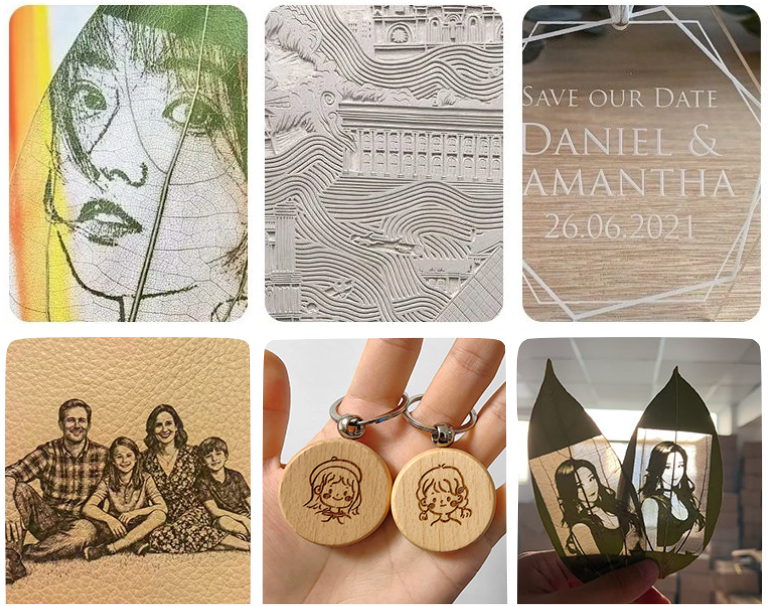
How it works
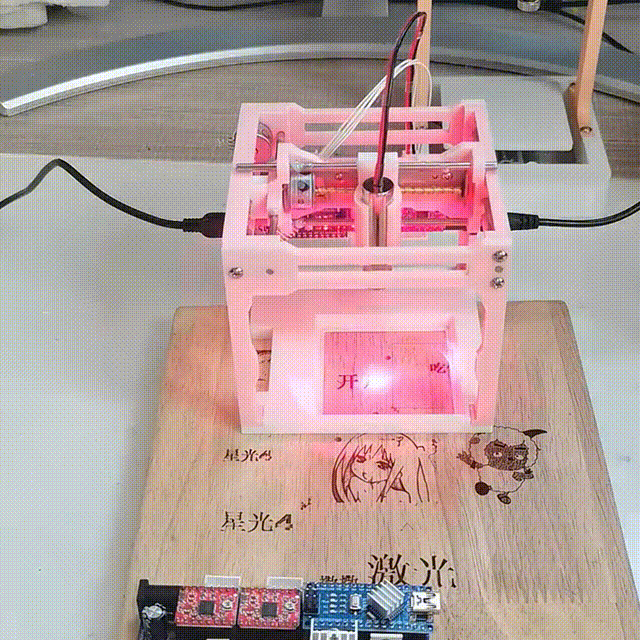
The heart of the machine is a custom PCB mainboard carrying an Arduino Nano. The Nano is flashed with the open-source GRBL 1.1 firmware, which parses the engraving path sent from the computer and translates it into concrete stepper-motor moves and laser on/off signals.
PC host app (LaserGRBL)
        |  USB serial
        v
Arduino Nano + GRBL 1.1   ->  parses the path into motion + laser commands
        |  step/dir                 |  PWM / on-off
        v                           v
A4988 stepper drivers  ->  X/Y motors     laser head
The motion hardware reuses stepper motors salvaged from old optical drives, which keeps the build cheap while giving a genuinely useful working envelope:
| Spec | Value |
|---|---|
| Engraving area | 50 x 50 mm |
| Mechanical positioning resolution | ~0.0125 mm |
| Laser spot diameter | 0.15-0.2 mm |
That combination is plenty for fine detail on card stock, leaves, thin wood, plastic and leather.
Hardware list
| Item | Spec | Qty |
|---|---|---|
| Prototype PCB | FR4, double-layer | 1 |
| Arduino Nano board | ATmega328P | 1 |
| Stepper driver | A4988 | 2 |
| N-channel MOSFET | IRFZ44N, TO220 | 1 |
| Voltage regulator | LM7805, TO220 (+ heatsink, M3x4 screw) | 1 |
| Indicator LEDs | F3 (power + laser signal) | 2 |
| Resistors (1/4 W) | 4.7 Ω, 47 Ω, 2K, 10K, 100K | 1 each |
| XH2.54 female terminals | 4P straight x2, 2P straight x4 | — |
| DC female jack | 5.5 x 2.1 mm, copper | 1 |
| Electrolytic capacitors | 16 V 100 µF (5x7) x2, 16 V 470 µF (8x12) x1 | 3 |
| 2.54 mm female headers | 1x8P x4, 1x15P x2 | — |
| Laser head | 5 V, 250 mW, 12 mm diameter | 1 |
| Stepper motors | micro stepper, 58 mm lead screw, 3.75 mm pitch | 2 |
| Optical shafts | stainless steel, 3 mm x 100 mm | 4 |
| Power supply | 12 V 2 A, 5.5x2.1 mm DC plug | 1 |
| Enclosure | 3D-printed frame (STL provided) | 1 set |
| Fasteners | M3x10 x4, M3x8 x4, M2.5x10 x5, M2x4 x4 | — |
You will also want laser safety goggles, a matching data cable, a 4-pin motor cable (XH2.54-4P, 30 cm) and some grease. The base can take eight round magnets (6 mm diameter, 1-3 mm thick) to hold the workpiece.
The frame and the build
The enclosure is 3D-printed, and the model files are published on the Bambu Lab MakerWorld platform so you can print your own. Everything else is standard, widely available parts — which is what keeps the total cost so low.
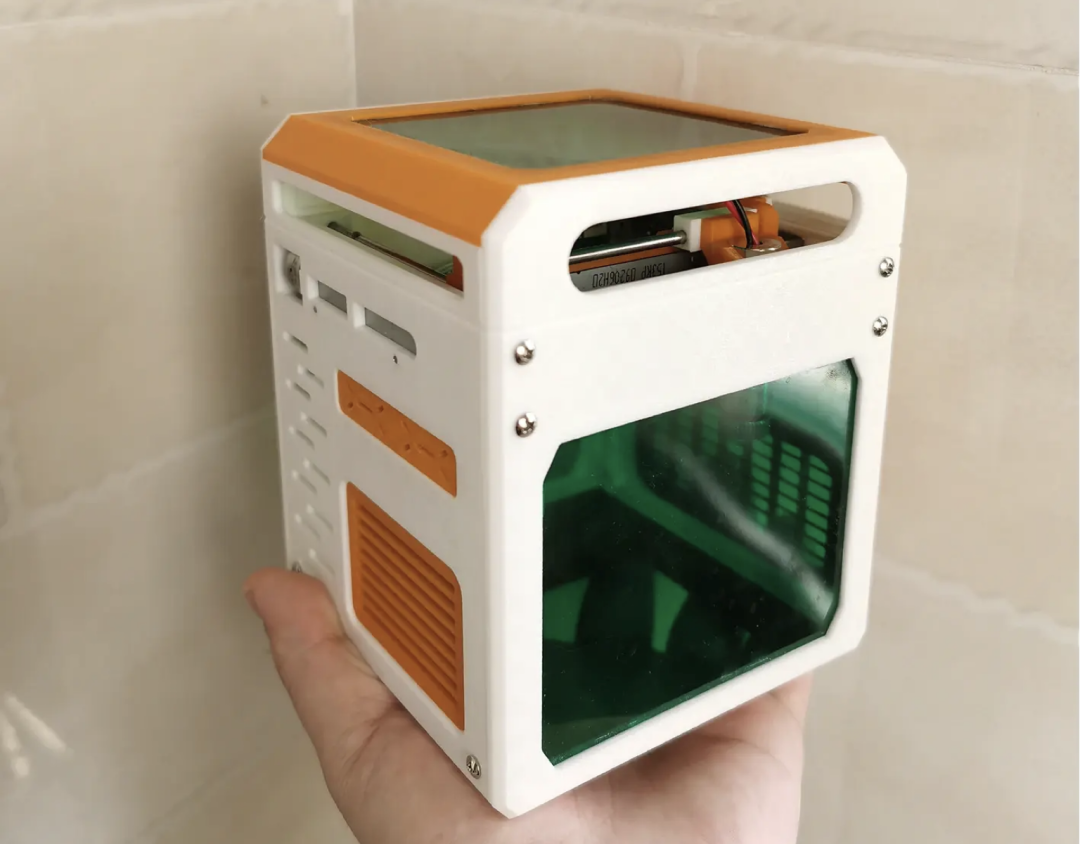
The Xingguang 4N has no screen and no buttons of its own. It connects to a computer over USB, and every action happens in the PC-side host software: import the image or text you want to engrave, set the size and parameters, and the software generates the code, sends it over the cable and drives the machine. Because the originals are open, the firmware and the hardware are both yours to study, rebuild and modify.
IOTTourChina covers open-source IoT hardware built on widely available Chinese silicon as part of its device and developer resource. Details should be confirmed against the project's official documentation.