ALBATROSS drops like a maple seed and sails itself for remote-water sensing
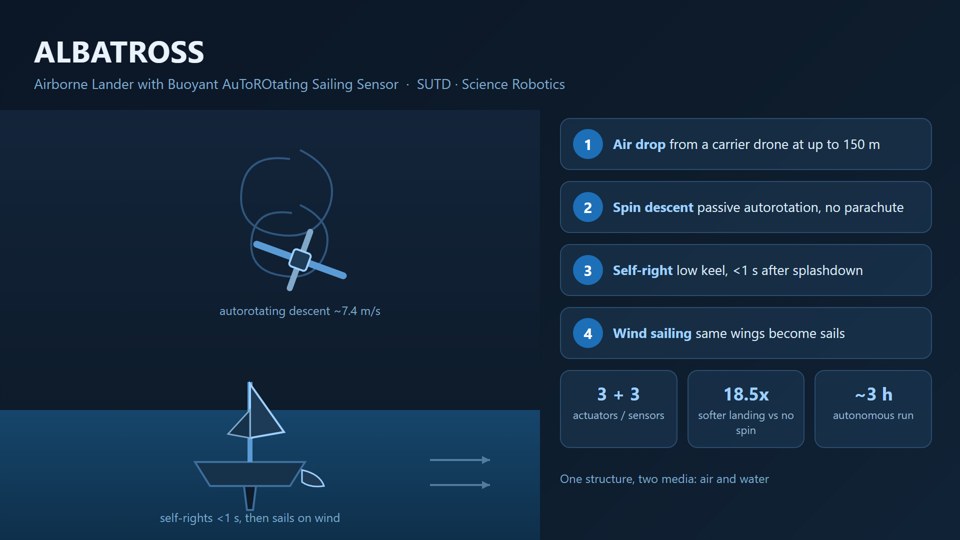
A maple seed spins to the ground because a single wing catches the air and turns a fall into a slow, stable descent. A team at the Singapore University of Technology and Design (SUTD) borrowed that trick for a robot that arrives from the sky and then sails on the water. Called ALBATROSS, short for Airborne Lander with Buoyant AuToROtating Sailing Sensor, the platform was described in a paper in Science Robotics (DOI 10.1126/scirobotics.aed1423).
One wing, two jobs
The core of ALBATROSS is a pair of rigid wingsails. In the air they act like a helicopter rotor: the platform spins about 2.75 times per second and descends in stable autorotation at roughly 7.4 meters per second. On the water the same wings become the main sail and the jib, driven by wind. There is no parachute to discard and no wings to unfold, so the machine moves straight from falling to sailing with the same structure.
That single-structure design is the point. Hybrid air-water robots usually carry separate hardware for each mode, often six to eight actuators, which adds weight, cost, and failure points. ALBATROSS uses just three actuators and three navigation sensors. One actuator moves the tail vane, one trims the jib, and one works the rudder. A GPS module, a hull compass, and a main-sail compass are the only navigation sensors.
The platform's center of gravity sits low along a weighted keel, so the aerodynamic spin axis lines up with the keel. The result is stable autorotation on the way down and passive self-righting after splashdown, the same principle a maple seed or a winged fruit uses.
How it survives the drop
It survives not with a rugged shell but by turning free fall into controlled spin almost immediately. In reservoir trials the team released the roughly one-kilogram prototype from a carrier drone, a DJI Matrice 350 in one test, at heights up to 150 meters. The platform entered autorotation within about three seconds, descended steadily near 7.4 meters per second with a peak impact deceleration of about 18.5 meters per second squared, and self-righted in under one second before switching to sailing mode.
The spin matters. The researchers estimate that a geometrically similar platform without autorotation would hit the water at a terminal speed near 31 meters per second, carrying about 18.5 times more impact energy. Autorotation turns a hard crash into a controlled soft landing.
| Phase | Figure |
|---|---|
| Descent rate | ~7.4 m/s |
| Spin rate | ~2.75 rev/s |
| Peak impact deceleration | ~18.5 m/s² |
| Self-righting time | < 1 s |
| Impact energy vs non-spinning | ~18.5x higher without spin |
Sailing with almost no power
The hardest problem for any sailboat is weak or contrary wind. ALBATROSS answers it with a rudder shaped like a fish tail. The rudder not only steers but also flaps sideways to add thrust, so the platform can still move in near-calm water and helps with upwind turns.
Powered only by rudder flapping, the platform advances at about 0.38 meters per second while drawing about 2.7 watts. In a 4 meters per second wind the L-type version reached a peak speed of about 0.82 meters per second, averaging 3.98 watts, with rudder-flap steering peaking at 7.97 watts. Field trials at Singapore's Bedok and Pandan reservoirs logged an autonomous waypoint run of about three hours while recording humidity, heat flux, and wind direction, finishing with roughly half the main battery remaining.
Control used two approaches. A rule-based controller followed traditional nautical rules, and a reinforcement-learning controller trained in simulation. In trials the RL controller matched the rule-based one and produced smoother maneuvers on site.
| Mode | Speed | Power |
|---|---|---|
| Rudder-only propulsion | ~0.38 m/s | ~2.7 W |
| Sailing at 4 m/s wind | ~0.82 m/s peak | ~3.98 W avg |
| Rudder-flap steering peak | - | ~7.97 W |
Where it can and cannot go yet
The use case is clear: get a sensor to remote water fast, then let it stay. Potential missions include tracking algal blooms, mapping oil spills, monitoring marine debris and wildlife, supporting fisheries, and rapid observation after typhoons or undersea earthquakes, when speed matters most.
ALBATROSS is not yet an ocean-grade product. The paper is candid about the limits: current prototypes are small and light, built for proof of concept rather than strong currents, high winds, or large waves. The gliding range is a trade-off between spin design and sailing design, and the self-righting behavior is sensitive to center-of-gravity shifts. Moving to open water will require tougher structures, corrosion-resistant materials, and a larger airframe, plus room for underwater sensors, sonar, and bigger energy storage.
Why it matters
ALBATROSS is less a finished product than a design philosophy: use passive dynamics and multi-function structures to cut actuators and sensors to the minimum while crossing media. The principles the team distilled, low center of gravity for passive spin and self-righting, rigid wingsails that are both lifting surfaces and propulsion sails, aerial deployment as an instant drop rather than sustained flight, and a bio-inspired rudder to cover weak-wind gaps, could let low-cost ocean sensors be scattered from aircraft, sail themselves, and report back.
For developers building environmental and IoT sensing networks, the takeaway is that the expensive part of reaching remote water is the transit, not the sensor. A platform that treats deployment as a one-time aerial drop and endurance as wind-powered sailing changes the economics of large-area, hard-to-reach monitoring.