Development Boards
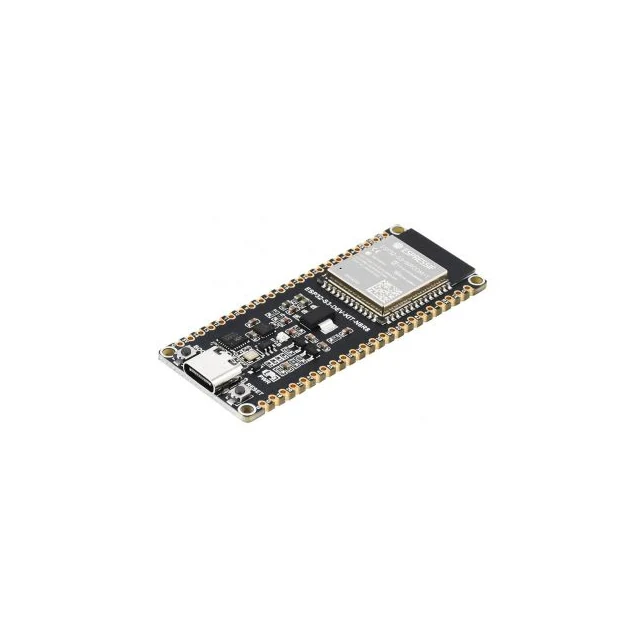
Waveshare ESP32-S3-DEV-KIT-N8R8
ESP32-S3-WROOM-1 dev board with one Type-C port, a CH343 USB bridge and DevKitC-1 pinout.
Capabilities below are vendor-documented. We have not tested this device or its integrations.
Sources checked:
Suitable projects
- Replacing a DevKitC-1 with one cable instead of two.
- Compact builds where the 1.8 V IO domain is acceptable.
- Comparing 8 MB and 16 MB module options on the same footprint.
Before you buy
- IO47 and IO48 sit in the 1.8 V VDD_SPI domain, so they cannot drive 3.3 V logic directly.
- USB and UART share a single Type-C port, which changes the flashing workflow.
Official resources
Related guides
- ESP32 chip comparison: C3, C6, H2, S2, S3, P4 and C5
- ESP32 hardware selection: from development board to module to antenna
- ESP32 production readiness: what changes after the prototype works
- ESP32 low-power reality: what the sleep current tables actually say
- ESP32 supply chain: what Espressif's own documents say, and where they stop
- Module
- ESP32-S3-WROOM-1-N8R8
- Variants
- N8R8, N16R8 and N32R16V
- CPU
- Dual-core Xtensa LX7 at 240 MHz, 512 KB SRAM
- USB
- One Type-C port through CH343 and CH334
- Pinout
- Compatible with ESP32-S3-DevKitC-1
- IO47 and IO48
- In the VDD_SPI domain, 1.8 V output high
Choosing Waveshare ESP32-S3-DEV-KIT-N8R8
This profile is based on official documentation, not our own device testing.
What it is
A compact ESP32-S3-WROOM-1 board with DevKitC-1 compatible pinout. Waveshare puts a CH343 USB bridge and a CH334 hub behind a single Type-C connector, so flashing and serial output share one cable.
The board is offered in three memory configurations: N8R8 with 8 MB of PSRAM, N16R8 with 16 MB of flash, and N32R16V on a WROOM-2 module.
Specifications
| Item | Value |
|---|---|
| Module | ESP32-S3-WROOM-1-N8R8 |
| Variants | N8R8, N16R8, N32R16V |
| CPU | Dual-core Xtensa LX7 at 240 MHz, 512 KB SRAM |
| USB | One Type-C connector through CH343 and CH334 |
| Pinout | Compatible with ESP32-S3-DevKitC-1 |
| IO47 and IO48 | In the VDD_SPI domain, 1.8 V output high |
The 1.8 V detail
Waveshare documents that IO47 and IO48 belong to the VDD_SPI power domain on this module, so their output high level is 1.8 V rather than 3.3 V. Any external logic driven from those pins needs level shifting, or a different pin.
This is the sort of detail that does not appear on a shop listing and does appear in your first failed prototype.
Check before ordering
- Confirm the memory variant. The three part numbers differ in flash, PSRAM and module type.
- One Type-C port means one cable for both USB and UART. Check that your flashing workflow accepts that.
- Pin compatibility with DevKitC-1 is a pinout claim, not a mechanical one. Verify the outline before reusing a carrier board.
Next step
Decide between N8R8 and N16R8 from your firmware and asset size, then verify which pins your design needs from the 1.8 V domain.