AI Network Video Recorders
Uniview VS-ESA9200 video analysis server
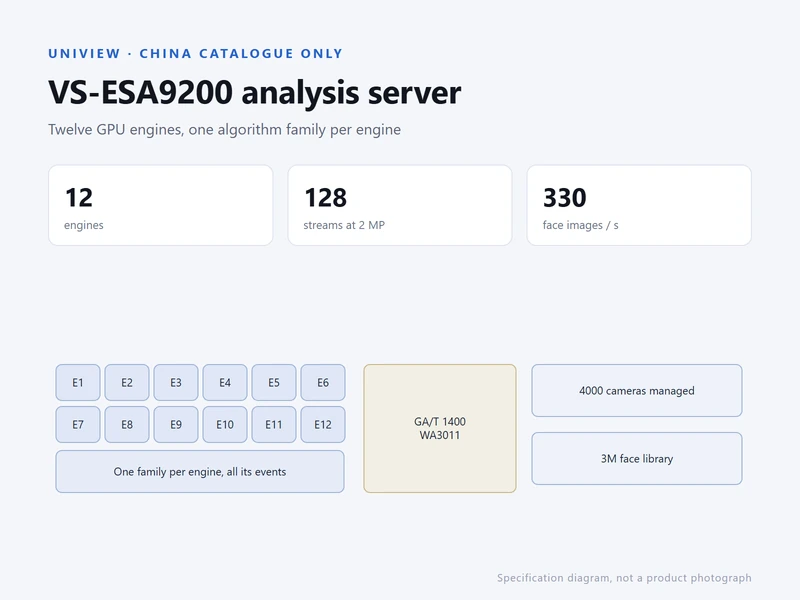
China-market 4U analysis server with twelve GPU engines, 128 analysed streams and 330 images per second, one algorithm family per engine.
Capabilities below are vendor-documented. We have not tested this device or its integrations.
Sources checked:
Also known as: ESA9200, Kunlun analysis server, Uniview video analysis and recognition server
Suitable projects
- China deployments that need face, structured metadata, open-platform detection and perimeter analytics in a single delivered box.
- Projects that must feed a GA/T 1400 view library rather than only a VMS.
- Sites where 100 or more streams need analysis and the integrator does not want to assemble servers and GPU cards.
- Retrieval work such as semantic search, image search and voice search over captures.
Before you buy
- It is not on the global catalogue, so an overseas project cannot order it through the usual channel and should plan on the IX2 recorders or a computation server instead.
- One algorithm family per engine: except for the AI open platform, each engine runs a single category and all its events, so a site that needs face and perimeter on the same engine cannot have it.
- Face, metadata and open-platform analytics have different per-engine capacities, so a mixed workload does not divide evenly into twelve.
- The chassis draws up to 800 W and weighs under 25 kg, so it is a data-room device rather than a cabinet unit.
- No price is published and the configuration is fixed at four GPU cards.
Official resources
Related guides
- Market
- Sold on the China catalogue; it does not appear on the global product site
- Architecture
- High-convergence service platform on the Uniview large-model base, one 64-bit many-core Hygon CPU, Euler OS
- GPU
- Four GPU cards providing 12 engines
- Memory and disks
- DDR5 32 GB times four; two 240 GB SSD for the system; one 480 GB SSD, five 8 TB and one 4 TB for data
- Stream analysis
- 128 channels at 2 MP, 128 at 4 MP, or 24 at 8 MP across the whole chassis
- Image throughput
- 330 images per second for face modelling, comparison and clustering; 256 per second for structured metadata
- Per engine
- 8 channels of 2 MP stream and 27 images per second for face; 8 channels and 20 images per second for metadata; 4 channels and 16 images per second for the open platform
- Face databases
- Three million in the static library, three million in blocklists, 128 blocklists, 40 million captures searchable by image
- Structured storage
- 80 million captures, attributes and models
- Video management
- 4000 local cameras with 2000 licences included, 8000 manageable, 4000 concurrent live views, 256 smart licences
- Offline import
- 100 GB of imported recording, analysed at up to 96x for 2 MP files
- Network and power
- Four gigabit ports, 800 W CRPS supply with 1 plus 1 redundancy, under 25 kg
- Data protocols
- GA/T 1400, WA3011 and the Uniview private protocol
Choosing a VS-ESA9200 analysis server
The ESA9200 is the only box in the Uniview range that delivers face, structured metadata, open-platform detection and perimeter analytics in one chassis without assembling servers. It is also the one product in this range that overseas projects cannot simply order: it sits on the China catalogue and does not appear on the global product site.
Everything below is from the Chinese product page. We have not tested a unit.
What arrives
One rack server with four GPU cards and twelve engines, one 64-bit many-core Hygon CPU running Euler, DDR5 32 GB times four, two 240 GB SSDs for the system and a data tier of one 480 GB SSD, five 8 TB and one 4 TB drive. Four gigabit ports, an 800 W CRPS supply with 1 plus 1 redundancy, under 25 kg.
That is a fixed configuration. There is no card-count ladder the way the Dahua and Hikvision servers offer, and no published option to ship with fewer engines.
The engine is the unit of capacity
Twelve engines share the chassis, and each engine is assigned one algorithm family. The published per-engine figures:
| Family | Per engine streams | Per engine images per second |
|---|---|---|
| Face | 8 at 2 MP | 27 |
| Structured metadata | 8 at 2 MP | 20 |
| AI open platform | 4 at 2 MP | 16 |
| ID card OCR | None | 8 |
| Street behaviour | 4 at 2 MP, 4 MP or 8 MP | None |
| Indoor behaviour | 4 at 2 MP, 4 MP or 8 MP | None |
| Perimeter | 4 at 2 MP, 4 MP or 8 MP | None |
Multiply by twelve and the arithmetic does not quite close. Twelve engines at eight face streams each is 96 streams, but the chassis is published at 128 streams. Twelve engines at 27 images per second is 324, but the chassis is published at 330. Either some engines carry a heavier stream share than the per-engine figure, or the headline counts a mixed-resolution load. Budget from the per-engine figures and treat the headline as a ceiling reached in a specific configuration.
One family per engine
This is the decision that shapes the design. Except for the AI open platform, each engine runs a single algorithm family and every event inside it. A site that needs faces on twelve streams and perimeter on twelve more cannot do both on the same engines.
The practical split for a mixed project:
| Requirement | Engines | Result |
|---|---|---|
| 48 face streams at 2 MP | 6 | 6 engines on face |
| 24 perimeter streams at 4 MP | 6 | 6 engines on perimeter |
| Total | 12 | No engine left for metadata |
Add a requirement for vehicle attributes and the arithmetic fails. Plan the family allocation on paper before quoting.
Per family ceilings
Face work publishes the deepest numbers. 128 streams at 2 MP, 128 at 4 MP or 24 at 8 MP across the chassis; 330 images per second for modelling, comparison and clustering; a three million static library, a three million blocklist across 128 lists; and 40 million captures searchable in seconds.
Structured metadata publishes 128 streams, 256 images per second, and storage for 80 million captures, attributes and models.
The open platform publishes 128 streams at 2 MP, 24 at 4 MP or 12 at 8 MP, with 256 images per second. Its five families are object detection, single-label classification, mixed detection, video behaviour anomaly and OCR.
Video management is built in
The server manages 4000 cameras locally with 2000 licences included, can reach 8000, runs 4000 concurrent live views and carries 256 smart licences. That matters for a project that would otherwise need a separate VMS licence line: the recorder fleet reporting to this box is already covered.
Domain support is published as one parent domain with five view-library subscriptions, eight child domains at seven levels. If the project is one site, none of that is used.
Offline analysis is a real feature
Recorded files can be imported into 100 GB of space and analysed at up to 96x for 2 MP material, 48x for 4 MP and 24x for 8 MP. For retrospective work, such as going back through a week of archive after an incident, that is faster than re-running live streams.
What it is not
It is not a recorder and not an overseas product. The published protocol set is GA/T 1400, WA3011 and the Uniview private protocol, which points at Chinese public-security integration rather than at ONVIF and RTSP workflows preferred elsewhere. An export project that needs ONVIF ingest from mixed brands should start from the IX2 recorders.
The alternative for overseas projects
The same capability is assembled, not delivered. Computation servers with GPU cards, the Unicorn platform and the IX2 recorders cover most of it, with two differences: analytics come from the recorders rather than from a CUDA stack, and text search is per recorder. Nothing on the global site reaches 330 face images per second in one box.
For the line-up across all five families, read Reading the Uniview intelligent range.
Commissioning a VS-ESA9200
This is an analysis server, not a recorder, so first boot lands on a platform rather than a storage wizard. The work divides cleanly: assign engines to algorithm families, then add streams, then build the libraries.
The steps follow the Chinese product page. We have not run them on a device.
Before power
The chassis carries an 800 W CRPS supply with 1 plus 1 redundancy and weighs under 25 kg. Fit the data drives before racking: five 8 TB plus one 4 TB for data, one 480 GB SSD as the data-tier system disk, two 240 GB SSDs for the system.
The four GPU cards are factory fitted. There is no published field-fit procedure and no option to add engines later, so the twelve-engine capacity is what you bought.
First login
Connect to one of the four gigabit ports and open the platform on the management address. Confirm the deployment engineer has the address before travel, because the page does not publish a default scheme the way recorder manuals do.
Set region, time and the administrator credential, then confirm the licence state: 2000 camera licences and 256 smart licences are included, with 4000 stream licences manageable locally.
Allocate engines before adding cameras
Twelve engines, one algorithm family each, with the AI open platform as the exception. Decide the allocation as a table before touching the interface, because reassigning later means the analysed history is discontinuous.
A worked split for an 80-camera office campus:
| Family | Engines | Streams at 2 MP | What it covers |
|---|---|---|---|
| Face | 4 | 32 | Entrances and lobby turnstiles |
| Video metadata | 4 | 32 | Vehicle gate and perimeter road |
| Perimeter | 2 | 8 at 4 MP | Fence line, higher resolution |
| Street behaviour | 2 | 8 | Public approach and plaza |
| Total | 12 | 80 | All twelve engines committed |
The face and metadata families take eight streams per engine but cost 27 and 20 images per second respectively, so the image budget runs out before the stream budget on face-heavy sites.
Add streams and confirm the resolution ladder
The chassis is published at 128 streams at 2 MP, 128 at 4 MP, or 24 at 8 MP. That is not a linear trade: doubling resolution does not halve the count between 2 MP and 4 MP on this product, but dropping to 8 MP cuts it by more than five.
Add cameras family by family, watching the per-engine utilisation rather than the total stream counter.
Load the libraries
Face work needs three tiers: a three million static library for search, blocklists up to three million across 128 lists for alarms, and 40 million captures for retrospective search. Load the static library first, then the blocklists, then confirm the capture count grows as streams come online.
Vehicle work needs the plate and attribute libraries. The structured tier stores 80 million captures, attributes and models for face and metadata combined, so the two families share one pool.
Set the alarms
Each family publishes its own event set. Face gives capture, comparison alarm, search by image, 1 to 1 comparison and personnel records. Meta data gives human body, vehicle and non-motor vehicle capture with attributes. Perimeter gives area entry, area exit, intrusion and loitering. Street behaviour gives physical conflict, crowd gathering and person down. Indoor behaviour gives occupancy counting, abnormal occupancy, absence from post, person down, conflict and phone use.
The platform also accepts rules written as text: choose a camera, describe the behaviour, set a threshold and a trigger. That is the BK workflow described on the page.
Wire the data out
The published data protocols are GA/T 1400, WA3011 and the Uniview private protocol. If the receiving platform is a provincial or municipal view library, GA/T 1400 is the path. If it is a third-party VMS expecting ONVIF or RTSP, this is the wrong product and the IX2 recorders are the right one.
Offline analysis
Import recordings into the 100 GB workspace and run them at up to 96x for 2 MP, 48x for 4 MP or 24x for 8 MP. Use it for retrospective jobs rather than re-running days of live streams, which would consume the live analysis budget.
Check before handover
Confirm the engine allocation matches the design table. Confirm captures are landing in the right library. Confirm the analysed stream count against the contracted camera list, not the first N cameras in the tree. Confirm the domain settings are off if the site is standalone, and confirm the 800 W draw and weight against the rack.
What the page does not answer
There is no published API reference, no ONVIF or RTSP claim, and no expansion path beyond one chassis. Multi-chassis work is done at the platform or view-library level, not by stacking servers.
For how this compares with the recorder families, read Reading the Uniview intelligent range.
FAQ — Uniview VS-ESA9200
Can I buy this outside China?
It is published on the Chinese catalogue only. The global product site has no ESA9200 page, so it is not part of the export line-up. Overseas projects use the IX2 recorders or assemble a computation server with a VMS.
What is an engine?
A unit of analysis capacity on the GPU cards. There are twelve in the chassis, and each one is assigned an algorithm family. The family decides how many streams and how many images per second the engine can take.
How many streams can it analyse?
128 at 2 MP, 128 at 4 MP or 24 at 8 MP across the chassis, depending on family. Face and metadata each take eight 2 MP streams per engine, while perimeter, street and indoor behaviour take four.
Why does the per-engine arithmetic not match the headline?
Twelve engines at eight face streams each is 96, not 128. Twelve at 27 images per second is 324, not 330. The page publishes both the per-engine figures and the chassis ceiling without reconciling them. Size from the per-engine numbers.
Can one engine run face and perimeter at the same time?
No. Except for the AI open platform, each engine runs one family and all its events. Face and perimeter must sit on different engines.
How large a face library does it hold?
Three million in the static library for search, three million in blocklists for alarms across 128 lists, and 40 million captures searchable by image in seconds.
Does it record video?
It manages 4000 cameras with 2000 licences included and 4000 concurrent live views, but the storage tier is published as five 8 TB plus one 4 TB data drive, 44 TB raw. It is a management and analysis platform, so long retention belongs on a recorder or a storage array.
What protocols does it speak?
GA/T 1400, WA3011 and the Uniview private protocol. There is no ONVIF or RTSP claim on the page, which is the main reason it does not travel well outside a Chinese public-security deployment.
Can it analyse old recordings?
Yes. Import files into 100 GB of workspace and run at up to 96x for 2 MP, 48x for 4 MP and 24x for 8 MP.
Is there a price?
No. Uniview publishes none, and the chassis is a fixed four-card configuration.