Video management servers
Uniview Unicorn video management platform
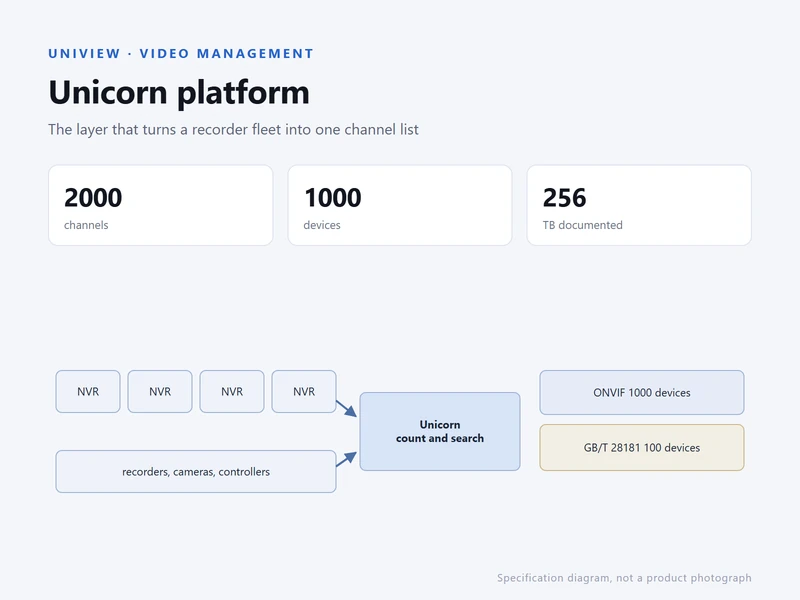
The software layer over a Uniview fleet: 1000 devices and 2000 channels on the 16-bay Unicorn appliance, with AcuSearch and SeekFree inside.
Capabilities below are vendor-documented. We have not tested this device or its integrations.
Sources checked:
Also known as: Unicorn, Unicorn Base, VMS-B180-A, UNV Guard, EZStation
Suitable projects
- Multi-site installations that need one channel list across recorders from different generations.
- Projects where the recorder does the analysis but the operator needs one search box across all of them.
- Sites that need access control, attendance and video in the same interface.
- Deployments that must keep third-party ONVIF cameras and GB/T 28181 devices in the same tree.
Before you buy
- AcuSearch, AcuTrack and SeekFree inside the VMS only work with recorders that have those features; the platform does not add them to older hardware.
- Unicorn is sized at 1000 devices and 2000 channels, so a larger estate needs a second instance or a different tier.
- The published storage ceiling of 256 TB assumes 32 drives of 8 TB in two enclosures, which is below current drive capacities.
- GB/T 28181 support is published as 100 managed devices, far below the 1000 ONVIF devices, so a large GB/T estate needs planning.
- The Unicorn and B180-A specification pages describe capacity and features rather than an API surface, so programmatic access has to be confirmed against the SDK documentation.
Official resources
Related guides
- Three delivery forms
- Unicorn as a 3U appliance, Unicorn Base as software on a server, and VMS-B180-A as a 1U appliance for smaller sites
- Unicorn capacity
- 1000 devices and 2000 channels, 256 cloud devices, 650 Mbps in and out, 30 simultaneous playback channels
- Unicorn storage
- 16 SATA bays up to 16 TB each, RAID 0, 1, 5, 6, 10, 50 and 60, plus two disk enclosures for 32 drives and 256 TB
- Unicorn hardware
- 32 GB RAM, 128 GB SSD system disk, 16 bays, 3U, dual power, under 12 kg
- B180-A capacity
- 250 devices and 500 channels, 512 Mbps in and 384 Mbps out, 4 GB RAM, one bay, 1U, under 4 kg
- Protocols managed
- 1000 ONVIF devices, 100 GB/T 28181 devices, 100 smart encoding devices, 128 access control devices, 30 decoders
- Search inside the platform
- AcuSearch, AcuTrack and SeekFree when the connected recorders support them, plus text search and search by image
- Analytics modules
- Face libraries up to 128, vehicle libraries up to 16, people counting in 8 areas of 32 channels, crowd density in 16 areas
- Map and wall
- Local and online maps with 7 layers, video wall control, up to 3 auxiliary monitors
- Other editions
- UNV Guard for the full access control and attendance stack, EZStation as the free site tool
Choosing a Unicorn deployment
Unicorn is the management layer that sits above the recorders. It is sold three ways: as a 3U appliance, as software on a server, and as a 1U appliance for smaller sites. The software is the same product; the difference is how many devices it can hold and how much storage comes with it.
Figures are from the Unicorn and B180-A specification pages plus the 2026 product guide. We have not tested a deployment.
The three sizes
| Item | VMS-B180-A | Unicorn appliance | Unicorn Base on a server |
|---|---|---|---|
| Form | 1U appliance | 3U appliance | Software |
| Devices | 250 | 1000 | 1000 |
| Channels | 500 | 2000 | 2000 |
| Inbound bandwidth | 512 Mbps | 650 Mbps | Server dependent |
| Outbound bandwidth | 384 Mbps | 650 Mbps | Server dependent |
| Simultaneous playback | 24 channels | 30 channels | Server dependent |
| Memory | 4 GB | 32 GB | Server dependent |
| Bays | 1 | 16 | Server dependent |
| Weight | Under 4 kg | Under 12 kg | Not applicable |
The 1U box has a single bay and a 16 GB eMMC system volume, so it is a head-end for a site that records on the cameras or on one NVR, not a storage platform.
What the appliance adds
The 3U chassis takes 16 SATA drives at up to 16 TB each, with RAID 0, 1, 5, 6, 10, 50 and 60, and supports two disk enclosures for 32 drives and a published maximum of 256 TB. The 1U box, for comparison, has two HDMI outputs and one VGA, both HDMI ports doing 4K, and decodes up to four channels of 4K, sixteen of 1080p or sixty-four of D1.
That is the case for the appliance over the software: an all-in-one head-end with redundancy, rather than a server the integrator has to specify.
The search layer
Unicorn carries AcuSearch, AcuTrack and SeekFree when the connected recorders have them, plus text search and search by image inside the platform. This is the point of putting a VMS above a fleet: one search box across chassis that each hold their own index.
Two honest limits. The platform does not add those features to recorders that lack them, and it does not publish a cross-recorder index size. A six-recorder site gets six indexes queried from one interface.
Protocol reach
The published management capacities are the most useful numbers on the page:
| Device class | Capacity |
|---|---|
| ONVIF devices | 1000 |
| GB/T 28181 devices | 100 |
| Smart encoding devices | 100 |
| Access control devices | 128 |
| Decoding devices | 30 |
| EZAgent | 20 |
The gap between 1000 ONVIF and 100 GB/T 28181 is worth planning around. A site that expects to bring a large Chinese-standard estate into Unicorn will hit the lower number long before the device ceiling.
The non-video modules
Face libraries up to 128, vehicle libraries up to 16, people counting in 8 areas of up to 32 channels each, and crowd density in 16 areas of one channel each. Access control, attendance, visitor and patrol modules are included in the platform description, and the full stack including advanced access control is sold as UNV Guard.
If the project is video-only, most of that is dormant. If it is a campus with turnstiles and timekeeping, it is the reason to choose this platform over a simpler one.
Where it competes with itself
EZStation is the free site tool and covers a single small site. The B180-A covers a site up to 500 channels. Buying Unicorn for a 40-camera shop pays for capacity that will never be used, and buying EZStation for a 900-channel campus means rebuilding in a year.
Storage arithmetic
The published 256 TB ceiling assumes 32 drives of 8 TB in two enclosures, which is modest by current drive sizes. Since the appliance itself takes 16 TB drives, a single chassis already holds more than the documented enclosure maximum. Treat 256 TB as a documented configuration, not a hard limit, and confirm larger drives with a distributor.
What it does not do
It is a management platform, not an analytics engine. It does not add engines, does not analyse streams itself, and does not publish an API surface on its specification page. Programmatic access has to be confirmed through the SDK documentation before a project depends on it.
For how the whole range fits together, read Reading the Uniview intelligent range.
Installing Unicorn over a recorder fleet
Unicorn is the management layer, so it goes in after the recorders are already working. The order that avoids rework is: size the platform, add devices, arrange the tree, then enable the search features the recorders already have.
Steps follow the Unicorn and B180-A specification pages. We have not run them on a device.
Size before install
Two numbers decide the hardware: 1000 devices and 2000 channels on Unicorn, 250 and 500 on the B180-A. Count cameras as channels and recorders, encoders, access controllers and decoders as devices, then leave headroom for the access control and intercom modules if the site has them.
The bandwidth numbers are also ceilings: 650 Mbps in and out on the appliance, 512 in and 384 out on the 1U box.
Rack the appliance
The 3U chassis takes 16 drives at up to 16 TB, with RAID 0, 1, 5, 6, 10, 50 and 60 and dual power. Build the array before loading the database.
The 1U box has a single bay and no drive included, with a 16 GB eMMC system volume, and is rated minus 10 to 55 C with 0 to 50 C recommended. If the site records onto cameras or NVRs and only needs a management head, that is enough.
Add devices in the right class
The Unicorn page breaks its capacity down by device class, and each class has its own ceiling:
| Class | Unicorn |
|---|---|
| ONVIF devices | 1000 |
| GB/T 28181 devices | 100 |
| Smart encoding devices | 100 |
| Access control devices | 128 |
| Decoding devices | 30 |
| EZAgent | 20 |
The B180-A page publishes only the totals, 250 devices and 500 channels, without the class breakdown.
Add recorders first, then cameras that report directly, then the access control and intercom hardware. The GB/T 28181 limit of 100 is the one that surprises projects with a large Chinese-standard estate.
Build the tree
Device groups drive everything downstream: permissions, maps, video wall layouts and alarm plans. Build them before adding users, because role inheritance follows the tree.
Maps support local files and an online map source, up to seven layers, with hot spots for channels, alarm inputs and access control points. The published storage allowance for map resources is 800 MB.
Confirm what search the recorders bring
Unicorn carries AcuSearch, AcuTrack and SeekFree when the connected recorders have them. Check the recorder model first: an IX2 brings SeekFree, an IM2 does not, and the VMS cannot add what the recorder lacks.
Once the recorders are in, the platform's own data search covers faces by attribute, event and image, pedestrians by clothing attributes, motor vehicles by plate and type, and non-motor vehicles by type and direction. Those searches run on captures the recorders produced.
Set the counting and library modules
Face libraries up to 128 and vehicle libraries up to 16 are configured in the platform. People counting supports 8 areas of up to 32 channels, with thresholds at three severity levels and reports by minute, hour, day or month. Crowd density supports 16 areas of one channel.
These limits are platform-side. The recorder still has to deliver the captures.
Plan the retention
Storage performance is 16 bays at up to 16 TB each, with two enclosures adding 32 drives for a documented 256 TB. Work out retention from bitrate and channel count, then confirm the enclosure configuration with the distributor, because the published ceiling assumes 8 TB drives.
Before handover
Confirm device counts per class against the design. Confirm the search features work on the recorders that were specified. Confirm the map layers and hot spots point at the right cameras. Confirm the video wall layouts survive a restart. Confirm the time source, because face and vehicle searches depend on it.
What the pages do not answer
There is no API reference, no licencing tier table beyond the two appliance sizes and no published cross-recorder index behaviour. Programmatic integration has to be confirmed against the SDK documentation, and multi-site aggregation is not described.
For the connection layer, read Connecting to Uniview.
FAQ — Uniview Unicorn
Is Unicorn hardware or software?
Both. It ships as a 3U appliance with 16 bays, as software to install on a server, and as a 1U appliance called VMS-B180-A for sites up to 500 channels.
How many cameras can it manage?
2000 channels and 1000 devices on Unicorn, 500 channels and 250 devices on the B180-A. Cameras count as channels; recorders, encoders, controllers and decoders count as devices.
Does it add AI to old recorders?
No. AcuSearch, AcuTrack and SeekFree work inside Unicorn only when the connected recorders carry those features. The platform aggregates and searches what the recorders produce.
How many ONVIF devices can it hold?
- That is separate from the 100 GB/T 28181 devices, 100 smart encoding devices, 128 access control devices and 30 decoding devices, all published on the same table.
How much storage can it address?
The appliance takes 16 drives at up to 16 TB each and supports two disk enclosures for 32 more drives, with a documented maximum of 256 TB. That ceiling assumes 8 TB drives, so larger drives change the arithmetic.
Can it do access control and attendance?
Yes. Access control, attendance, visitor, patrol and people counting are in the platform description, and the full stack including advanced access control is sold as UNV Guard.
How many face libraries?
128 face libraries and 16 vehicle libraries, plus people counting in 8 areas of up to 32 channels each and crowd density in 16 areas of one channel.
What is EZStation then?
The free site tool for a single small site. Unicorn is the paid platform with the device classes, redundancy and modules above it.
Does it publish an API?
Not on its specification page. Capacity and features are documented, the programmatic surface is not, so confirm SDK and API support before a project depends on it.
What is the operating range?
The 1U box is rated minus 10 to 55 C with 0 to 50 C recommended. The 3U appliance page does not restate a temperature limit, so treat the data-room assumption as unconfirmed for that model.
Is there a price?
No. Uniview publishes none for any of the three delivery forms.