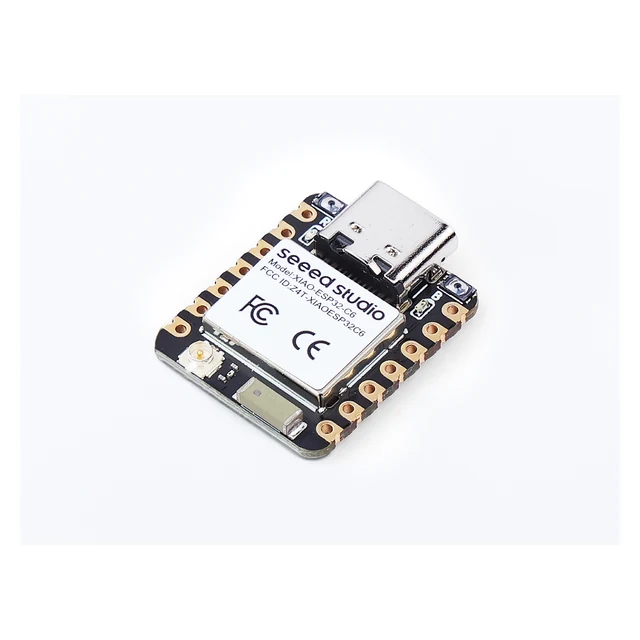
Development Boards
Seeed Studio XIAO ESP32C6
Thumb-sized ESP32-C6 board with Wi-Fi 6, Thread and Zigbee, plus a switchable ceramic or UFL antenna.
Capabilities below are vendor-documented. We have not tested this device or its integrations.
Sources checked:
Suitable projects
- Matter and Thread devices in a very small footprint.
- Battery sensors that sleep most of the time.
- Adding 802.15.4 to a product that already uses XIAO carriers.
Before you buy
- GPIO14 is the antenna switch: low selects the ceramic antenna and high selects UFL, so reusing that pin changes the RF path.
- The sleep figure is a vendor measurement on the module, not in your enclosure with your firmware.
Official resources
- ESP32-C6 Series Datasheet, Version 1.5
- XIAO ESP32-C6 schematic v1.0
- XIAO ESP32-C6 getting started wiki
Related guides
- ESP32 chip comparison: C3, C6, H2, S2, S3, P4 and C5
- ESP32 hardware selection: from development board to module to antenna
- ESP32 production readiness: what changes after the prototype works
- ESP32 low-power reality: what the sleep current tables actually say
- ESP32 supply chain: what Espressif's own documents say, and where they stop
- SoC
- ESP32-C6 with two RISC-V cores, up to 160 MHz
- Memory
- 512 KB SRAM, 4 MB flash
- Wireless
- Wi-Fi 6 in 2.4 GHz, Bluetooth LE 5.0, Zigbee and Thread
- GPIO
- 11 pins with PWM, 7 ADC channels
- Antenna
- Ceramic on board plus a UFL connector, switched by GPIO14
- Sleep current
- 15 uA in deep sleep, vendor figure
- Battery
- 3.7 V input with charge management
- Size
- 21 x 17.8 mm
- Temperature
- -40 to 85 C
Choosing Seeed Studio XIAO ESP32C6
This profile is based on official documentation, not our own device testing.
What it is
A 21 x 17.8 mm board built on the ESP32-C6, with 11 GPIO pins, 7 ADC channels, 512 KB of SRAM and 4 MB of flash. It carries Wi-Fi 6 in the 2.4 GHz band, Bluetooth LE 5.0, Zigbee and Thread.
The XIAO footprint is the point: it drops onto existing XIAO carriers, which makes it the cheapest way to add Thread or Zigbee to a product built around that ecosystem.
Specifications
| Item | Value |
|---|---|
| SoC | ESP32-C6, two RISC-V cores, up to 160 MHz |
| Memory | 512 KB SRAM, 4 MB flash |
| Wireless | Wi-Fi 6 at 2.4 GHz, Bluetooth LE 5.0 |
| Protocols | Zigbee and Thread on IEEE 802.15.4 |
| GPIO | 11 pins with PWM, 7 ADC channels |
| Antenna | Ceramic on board, plus a UFL connector |
| Sleep current | 15 uA deep sleep, vendor figure |
| Battery | 3.7 V input with charge management |
| Size | 21 x 17.8 mm |
| Temperature | -40 to 85 C |
The antenna is a GPIO
The board has both a ceramic antenna and a UFL connector, and GPIO14 selects between them: low for the ceramic antenna, which is the default, and high for the external one.
That makes GPIO14 a pin you cannot reuse for anything else without changing the RF path. It is also the first thing to check when a design that worked on the bench has poor range in an enclosure.
Check before ordering
- Reserve GPIO14 for the antenna switch in your pin plan.
- The 15 uA deep sleep figure is measured on the module. Expect more in a product with regulators and sensors around it.
- Four pads are needed for battery and charge management. Check the carrier board before assuming the cell connects directly.
Next step
Confirm the antenna plan first, then map every pin against the carrier board you intend to use.