Development Boards
M5Stack CoreS3
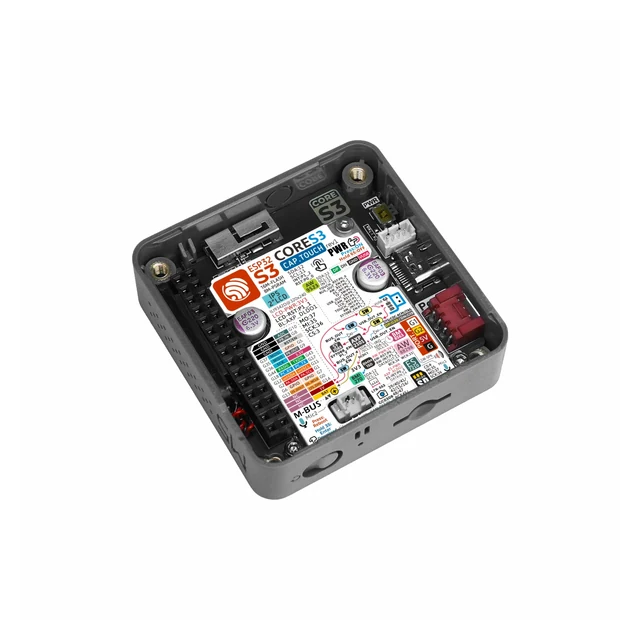
ESP32-S3 controller with a 2-inch touch screen, camera, IMU and DIN base for panel and control prototypes.
Capabilities below are vendor-documented. We have not tested this device or its integrations.
Sources checked:
Also known as: CoreS3 K128
Suitable projects
- Wall panels and room controllers with a small touch screen.
- Prototypes that need camera, motion and audio sensing in one case.
- DIN-rail installations where the included base saves a bracket.
Before you buy
- The magnetometer drifts near magnets; the vendor documents removing magnets from controllers used with it.
- The 0.3 MP camera reads presence and light, not detailed scenes.
Official resources
- ESP32-S3 Series Datasheet, Version 2.2
- CoreS3 documentation, PDF edition
- CoreS3 mainboard schematic v1.0
- CoreS3 documentation and pinout
Related guides
- ESP32 chip comparison: C3, C6, H2, S2, S3, P4 and C5
- ESP32 hardware selection: from development board to module to antenna
- ESP32 production readiness: what changes after the prototype works
- ESP32 low-power reality: what the sleep current tables actually say
- ESP32 supply chain: what Espressif's own documents say, and where they stop
- SoC
- ESP32-S3, dual-core Xtensa LX7 at 240 MHz
- Flash and PSRAM
- 16 MB flash, 8 MB Quad PSRAM
- Display
- 2.0-inch touch IPS, 320 x 240, ILI9342C or ILI9342E
- Camera
- GC0308, 0.3 MP, sharing a ribbon with the proximity sensor
- Sensors
- BMI270 six-axis IMU, BMM150 magnetometer, LTR-553ALS-WA proximity
- Audio
- ES7210 codec with two microphones, AW88298 1 W amplifier
- Power
- AXP2101 PMU, 500 mAh battery, 9 to 24 V DC input through the DIN base
- Size
- 54 x 54 x 15.5 mm for the main unit
Choosing M5Stack CoreS3
This profile is based on official documentation, not our own device testing.
What it is
A controller rather than a bare board. The CoreS3 combines an ESP32-S3 with a 2-inch capacitive touch IPS panel, a 0.3 MP camera, a six-axis IMU, a magnetometer, an RTC, dual microphones and a 1 W speaker, all in a 54 mm cube that ships with a DIN base.
It is the shortest path from an idea to a working panel with a screen, sound and motion sensing, at the cost of paying for parts you may not use.
Specifications
| Item | Value |
|---|---|
| SoC | ESP32-S3, dual-core Xtensa LX7 at 240 MHz |
| Flash and PSRAM | 16 MB flash, 8 MB quad PSRAM |
| Display | 2.0-inch touch IPS at 320 x 240 |
| Camera | GC0308, 0.3 MP |
| Sensors | BMI270 IMU, BMM150 magnetometer, LTR-553ALS-WA proximity |
| Audio | ES7210 codec, two microphones, AW88298 1 W amplifier |
| Power | AXP2101 PMU, 500 mAh battery, 9 to 24 V DC input through the DIN base |
| Size | 54 x 54 x 15.5 mm main unit |
What the camera is for
The GC0308 is a 0.3 MP sensor paired on one ribbon with the proximity sensor. It is enough to detect presence, motion or a change in light. It is not a sensor for reading text, faces at distance or machine vision tasks. Products that need that belong on an ESP32-S3 board with a proper camera module.
Check before ordering
- The magnetometer drifts near magnets. The vendor documents removing magnets from controllers used alongside it.
- The DIN base is part of the kit, so check whether your enclosure plan needs it.
- Battery life depends on the panel brightness and the Wi-Fi duty cycle, not on the chip alone.
Next step
Confirm the SKU, whether the DIN base is included in your region, and which firmware stack you will use for the display before ordering.