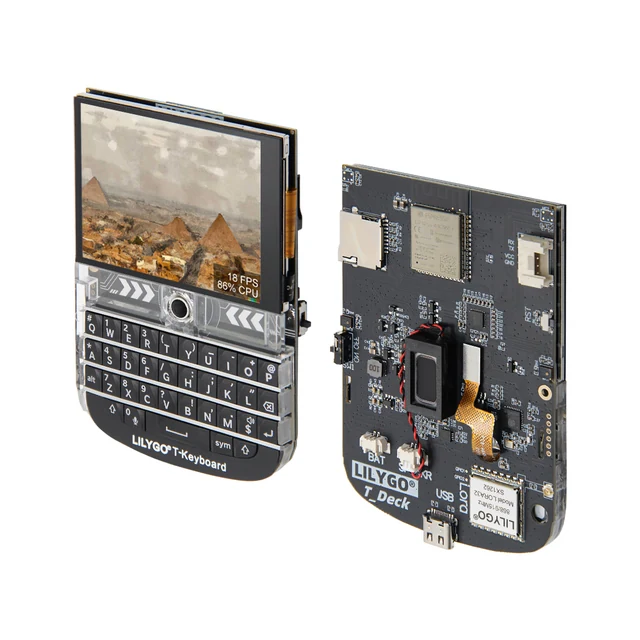
Development Boards
LilyGO T-Deck
Handheld ESP32-S3 terminal with a 2.8-inch screen, physical keyboard, trackball and an optional LoRa radio.
Capabilities below are vendor-documented. We have not tested this device or its integrations.
Sources checked:
Suitable projects
- Messaging terminals and field devices with a keyboard.
- LoRa mesh nodes that also need a screen and text entry.
- Handheld test tools built on ESP-IDF or Arduino.
Before you buy
- The LoRa module shares the SPI bus, so only one device can be selected at a time.
- GPIO10 has to be driven high when the board runs from the battery, and the middle trackball button is unavailable once the microphone is enabled.
- The keyboard is a separate ESP32-C3 acting as an I2C slave, so its firmware is part of your build.
Official resources
Related guides
- ESP32 chip comparison: C3, C6, H2, S2, S3, P4 and C5
- ESP32 hardware selection: from development board to module to antenna
- ESP32 production readiness: what changes after the prototype works
- ESP32 low-power reality: what the sleep current tables actually say
- ESP32 supply chain: what Espressif's own documents say, and where they stop
- MCU
- ESP32-S3FN16R8, dual-core LX7 at 240 MHz
- Memory
- 16 MB flash, 8 MB PSRAM, TF card slot
- Display
- 2.8-inch ST7789 at 320 x 240, no touch
- Input
- Trackball and a physical keyboard on I2C
- Radio
- SX1262 LoRa at 433 to 915 MHz, optional
- Audio
- ES7210 codec with a microphone array
- Battery
- 2000 mAh lithium polymer
- Size
- 100 x 68 x 11 mm
Choosing LilyGO T-Deck
This profile is based on official documentation, not our own device testing.
What it is
A handheld terminal rather than a development board in the usual sense. The T-Deck puts an ESP32-S3FN16R8, a 2.8-inch 320 x 240 display, a trackball, a full physical keyboard and an optional SX1262 LoRa radio into a 100 x 68 x 11 mm case with a 2000 mAh battery.
It exists for one class of product: a device that someone holds, types on and carries around.
Specifications
| Item | Value |
|---|---|
| MCU | ESP32-S3FN16R8, dual-core LX7 at 240 MHz |
| Memory | 16 MB flash, 8 MB PSRAM |
| Display | 2.8-inch ST7789 at 320 x 240, no touch |
| Input | Trackball and physical keyboard on I2C |
| Radio | SX1262 LoRa at 433 to 915 MHz, optional |
| Audio | ES7210 codec with a microphone array |
| Battery | 2000 mAh lithium polymer |
| Storage | TF card slot |
| Size | 100 x 68 x 11 mm |
Three things the wiki tells you that a product page does not
The LoRa module shares the SPI bus with the other peripherals, so only one device can be selected at a time and every other chip select has to be held high before you talk to the SX1262.
The keyboard is not a matrix wired to the ESP32-S3. It is a separate ESP32-C3 running as an I2C slave, which means keyboard firmware is part of your build and your update plan.
Driving the board from the battery requires GPIO10 to be high. On USB power the pin can be ignored, which is exactly the kind of difference that makes a prototype work on the bench and fail in the field.
Check before ordering
- The LoRa radio is optional. Confirm the variant if you need it.
- There is no touch screen. All input is the trackball or the keyboard.
- The middle trackball button is unavailable once the microphone is enabled.
Next step
Decide whether you need LoRa, then confirm the keyboard firmware version and the display driver your stack expects.