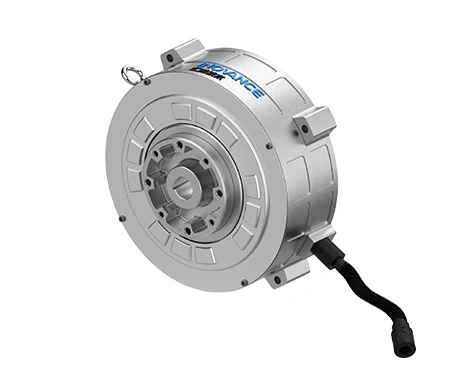
Spindle Motors
MX3 Spindle Motors
Direct-drive spindle motors for air-jet and water-jet looms, supplied assembled as a flanged unit rather than as a frameless kit.
Capabilities below are vendor-documented. We have not tested this device or its integrations.
Sources checked:
Also known as: Inovance MX3 electric spindle motor, MX3 second-generation spindle motor, 汇川 MX3 电主轴
Suitable projects
- Replacing a belt-driven loom spindle, so the synchronous pulley, the drive belt and the brake disc come off the machine.
- Air-jet looms running the TAJ300-Q7 control cabinet.
- Water-jet looms running a TWJ300 cabinet, or any loom on the standalone ITD500E spindle drive.
Before you buy
- The stator and rotor ship assembled and must not be separated to install them; this is a complete flanged motor, not a frameless kit.
- The magnetic field is strong enough that the user guide bars anyone with a pacemaker or a metal implant from working on the motor.
- It needs a matched drive: Inovance pairs it with the TAJ300-Q7 or a TWJ300 cabinet, or the standalone ITD500E spindle drive.
- No numeric IP class is published. The guide only says the stator is potted and has a high IP rating.
- Rated altitude is 1000 m. Above that the rating falls to 88.7 percent at 3000 m and 64.5 percent at 5000 m.
- It is a loom spindle motor, so the application list does not extend to robot joints.
Official resources
- MX3-INT series user guide, revision A00
- MX3 series user guide, revision A02, China-market edition
- ITD500E loom spindle drive user guide, revision A02
- MX3-50C70B outline drawing, revision B01
- MX3-50C70B STEP model, revision B00
- MX3 series product page
Related guides
- MX3-50C70B-INT
- 700 rpm, 54 N·m rated, 410 N·m peak
- MX3-50C10C-INT
- 1000 rpm, 43 N·m rated, 340 N·m peak
- MX3-45C80B-INT
- 800 rpm, 53.7 N·m rated, 300 N·m peak
- Rated power
- 4.5 kW on all three global models
- Rated voltage
- 380 V
- Rated current
- 11.5 A on 50C70B and 50C10C, 12.5 A on 45C80B
- Insulation class
- F
- Efficiency
- Level 1 to GB 30253-2013, quoted as IE5
- Duty type
- S1 continuous
- Mounting
- Flange, with an optional adapter flange
- Mass
- 31.5 kg on 50C70B and 50C10C, 24.65 kg on 45C80B
- Stator sealing
- High-strength potting glue; no numeric IP class is published
Choosing Inovance MX3 Spindle Motors
This profile is based on official documentation, not our own device testing. The figures below come from the global-version user guide, revision A00, unless stated otherwise.
The MX3 is the second generation of Inovance's electric spindle motor for weaving machines. Inovance describes it as a direct drive motor for air-jet and water-jet looms, with high torque-to-volume and torque-to-inertia ratios, and pairs it with a TAJ or TWJ control cabinet to form a loom spindle beating system.
It is not a frameless kit
Direct drive and frameless are often used as if they were the same thing. On this motor they are not.
The guide states that the stator and rotor are assembled and supplied together and can be installed directly without separation. The unit arrives as a flanged motor with a rear cover, an eye bolt for lifting, a tapered shaft and a 1.8 m power cable. The outline drawing for the 50C70B shows a 326 mm flange, a 291 mm H8 bore and a shaft taper, and puts the unit at 31.5 kg. Nothing about it is a bare stator and rotor ring that you thread onto your own shaft.
That matters when you compare it against a robot joint kit. A frameless motor asks you to design the housing, the bearing and the cooling. This one you bolt on.
The three global models
The global-version guide covers three models, all at 4.5 kW and 380 V.
| Model | Rated speed | Rated torque | Peak torque | Rated current |
|---|---|---|---|---|
| MX3-50C70B-INT | 700 rpm | 54 N·m | 410 N·m | 11.5 A |
| MX3-50C10C-INT | 1000 rpm | 43 N·m | 340 N·m | 11.5 A |
| MX3-45C80B-INT | 800 rpm | 53.7 N·m | 300 N·m | 12.5 A |
The model code carries the ratings. The two digits plus a letter after MX3 give rated power, and the next pair gives rated speed: 50C is 5000 W and 70B is 700 rpm.
That rule and the table above disagree, and it is worth noticing. All three global models are rated 4.5 kW in Inovance's own electrical table, yet the codes of the 50C models decode to 5000 W, and the China-market guide does list 5.0 kW for them. Treat the nameplate as the authority and ask for the figure in writing.
The peak torque is what matters for this duty. Inovance describes the arrangement as a spindle beating system, so the motor is loaded in a short pulse on every pick rather than holding a steady torque, and peak torque runs 5.6 to 7.9 times the rated figure across the three models.
What direct drive removes
A belt-driven loom spindle carries a synchronous pulley, a drive belt and a brake disc between the motor and the load. Direct drive takes all three out of the spindle path, and with them the losses they introduce.
Inovance publishes the mechanical consequence on the product page rather than in the guide:
| Item | Claim |
|---|---|
| Crossbeam weight | More than 28 percent lower |
| Power section volume | More than 50 percent lower |
| Power section part count | More than 80 percent lower |
| Installation labour time | More than 80 percent lower |
| Energy consumption | 25 percent less |
| Production efficiency | 30 percent higher |
The energy and efficiency figures are Inovance's own comparison against the belt-driven arrangement it replaces, not a measurement we made.
One thing the belt does not fully disappear from is the shedding mechanism. The guide notes that whether you install the belt pulley for the shedding means depends on the mill and the working conditions; if the loom does not need it, you leave it off and the equipment runs unaffected.
Envelope and environment
The motor is a 380 V permanent-magnet machine, duty type S1, insulation class F, flange mounted, with an efficiency level of 1 on the GB 30253-2013 scale that Inovance quotes as IE5. Rotation is counter-clockwise seen from the load side.
Ambient limits are narrow by industrial standards. Operating temperature is 0 to 40 °C with a change rate under 0.5 °C per minute, storage is -40 to +60 °C, and both are limited to 95 percent relative humidity without condensation. The rated altitude is 1000 m, above which the rating derates: 94.7 percent at 2000 m, 88.7 percent at 3000 m, 82.4 percent at 4000 m and 64.5 percent at 5000 m.
On ingress protection, the guide does not publish a class. It says the stator core is sealed with high-strength potting glue that gives a high IP rating with high thermal conductivity and resistance to vibration, corrosion and heat. If your installation needs a stated IP number, ask Inovance for it in writing rather than assuming one.
What you have to supply
The motor is part of a system, and the rest of it is not in the box.
You need a matched drive. Inovance lists three configurations: the MX3 with a TAJ300-Q7 cabinet on an air-jet loom, with a TWJ300-A5, A6 or A8 cabinet on a water-jet loom, or with the standalone ITD500E loom spindle drive. Connecting the motor to industrial power directly is called out as a way to damage it.
You need an adapter flange if the loom does not already match. The equipment builder can make it, but the guide requires it to be designed jointly with an Inovance engineer, and Inovance publishes flange options such as MX3-F14435 and MX3-F14335 for specific loom models.
You also need lifting equipment rated for a 31.5 kg motor with a strong magnetic field, and the auxiliary disassembly tool if the motor ever has to come off the loom shaft.
Safety before anything else
The rotor magnets produce a magnetic field and a large attraction force around the motor. The guide bars anyone with a pacemaker or a metal implant from working on it, and the motor carries a warning mark.
Check before ordering
- Confirm whether the loom is air-jet or water-jet, because the cabinet changes with it.
- Confirm the rated speed you need against 700, 800 or 1000 rpm, since 700 rpm is the rated speed of the 50C70B and not a series maximum.
- Ask which edition of the motor you are being quoted. The China-market guide, revision A02, lists five models and rates the 50C70B and 50C10C at 5.0 kW, where the global guide rates them at 4.5 kW.
- Get the flange interface agreed with Inovance before the loom is machined.
- Decide whether the shedding means needs its belt pulley.
- Check the altitude and ambient temperature of the plant against the derating table.
- Ask for a written IP class if the installation requires one.
Next step
The user guides, the outline drawing, the STEP model and the product page are listed under Official resources on the overview tab of this device page.
Read the quick start tab before the motor reaches the loom. Treat it as a loom spindle motor that bolts on, not as a frameless kit you build around.
Quick Start — Inovance MX3 Spindle Motors
This is an untested reference for first installation on a loom. It is based on official documentation, not our own device testing.
1. Check what arrived
The motor arrives assembled: the guide states that the stator and rotor are supplied together and can be installed directly without separation. Do not take them apart to fit them, and do not treat this as a frameless kit that gets threaded onto your own shaft.
Confirm the model and the nameplate against the order. The nameplate carries rated power, rated frequency and rated speed, and those three numbers are what the drive expects to see.
2. Clear the safety floor first
The rotor magnets produce a strong field and a large attraction around the motor. Anyone with a pacemaker or a metal implant must not work on it. Keep clocks and magnetisable media such as disks and credit cards away from it, and do not knock the motor shaft, because mechanical shock degrades performance.
Use lifting equipment rated for 30 to 40 kg on the eye bolt. Plan for it before you loosen anything, because once the fixing nuts come off the motor is free.
3. Fit the adapter flange and hang the motor
The adapter flange goes on the loom first. An equipment builder can make it, but the guide requires the design to be agreed with an Inovance engineer, and Inovance also sells flanges such as MX3-F14435 and MX3-F14335 for named loom models.
The motor mounts on a flange, with the shaft taper engaging the loom shaft and M20 nuts clamping the two together. Hang the motor from the eye bolt, bring it to the shaft, and tighten the four M10×65 screws that join the housing to the adapter flange.
Decide whether the shedding means needs its belt pulley. The guide leaves this to the mill: if the loom does not use that pulley, leave it off and the equipment runs unaffected.
4. Wire the power cable
The motor end of the cable lands on U, V, W and PE at the drive side. The conductor colours are blue for U, black for V, red for W and yellow-green for PE, all on M4 studs.
Phase order matters. The guide warns that mismatched three-phase cables will damage the motor, so check the sequence before the first power-up rather than after.
5. Connect a matched drive
Inovance lists three configurations: a TAJ300-Q7 cabinet on an air-jet loom, a TWJ300-A5, A6 or A8 cabinet on a water-jet loom, or the standalone ITD500E loom spindle drive. Do not connect the motor straight to industrial power.
When an ITD500E is paired with an MX3, the guide says the motor parameter group does not need to be set at all: verify that the values the drive reports for rated frequency and rated current match the nameplate.
The commissioning flow in the China-market guide also sets two constants, A4.39 for the motor rating and A4.08 for the loom type, the latter to 3 for an air-jet loom and 5 for a water-jet loom. Treat those numbers as edition-specific and confirm them against the drive guide that ships with your unit.
6. Check insulation before energising
Two static checks come before the first run. Insulation resistance must be at least 50 MΩ measured at 500 V DC for one second. Insulation withstand is 2160 V AC for one second.
7. Jog, then run
Jog auto-tuning comes first. In the China-market flow, a drive reporting Er36.13 at this step has a known fault diagnosis path in the ITD500E drive guide.
Then run at normal speed and watch four things: the starting performance, the loom speed ripple, whether a gear mark appears on the cloth surface, and whether the loom parks in the right position. Jog at any angle to check that the loom does not slip.
Rotation is counter-clockwise seen from the load side with all cables correct. If it runs the other way, stop and fix the wiring rather than reversing it in software.
8. Stopping and DC braking
The drive brakes the loom through the control cabinet's brake disc signal, or through the STOP button on its own panel. To release the loom to a free state, set A4.10 to 0, hold STOP for more than four seconds, power off, then use the loom brake DIP switch.
9. Put the lint on the maintenance calendar
On an air-jet loom, lint collects inside and outside the motor and has to be cleared every 30 days, more often if the plant is dusty. The guide states plainly that lint left in place can cause a fire.
Check the tightness of the screws and nuts on the spindle motor and the adapter flange on the same 30-day cycle.
Mistakes that damage this motor
- Separating the stator and rotor because the unit was assumed to be a frameless kit.
- Connecting the motor directly to industrial power instead of a matched drive.
- Getting the U, V and W order wrong at the drive terminals.
- Knocking the motor shaft during handling.
- Skipping the 30-day lint clean on an air-jet loom.
- Assuming a numeric IP class that the documentation does not actually state.
- Running it at 5000 m altitude or in a 45 °C plant without applying the derating table.
FAQ — Inovance MX3 Spindle Motors
Is this a frameless motor?
No. The user guide states that the stator and rotor are assembled and supplied together and can be installed directly without separation. The unit arrives as a flanged motor with a rear cover, a lifting eye bolt, a tapered shaft and a 1.8 m cable, and the 50C70B weighs 31.5 kg. Direct drive and frameless are separate ideas, and this motor is the first without being the second.
What is the protection class?
The guide publishes no numeric class. It says the stator core is sealed with high-strength potting glue that gives a high IP rating, with high thermal conductivity and resistance to vibration, corrosion and heat. Separately, it requires that when the motor is built into a cabinet or final assembly, the enclosure must meet IEC and local law on IP rating. If your project needs a stated number, ask Inovance for it in writing.
What is the rated speed, and is 700 rpm a peak or a rated figure?
Both readings exist in Inovance's own material. The global-version guide's electrical table lists 700 rpm as the rated speed of the MX3-50C70B-INT, with the 50C10C-INT at 1000 rpm and the 45C80B-INT at 800 rpm. The product page describes continuous and stable operation even at a peak speed of 700 rpm. No separate maximum is published, so size the application against the rated figure and get the maximum confirmed.
How much torque does it produce?
Rated torque is 54 N·m at 700 rpm on the 50C70B, 43 N·m at 1000 rpm on the 50C10C, and 53.7 N·m at 800 rpm on the 45C80B. Peak torque is 410, 340 and 300 N·m respectively. The wide gap between rated and peak fits the duty: Inovance calls the arrangement a spindle beating system, so the motor sees a short pulse on every pick rather than a steady load.
What machinery does it target?
Weaving machines. The guide opens by calling it a direct drive motor for weaving machines, and the commissioning flow distinguishes air-jet from water-jet looms. It forms a spindle beating system with a TAJ or TWJ control cabinet. It is not positioned for ceramic, food, metal-working or printing machinery.
Does the series suit a robot joint?
No. It is a loom spindle motor with a shaft taper that mates to the loom crankshaft, and the documentation covers nothing else. A robot joint needs torque density, a hollow bore and a feedback device, and none of those are in scope here.
Which drive and control cabinet match the motor?
Inovance lists three configurations: the MX3 with a TAJ300-Q7 cabinet on an air-jet loom, with a TWJ300-A5, A6 or A8 cabinet on a water-jet loom, or with the standalone ITD500E loom spindle drive. Connecting the motor directly to industrial power is called out as a way to damage it.
What do I have to supply myself?
An adapter flange if the loom does not already match, agreed with an Inovance engineer; lifting equipment rated for 30 to 40 kg; the auxiliary disassembly tool for removing the motor from the shaft; and the drive or cabinet. Inovance sells flanges such as MX3-F14435 and MX3-F14335 for named loom models.
What is the efficiency rating?
Level 1 on the GB 30253-2013 scale, which Inovance quotes as IE5. The product page also claims 25 percent less energy consumption and 30 percent higher production efficiency than the belt-driven arrangement it replaces. Those are the vendor's own comparisons, not our measurements.
What are the operating limits?
Operation is 0 to 40 °C with a change rate under 0.5 °C per minute, storage is -40 to +60 °C, and both are limited to 95 percent relative humidity without condensation. Rated altitude is 1000 m, with the rating derating to 94.7 percent at 2000 m, 88.7 percent at 3000 m, 82.4 percent at 4000 m and 64.5 percent at 5000 m.
What maintenance does it need on a loom?
On an air-jet loom, clear the lint inside and outside the motor every 30 days, more often if the plant is dusty. The guide states that lint left in place can cause a fire. Check the tightness of the screws and nuts on the motor and the adapter flange on the same cycle.
Where are the official figures published?
The user guides, the outline drawing, the STEP model and the product page are listed under Official resources on the overview tab of this device page. The global-version guide is revision A00; the China-market guide is revision A02 and rates the 50C70B and 50C10C at 5.0 kW where the global edition rates them at 4.5 kW.