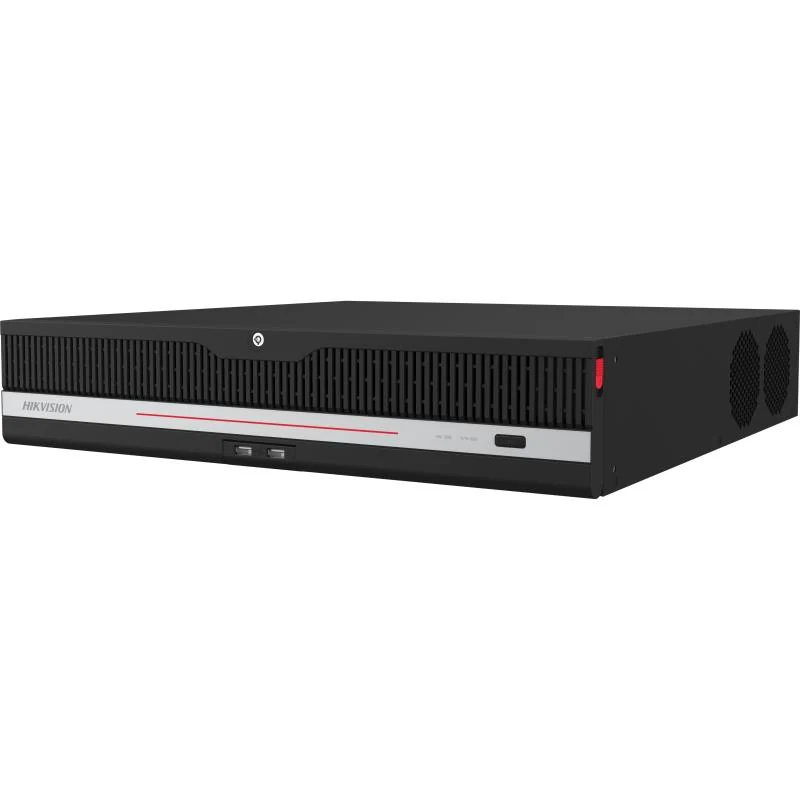
AI Network Video Recorders
Hikvision DeepinMind high-channel I and H series
128 and 256 channel DeepinMind recorders in 16 or 24 bay chassis, with either a fixed analytics menu or nine to eighteen adjustable engines.
Capabilities below are vendor-documented. We have not tested this device or its integrations.
Sources checked:
Also known as: iDS-9600NXI-I16, iDS-96000NXI-I24, iDS-9600NXI-H16R, iDS-96000NXI-H24R
Suitable projects
- A site that has to hold 16 to 24 drives and more than a hundred cameras.
- Face search projects where picture library size matters more than throughput.
- Installations that need an LCD on the front for local checks without a laptop.
Before you buy
- The 10 TB per drive ceiling halves the storage of a 24 bay unit compared with a mainstream DeepinMind with the same bays.
- The H models start at 0 C rather than -10 C, which rules out an unheated outdoor cabinet; the I sheets do not state a range at all.
- The I models decode only 20 channels at 1080p, so a large video wall belongs on an M or H unit.
- Neither sheet carries the 32 MP input footnote, and the I models are older documents dated 2022 with firmware V4.60.110.
Official resources
- iDS-96128NXI-I16 datasheet, firmware V4.60.110, October 2022
- iDS-96256NXI-I24 datasheet, firmware V4.60.110, October 2022
- iDS-96128NXI-H16R datasheet, October 2026
- iDS-96256NXI-H24R datasheet, firmware V5.03.100, November 2024
- Device Network SDK (HCNetSDK) V6.1.11.40, Windows 64-bit
- Device Network SDK (HCNetSDK) V6.1.11.40, Linux 64-bit
- WebSDK V3.3.1, browser-side live view and playback
Related guides
- Channels
- 128 on I16 and H16R, 256 on I24 and H24R
- AI architecture
- Fixed function menu on I, 9 engines on H16R and 18 on H24R
- Drive bays
- 16 SATA on I16 and H16R, 24 on I24 and H24R
- HDD ceiling
- Up to 10 TB per drive, half the mainstream family
- RAID
- 0, 1, 5, 6 and 10
- Bandwidth
- 512 Mbps on I16 and H16R, 768 Mbps in and 512 out on I24, 1024 in and 768 out on H24R
- Decoding
- 20 channels at 1080p on the I models, 2 channels at 32 MP on H16R
- Chassis
- 133 mm tall on 16 bay models, 173 mm on 24 bay models
- Power
- 150 W on H16R, 300 W on H24R, without drives
- Working temperature
- 0 to 50 C on the H models, not stated on the I models
- Expansion
- 1 eSATA, plus 2 miniSAS on the I models
Choosing a 128 or 256 channel DeepinMind recorder
This profile is based on official documentation, not our own device testing.
Two architectures under one range
The four models in this range look alike from the front and are built differently inside. The I models carry a fixed menu of analytics. The H models carry nine or eighteen engines that can be assigned to different algorithms. Both accept 16 or 24 drives and both stop at 10 TB per drive.
| Model | Channels | Bays | AI hardware | Face comparison | Structuralisation | Height |
|---|---|---|---|---|---|---|
| iDS-96128NXI-I16 | 128 | 16 | fixed menu | 48 on stream, 96 on pictures | 48 channels | 133 mm |
| iDS-96256NXI-I24 | 256 | 24 | fixed menu | 64 on stream, 128 on pictures | 96 channels | 173 mm |
| iDS-96128NXI-H16R | 128 | 16 | 9 engines | 72 on stream, 128 on pictures | 54 channels | 133 mm |
| iDS-96256NXI-H24R | 256 | 24 | 18 engines | 144 on stream, 256 on pictures | 108 channels | 173 mm |
The fixed menu versus the engine budget
The I models read like a specification sheet for a finished product. On the I16 that means 48 channels of face recognition, 96 channels of perimeter protection, 32 channels of object throwing detection, a 7 inch touch screen on the front, and 64 face libraries holding 500,000 pictures. You cannot rebalance those numbers, and you do not have to configure them either.
The H models give you a budget: eight channels of face comparison and six channels of structuralisation per engine, which is the ratio the numbers above show. Eighteen engines reach 144 and 108. The trade is configuration work against flexibility, and the power bill is real: under 150 W on the H16R and under 300 W on the H24R, without drives. The I sheets state no consumption figure, so there is nothing to compare against on that side.
Storage is the binding constraint
Every model here caps each drive at 10 TB, half the mainstream DeepinMind ceiling of 20 TB. A 24 bay unit therefore holds 240 TB raw rather than 480 TB. Before choosing 256 channels, divide the camera bitrate into the incoming bandwidth: 768 Mbps on I24, 1024 Mbps on H24R. At 8 Mbps per camera that is 96 cameras on I24 and 128 on H24R, well below the channel count either box advertises.
Pick this series when
- The camera count is above 128 and a single recorder has to hold it.
- Drive density matters more than drive size, because the rack space is fixed.
- The I model fits when the analytics requirement is ordinary and a front screen helps on site.
- The H model fits when several algorithms have to run at once and the room is air conditioned.
Do not pick it when
- The room runs cold: the H range starts at 0 C and the I sheets state no range at all.
- The site needs the largest possible single drive, which caps at 10 TB here.
- A video wall is part of the design, because the I models decode only 20 channels at 1080p.
What we could not verify
The I datasheets are dated 2022 and carry firmware V4.60.110, older than the V5.05.650 manual used for the rest of this family, so some menu paths may differ. We did not test throughput, RAID rebuild or the object throwing detection feature.
Getting a 128 or 256 channel DeepinMind recorder running
This is a bring-up sequence drawn from the Hikvision NVR user manual for firmware V5.05.650, the quick start guide and the product communication matrix. We did not run these steps on a device.
Plan the array before the first boot
Sixteen or twenty four drives, 10 TB each, and a format on first use. Decide the RAID level before recording starts, because changing it later destroys the array. At 24 drives the difference between RAID 5 and RAID 6 is one drive of extra parity against the risk of a second failure during a rebuild, and a rebuild on a 10 TB drive is measured in hours, not minutes.
On the I models, two miniSAS ports and one eSATA port extend storage beyond the internal bays. Check the expansion chassis compatibility with the vendor before promising a capacity figure.
Activate the recorder
No operation is allowed before activation. On first access you set an admin password, and the quick start guide gives three routes: the web browser, SADP, or the client software. The same screen offers a reserved email, a Hik-Connect binding, security questions and an export of the GUID for password recovery.
Record the password somewhere outside the device. Password recovery depends on the email or the GUID you set here, and neither can be added later from a locked-out state.
Find it on the network
SADP listens on UDP 37020 and will list the recorder before it has an address you know. The communication matrix gives the rest of the surface:
| Service | Port |
|---|---|
| Web | TCP 80, enabled by default |
| Web over TLS | TCP 443, TLS 1.1 and 1.2, not enabled by default |
| SDK | TCP 8000, or 8443 over TLS |
| RTSP | TCP 554 |
| ONVIF discovery | UDP 3702 |
| SADP | UDP 37020 |
Turn on HTTPS before the recorder leaves the bench. In the matrix the TLS web row is the one marked as not enabled by default, and the plain row is the one that is on.
Watch the bandwidth, not the channel count
A 256 channel model accepts 256 cameras on paper. The H24R takes 1024 Mbps in and the I24 takes 768 Mbps, so at 8 Mbps per camera the practical limit is 128 and 96 cameras. Add cameras until the incoming bandwidth graph flattens, then stop.
Allocate the engines, if the model has them
On the H models, engine allocation sits under System, Smart Settings, with a separate Engine Status page. The manual requires at least one engine on perimeter protection before that feature works at all. On the I models there is nothing to allocate: the analytics are a fixed menu, and the front screen is the quickest way to confirm a channel is being analysed.
Before you hand it over
Change the admin password, enable HTTPS, set the time source, confirm the array is healthy, and verify that the recording schedule covers every channel. On the H models check the working range: 0 to 50 C, so an unheated room in winter is outside the specification.
What the manual does not answer
The manual never mentions GB28181 by name. The communication matrix lists a National Standard service on TCP 5061, the port GB/T 28181 platforms normally register on, but no document we read describes the registration procedure. If a platform connection is in scope, ask the vendor for the integration note rather than inferring it from the port list.
For what the Device Network SDK archive contains, which switches have to be enabled, and which interfaces it documents for this family, read Hikvision DeepinMind integration.
FAQ — Hikvision DeepinMind high channel recorders
Why does the I series have no engine count?
Because it is a different architecture, not a missing row. The I datasheets never use the word engine. They name an Intel processor and quote fixed figures: 48 channels of face recognition on stream or 96 on pictures, 48 of structuralisation and 96 of perimeter on iDS-96128NXI-I16, doubling to 64 on stream, 128 on pictures, 96 of structuralisation and 168 of perimeter on iDS-96256NXI-I24. None of it is adjustable.
Can I change which algorithms run on an I series unit?
Not in the way the engine models allow. There is no pool to reallocate, so the mix is whatever the model number specifies. A site whose algorithm list changes from project to project should look at the H series instead.
What does one H engine buy?
Eight channels of face recognition on stream, six of video structuralisation and four of AcuSearch, with the ratio holding across both models. Nine engines on iDS-96128NXI-H16R give 72, 54 and 36; eighteen on iDS-96256NXI-H24R give 144, 108 and 72.
Does the H series run the large model on every channel?
Yes. Both H sheets state all channel perimeter protection powered by the large model, which is the difference from the M and P series, where enabling the large model halves the coverage and needs a second engine for the secondary pass.
Why are these models capped at 10 TB per drive?
It is what the sheets state, and it is half the 20 TB ceiling of the mainstream M series recorders. With 16 bays on iDS-96128NXI-H16R and 24 on iDS-96256NXI-H24R, the raw ceiling is 160 TB and 240 TB, which is below a 16 bay M16R at 320 TB despite the larger chassis.
Why does the H series start at 0 °C instead of -10 °C?
The sheets give 0 to 50 °C, five degrees narrower at the cold end than the M series, and the I sheets do not state a working temperature at all. For an unheated cabinet or a cold store, that difference has to be resolved in writing before the unit is specified.
Which model should I pick for 256 channels?
iDS-96256NXI-H24R is the only 256 channel unit we found in the family. It carries 18 engines, 1024 Mbps in and 768 Mbps out, and draws up to 300 W without drives, against 150 W on the 128 channel iDS-96128NXI-H16R.
How much power do these units need?
Under 150 W without drives on iDS-96128NXI-H16R and under 300 W on iDS-96256NXI-H24R. Add the drives and plan the circuit for the populated figure, not the bare chassis figure in the datasheet.