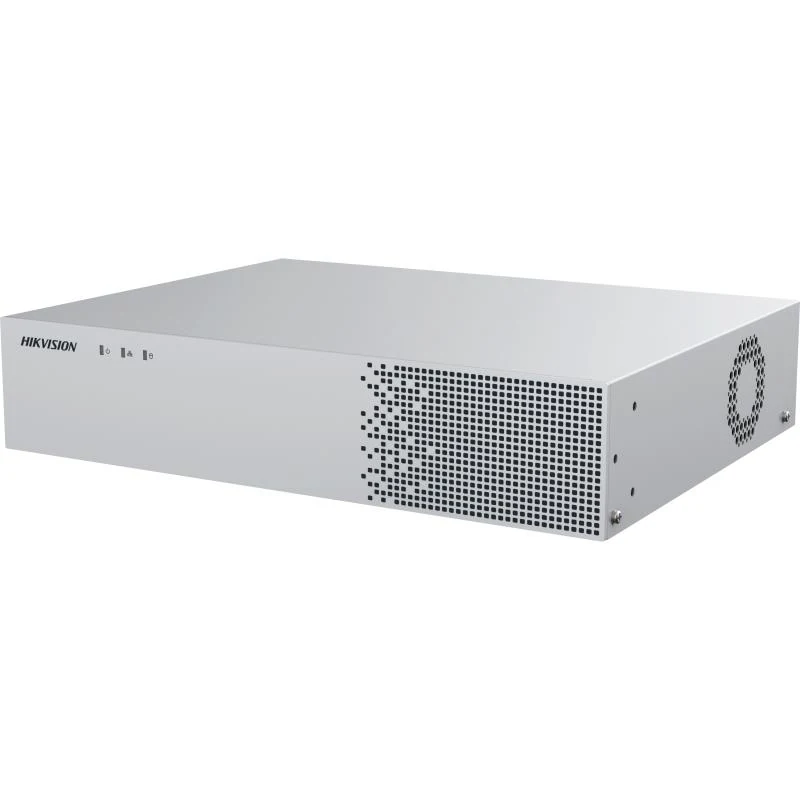
AI Network Video Recorders
Hikvision DeepinMind Edge compact recorders
Entry DeepinMind recorders from 8 to 32 channels, one or two AI engines and up to four drive bays, in desktop, 1U and 1.5U chassis.
Capabilities below are vendor-documented. We have not tested this device or its integrations.
Sources checked:
Also known as: iDS-6700NXI-M1, iDS-7600NXI-M2, iDS-7700NXI-M4
Suitable projects
- A single site with 8 to 32 cameras where face lists or perimeter rules have to run on the recorder.
- Branch offices that need a rack unit with two or four drives rather than a desktop box.
- PoE deployments, where the 8P and 16P variants remove the separate switch.
Before you buy
- The 8 and 16 channel M1 units carry a footnote limiting 32 MP input to 8 channels; the M2 and M4 datasheets do not repeat it, so the limit is undocumented there.
- One engine on the M2 family means one algorithm on the recorder at a time, whatever the channel count.
- Certification differs inside the family: the M1 sheet lists five marks without FCC, the M2 and M4 sheets list thirteen including FCC and UL.
Official resources
- iDS-6708NXI-M1/X datasheet, September 2026
- iDS-6716NXI-M1/X datasheet, September 2026
- iDS-7616NXI-M2/X datasheet, September 2026
- iDS-7732NXI-M4/X datasheet, September 2026
- Network Video Recorder user manual, firmware V5.05.650
- Device Network SDK (HCNetSDK) V6.1.11.40, Windows 64-bit
- Device Network SDK (HCNetSDK) V6.1.11.40, Linux 64-bit
- WebSDK V3.3.1, browser-side live view and playback
Related guides
- Channels
- 8 to 32 IP channels
- AI engines
- 1 on the 8 channel M1 and the M2 family, 2 on the 16 channel M1 and the M4 family
- Drive bays
- 1 SATA on M1, 2 on M2, 4 on M4
- HDD ceiling
- Up to 20 TB per drive
- Bandwidth
- 128 to 320 Mbps in, up to 400 Mbps out
- Decoding
- 2 channels at 32 MP down to 32 channels at 2 MP
- Chassis
- 319 x 243 x 65 mm desktop, 385 x 315 x 52 mm 1U, 445 x 400 x 71 mm 1.5U
- Power
- 50 W or less without drives
- Working temperature
- -10 to 55 C
- Interfaces
- ONVIF profile S and G, SDK, ISAPI, RTSP, 1 or 2 gigabit RJ-45
Choosing a compact DeepinMind recorder
This profile is based on official documentation, not our own device testing.
What the series is
Seven model numbers cover the entry end of the DeepinMind range: the 67xx family with one drive bay, the 76xx family with two bays in a 1U chassis, and the 77xx family with four bays in a 1.5U chassis. All of them run the analytics on the recorder itself, and all of them expose the same interface: ONVIF profile S and G, the Hikvision SDK, ISAPI and RTSP.
The family is where the difference between channels and engines first bites. Read the table by column, not by model name.
| Model | Channels | Engines | Bays | Bandwidth in and out | Chassis |
|---|---|---|---|---|---|
| iDS-6708NXI-M1/X | 8 | 1 | 1 | 128 / 256 Mbps | 319 x 243 x 65 mm |
| iDS-6716NXI-M1/X | 16 | 2 | 1 | 256 / 256 Mbps | 319 x 243 x 65 mm |
| iDS-7608NXI-M2/X | 8 | 1 | 2 | 128 / 256 Mbps | 385 x 315 x 52 mm |
| iDS-7616NXI-M2/X | 16 | 1 | 2 | 256 / 256 Mbps | 385 x 315 x 52 mm |
| iDS-7632NXI-M2/X | 32 | 1 | 2 | 320 / 400 Mbps | 385 x 315 x 52 mm |
| iDS-7716NXI-M4/X | 16 | 2 | 4 | 256 / 256 Mbps | 445 x 400 x 71 mm |
| iDS-7732NXI-M4/X | 32 | 2 | 4 | 320 / 400 Mbps | 445 x 400 x 71 mm |
Two rows in that table are easy to misread. The 16 channel M1 has two engines while the 32 channel M2 has one. If the requirement is two algorithms at once on a small camera count, the smaller model is the stronger one. And the 32 channel M2 carries a single engine, so its channel count buys recording capacity, not analytics capacity.
Two decisions, in this order
First, decide whether the box has to run more than one algorithm. One engine runs one algorithm; the mode is a configuration choice, not a licence that adds hardware. A site that wants perimeter protection and face comparison together needs two engines, which means the M1 at 16 channels or the M4 at 16 and 32 channels.
Second, decide retention. Every model in the family accepts drives up to 20 TB, so a four bay unit holds 80 TB raw before RAID and a two bay unit holds 40 TB. At 4 Mbps per camera and 16 cameras, one day of recording is about 0.7 TB, which puts 40 TB at roughly 58 days and 80 TB at roughly 116 days. That is arithmetic on the datasheet numbers at a stated bitrate, not a measurement, and H.265+ will stretch both figures.
Where the limits are
The 8 and 16 channel M1 sheets state that 32 MP or 24 MP input is limited to eight channels. On an 8 channel model that means every channel; on a 16 channel model it means half. The M2 and M4 sheets do not repeat the qualifier, so a 32 channel M2 has no documented per channel resolution limit, only a headline figure.
Certification is not uniform. The M1 sheets list five marks, CE, CB, REACH, WEEE and UKCA, with no FCC. The M2 and M4 sheets list thirteen, adding FCC, IC, KC, UL, RCM, BSI and LOA. A tender that requires FCC has to move up one family, or the vendor has to supply a declaration that the datasheet does not.
Pick this series when
- The site has 32 cameras or fewer and the analytics can live on the recorder.
- A single algorithm is enough, or the box is the 16 channel M1 or an M4.
- There is no rack, and a desktop chassis at 319 mm wide is acceptable.
Do not pick it when
- Two algorithms are needed on 32 channels, which needs an M8 or larger.
- The project needs 24 drives, a screen on the front, or redundant power.
- Every channel has to run large model analytics, which is the H series rather than this one.
What we could not verify
We did not test inference throughput, false alarm rates or drive compatibility. The retention figures above are arithmetic. Hikvision does not publish a price for these models on the product pages, so none is listed here.
Getting a compact DeepinMind recorder running
This is a bring-up sequence drawn from the Hikvision NVR user manual for firmware V5.05.650, the quick start guide and the product communication matrix. We did not run these steps on a device.
Before you power it on
Fit the drives first. The manual states that a newly installed hard disk must be initialized before use, and the initialization is a format, so any data on a used drive is lost.
Check the bay count against the model: one bay on the 67xx, two on the 76xx, four on the 77xx. All three accept 3.5 inch drives up to 20 TB.
Activate the recorder
No operation is allowed before activation. On first access you set an admin password, and the quick start guide gives three routes: the web browser, SADP, or the client software. The same screen offers a reserved email, a Hik-Connect binding, security questions and an export of the GUID for password recovery.
Record the password somewhere outside the device. Password recovery depends on the email or the GUID you set here, and neither can be added later from a locked-out state.
Find it on the network
SADP listens on UDP 37020 and will list the recorder before it has an address you know. The communication matrix gives the rest of the surface:
| Service | Port |
|---|---|
| Web | TCP 80, enabled by default |
| Web over TLS | TCP 443, TLS 1.1 and 1.2, not enabled by default |
| SDK | TCP 8000, or 8443 over TLS |
| RTSP | TCP 554 |
| ONVIF discovery | UDP 3702 |
| SADP | UDP 37020 |
Turn on HTTPS before the recorder leaves the bench. In the matrix the TLS web row is the one marked as not enabled by default, and the plain row is the one that is on.
Add the cameras
The recorder accepts cameras over ONVIF profile S and G, over RTSP, and over the Hikvision protocol on port 8000. On the 8P and 16P variants the PoE ports put the camera on the same switch as the recorder, so the camera appears in the device list without an address change.
Allocate an engine
This is the step that separates a DeepinMind from a plain NVR. Engine allocation sits under System, Smart Settings, and there is a separate Engine Status page that shows what each engine is doing. The manual is explicit that at least one engine has to run perimeter protection before that feature works.
If the box has one engine, only one algorithm runs. Choose it deliberately rather than leaving the default.
Before you hand it over
Change the admin password, enable HTTPS, set the time source, and confirm the drive is initialized and the recording schedule covers every channel. Check the certification list on the datasheet for the exact model, because it is not the same across the family.
What the manual does not answer
The manual never mentions GB28181 by name. The communication matrix lists a National Standard service on TCP 5061, the port GB/T 28181 platforms normally register on, but no document we read describes the registration procedure. If a platform connection is in scope, ask the vendor for the integration note rather than inferring it from the port list.
For what the Device Network SDK archive contains, which switches have to be enabled, and which interfaces it documents for this family, read Hikvision DeepinMind integration.
FAQ — Hikvision DeepinMind compact recorders
Does M1 mean one channel?
No. M1 is the drive bay count, one bay. iDS-6708NXI-M1/X is an eight channel recorder with one bay, and iDS-6716NXI-M1/X is a sixteen channel recorder with the same single bay. Reading the M number as channels gives the wrong answer on every model in the family.
Which compact models can run two algorithms at once?
iDS-6716NXI-M1/X, iDS-7716NXI-M4/X and iDS-7732NXI-M4/X each carry two engines. The other four models carry one. Two algorithms at once is a hardware requirement, so a site that wants perimeter protection and face comparison together has to pick from those three.
The 32 channel M2 lists one engine. Is that a datasheet error?
It is what the sheet says, and the same pattern appears on the 16 channel M2. On those models the channel count buys recording capacity rather than analytics capacity. A 32 channel M2 with one engine can run one algorithm across its channels, not two.
How many face channels does one engine give?
Eight on video stream, and the ratio holds across the family: eight channels on the single engine iDS-6708NXI-M1/X, sixteen on the two engine M4 models. Picture comparison is a separate figure and varies by model, sixteen channels on iDS-7716NXI-M4/X against thirty two on iDS-7732NXI-M4/X.
Do these recorders support the large model?
Yes, for perimeter protection. Every compact sheet lists two rows, with and without the large model, and the large model halves the capacity. On the single engine iDS-6708NXI-M1/X the row runs from 8 channels at 4 MP to 4, and on iDS-7616NXI-M2/X from 12 channels at 2 MP to 6. What the compact line does not offer is full channel large model coverage, which the H series provides.
Can the compact line take 20 TB drives?
Yes. Every model in the family accepts drives up to 20 TB, which puts a four bay unit at 80 TB raw before RAID and a two bay unit at 40 TB.
How long will sixteen cameras record on a compact unit?
At 4 Mbps per camera the load is about 0.7 TB per day. A two bay unit at 40 TB holds roughly 58 days and a four bay unit at 80 TB holds roughly 116 days. That is arithmetic on the datasheet capacity, not a measurement, and H.265+ will stretch both figures.
Is FCC on the datasheet?
It depends on the model. The M1 sheets list five marks, CE, CB, REACH, WEEE and UKCA. The M2 and M4 sheets list thirteen, which adds FCC, IC, KC, UL, RCM, BSI and LOA. A tender that requires FCC cannot use the M1 models without a separate declaration.