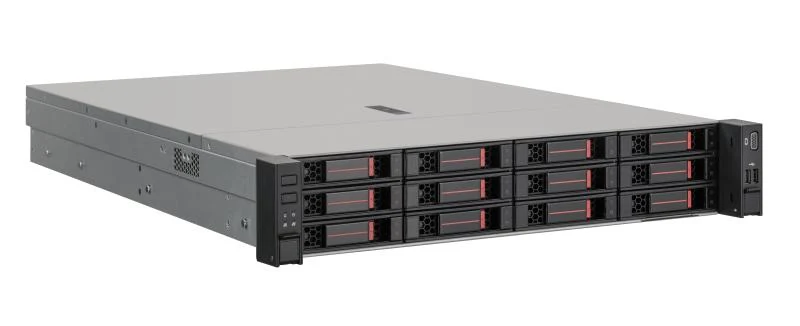
AI Network Video Recorders
Hikvision DeepinMind Central AI servers
Seventeen servers in four families: full analysis, abnormal event detection, fusion with text search, and model comparison.
Capabilities below are vendor-documented. We have not tested this device or its integrations.
Sources checked:
Also known as: DeepinMind server, Full Analysis Server, Abnormal Event Analysis Server, Intelligent Fusion Server, Intelligent Fusion Server Ultra, Model Comparison Server, AIOP server
Suitable projects
- A city or campus deployment where recorders should only record and search runs centrally.
- Investigations across many recorders that need one picture library instead of one per box.
- Projects that need event detection, such as falls or crowds, without buying it per camera.
- Sites that need search by written description or by voice, which starts at the DS-IX2128.
Before you buy
- The model number does not encode channel count consistently: DS-IE1016 is 64 channels while DS-IE1032 is 32, and DS-IX2001 carries one accelerator card rather than 2001 channels.
- The working range is 5 to 35 C on the fusion models, an office environment, which is narrower than any recorder in the family.
- The DS-IX2001 and DS-IX2003 documents are marked as sample units in their own file names, so treat their figures as provisional.
- The DS-IM2006 datasheet returns an access error on the public download path, so its numbers come from the product page.
- AcuSeek consumes one engine for video structuralisation, which is a quarter of the capacity on the DS-IX2128 and a sixth on the DS-IX2256.
Official resources
- DS-IX2001-A7U/LX datasheet, March 2026, sample unit file
- DS-IX2256-C1U/XP datasheet, July 2026
- DS-IE1016-A7U/BA(H10) datasheet, November 2024
- DS-IE1032-A7U/BA(H10) datasheet, March 2025
- DS-IE2016-SU/BA-K2 datasheet, September 2026
- Device Network SDK (HCNetSDK) V6.1.11.40, Windows 64-bit
- Device Network SDK (HCNetSDK) V6.1.11.40, Linux 64-bit
- WebSDK V3.3.1, browser-side live view and playback
- DeepinMind Central AI Server product pages, 17 models
Related guides
- Roles in the range
- Full analysis on DS-IF, event detection on DS-IE, fusion and search on DS-IX, model comparison on DS-IM
- Model count
- 17 models: 5 DS-IF, 6 DS-IE, 5 DS-IX, 1 DS-IM
- Concurrent video
- 32 channels on DS-IX2001, 128 on DS-IX2128, 256 on DS-IX2256, 64 on DS-IE1016 and DS-IE1064
- Picture throughput
- 128 faces per second on DS-IX2001, 384 on DS-IX2003, 256 pictures per second on the DS-IE10xx series
- Text search
- AcuSeek on DS-IX2128 at 3 million targets per day and on DS-IX2256 at 6 million; no AcuSeek below the Ultra models
- Text-defined alert
- 30 channels on DS-IX2128, 60 on DS-IX2256, 1000 groups either way
- Model slots
- 64 AI models and 141 TOPS per GPU card on the DS-IE20xx series, AIMMS 1.12.0
- Library size
- 3 million arming entries on DS-IX2001, 40 million across 1024 lists on DS-IM2006
- Clustering
- Up to 5 nodes on DS-IX2001, DS-IX2002 and DS-IX2003, single node on DS-IE10xx
- Compute
- 1 to 3 KT2 cards on DS-IX200x, H12 plus 4 to 5 L2 cards on the Ultra models, 6 L2 on DS-IM2006
- Working temperature
- 5 to 35 C on DS-IX2001
Choosing a DeepinMind Central AI server
Seventeen models, four prefixes and four different jobs. The digits in the model number do not decode the same way in every series.
This profile is based on official documentation, not our own device testing.
Four prefixes, four products
The central range is not one server with options. Each prefix is a separate product with its own name on the page, and the datasheets do not present them as alternatives to each other.
| Prefix | Product name | Job | Models |
|---|---|---|---|
| DS-IF | Full Analysis Server | Faces, vehicles and video structuralisation on live channels | 5 |
| DS-IE | Abnormal Event Analysis Server | Behaviour and event detection, and AI Open Platform model packages | 6 |
| DS-IX | Intelligent Fusion Server, and Ultra | Analysis, storage and search in one unit | 5 |
| DS-IM | Model Comparison Server | Comparison against very large face libraries | 1 |
Seventeen model numbers in total. The rest of this page is what separates them, and where the documentation makes that harder than it should be.
The numbering does not run in one direction
The first thing to unlearn is the assumption that a bigger number means more channels. It holds in some series and fails in others.
| Series | Rule the numbers follow | Evidence |
|---|---|---|
| DS-IF10xx | Digits track channels | IF1032 is 32 channels at 2 MP, IF1064 is 64 |
| DS-IE10xx | Digits do not track channels | IE1016 is 64 channels, IE1032 is 32, IE1064 is 64 |
| DS-IE20xx | Digits track channels, suffix tracks cards | IE2016 with a K2 suffix carries 2 GPU cards, IE2064 with K6 carries 6 |
| DS-IX200x | Digits are the accelerator card count | IX2001 has one KT2, IX2002 has two, IX2003 has three |
| DS-IX2x28 and 2x56 | Digits are channels | IX2128 is 128 channels, IX2256 is 256 |
An IE1016 and an IE1064 have the same headline capacity, 64 channels of video analysis at 256 pictures per second, and both are single node appliances. The difference is in the event list each one is documented for, not in throughput. A buyer who orders by model number alone can therefore pay for capacity that does not exist, or skip a model that would have been enough.
The seventeen, grouped by what they do
Reading the datasheets, five groups emerge.
| Group | Models | 2 MP video channels | Accelerator | Notable figure |
|---|---|---|---|---|
| Face and vehicle analysis | DS-IF1032-03U/X-07 | 32 | 6 KT2 | 160 pictures per second |
| DS-IF1064-03U/X-07 | 64 | 8 KT2 | 320 pictures per second | |
| DS-IF1064-03U/X-A7 | 64 | 2 KT2 | same channels as the 8 card build | |
| DS-IF2004-C1U/X | picture analysis only | 4 L2 | 240 images per second modelling | |
| DS-IF2006-C1U/X | picture analysis only | 6 L2 | higher modelling throughput | |
| Behaviour analysis, first generation | DS-IE1016-A7U/BA(H10) | 64 | H10 platform | 256 pictures per second, ISAPI |
| DS-IE1032-A7U/BA(H10) | 32 | H10 platform | same picture rate | |
| DS-IE1064-A7U/BA(H10) | 64 | H10 platform | same picture rate | |
| Behaviour analysis, AI Open Platform | DS-IE2016-SU/BA/K2 | 30 to 40 | 2 GPU, 6 chips | 64 model slots, 141 TOPS per card |
| DS-IE2032-SU/BA/K4 | scaled with cards | 4 GPU, 12 chips | 80 channel scheduled capture | |
| DS-IE2064-SU/BA/K6 | scaled with cards | 6 GPU, 18 chips | same platform, more cards | |
| Fusion and search | DS-IX2001-A7U/LX/B | 32 | 1 KT2 | cluster of up to 5 nodes |
| DS-IX2002-A7U/LX/B | 64 | 2 KT2 | 256 pictures per second | |
| DS-IX2003-A7U/LX/B | 96 | 3 KT2 | 384 pictures per second | |
| DS-IX2128-C1U/XP | 128 | H12 plus 4 L2 | AcuSeek at 3 million targets per day | |
| DS-IX2256-C1U/XP | 256 | 2 H12 plus 5 L2 | AcuSeek at 6 million targets per day | |
| Model comparison | DS-IM2006-C1U | not applicable | 6 L2 | 40 million entries in 1024 lists |
Two entries in that table need a note. The IF1064 exists in two builds, one with eight KT2 cards and one with two, and both pages claim 64 channels and 320 pictures per second. Either the later platform is four times more efficient per card, or one of the two pages is stale. We could not resolve it from public material, so treat the card count as the figure to confirm on a quotation.
The IE10xx family does not list GPU cards at all. Its pages describe an H10 processing platform, a 480 GB SSD, a 1U chassis and ISAPI as the protocol. It is a closed appliance, not a card-based server.
IE20xx is an AI Open Platform server, not a bigger IE10xx
The three IE20xx models are the ones most easily mistaken for the older series. They are a different product. Each carries 64 model slots, runs AIMMS 1.12.0, and exposes picture and video analysis through the AI Open Platform rather than a fixed behaviour list. The GPU specification is quoted per card: 141 TOPS at INT8 and 48 GB of memory, multiplied by two, four or six cards.
The scheduling detail is the most useful number on those pages: 80 channels of scheduled capture analysis per device, with capture intervals from one to 3600 seconds. That is a different workload from live video analysis, and it is the reason an AI Open Platform server can sit next to a recorder instead of replacing it.
Only two models carry AcuSeek
Search on the central range starts at the Ultra models. The IX2128 and IX2256 are the only two servers whose datasheets list AcuSeek, at 3 and 6 million targets per day respectively, and both carry the Text-Defined Alert feature that turns a written sentence into an alarm rule: 30 channels on the IX2128, 60 on the IX2256, with 1000 groups either way.
There is a constraint inside the constraint. The engine table on both models states that using AcuSeek requires one engine to be given to video structuralisation. Since the IX2128 has four engines and the IX2256 has six, the search capability is bought at the price of a quarter or a sixth of the analysis capacity. That sentence appears in a single cell of a specification table and is the kind of line that changes a bill of materials.
The older IX2001, IX2002 and IX2003 have no AcuSeek at all. They search by face picture, not by text, with a two second response across 18 million records.
Clustering is not uniform
The IX2001, IX2002 and IX2003 are documented for a cluster of up to five nodes. The IE10xx models state a cluster capacity of one, and the IE20xx pages do not mention clustering. If horizontal scale is in the plan, the choice is effectively made for you: the fusion series scales, the behaviour series does not.
The physical reality
These are servers, not recorders. DS-IX2001 works from 5 to 35 °C, which is an office environment; every recorder in the family is rated to at least 50 °C. DS-IM2006 carries two 24 core processors, 768 GB of memory, six GPUs and a 1400 W redundant supply. The IE20xx models sit in a 2U chassis with a 1+1 800 W supply and draw up to 700 W before drives. None of them belongs in an unventilated cabinet on a factory floor.
Pick this series when
- Recorders should record and the analytics should live centrally, across many sites.
- One picture library has to cover dozens of recorders rather than one per box.
- Behaviour detection is the requirement, which is the IE family rather than a recorder engine, and the AI Open Platform variant when the event list has to be extended with model packages.
- Text search over existing footage is the requirement, which is the IX2128 or the IX2256 and nothing below them.
- The library is in the millions, where the IM2006 replaces search with comparison.
Do not pick it when
- The site is a single building with 32 cameras, where a recorder with engines is cheaper and simpler.
- The room is not air conditioned to office standards.
- The requirement is live alarm on a handful of channels, which the edge models do at 60 W.
What we could not verify
The DS-IX2001 and DS-IX2003 datasheets are labelled as sample units in their file names, so their figures should be treated as provisional until a production document is supplied. The DS-IM2006 datasheet returns an access error on the public download path, so its numbers come from the product page rather than the PDF. The IF10xx pages have no datasheet link at all, and the IF1032 and IF1064 figures above come from their specification pages.
No installation manual was read for any of these servers, so this page describes capability rather than commissioning steps. Prices are not published.
Integrating a DeepinMind Central AI server
This note is built from the three datasheets and the product communication matrix. We did not read a server installation manual and we did not run these steps on hardware, so it covers the interfaces and the prerequisites rather than a click by click sequence.
Check the room first
The working range on DS-IX2001 is 5 to 35 °C, and the datasheet gives 8 to 90 percent humidity without condensation. That is an office specification. A server room that already runs at 30 °C in summer has 5 degrees of margin, and a factory cabinet has none.
DS-IM2006 takes two power feeds at 1400 W each side of a 1+1 pair. DS-IX2001 draws 240 W rated and 261 W maximum. Size the UPS for the maximum, not the rated figure.
Confirm what the appliance actually is
The three models are not interchangeable and they do not share an interface.
DS-IX2001 exposes a web application for search, list alarm, person archives, body search and vehicle search. Its datasheet does not list ISAPI.
DS-IE1016 lists ISAPI explicitly, together with AIMMS 1.12.0 as the management software version. If the integration plan is API driven, this is the model whose documentation names an API.
DS-IM2006 is a comparison engine with its own operating system, Open Euler 2203, and its datasheet describes functions rather than an API. Treat it as an appliance with its own console until the vendor supplies an integration note.
Plan the library before the hardware
Throughput on DS-IM2006 depends on library size: 120 comparisons per second at ten million entries, 100 at twenty, 90 at thirty and 70 at forty. Design the list structure first, because a single list of forty million entries runs at two thirds the speed of a ten million list on the same hardware.
On DS-IX2001 the limits are different: three million arming entries across 128 list libraries, ten million hot pictures plus thirty million cold. Picture size and resolution requirements are stated in the datasheet, including a 48 by 48 pixel minimum and a 10 MB maximum per picture.
Clustering
DS-IX2001 supports a cluster of up to five devices, with load balancing, dynamic addition and failover. DS-IE1016 lists a cluster capacity of one, so it does not scale horizontally. If the plan assumes three event detection nodes behind one address, that assumption does not come from the datasheet.
Video import
Both analysis appliances accept imported files as well as live streams. DS-IX2001 takes single videos up to 10 GB and 100 GB total, at up to 40 times accelerated analysis, in TS, MP4, AVI, ASF, PS, MBF and several vendor formats. DS-IE1016 takes the same 10 GB per file and 100 GB total, and it lists scheduled capture analysis of up to 16 tasks, each linked to 16 channels in rotation.
That is the feature to test before a project commits: imported footage is where format support either works or does not.
Before you go live
Confirm the firmware and management software versions in writing, confirm the certification position, since none of the three datasheets carries an Obtained Certification row, and run one search and one comparison against a known picture. The datasheets give response times of about two seconds for search; verify them on the actual library.
What we could not verify
We did not read a server installation manual, so the commissioning sequence, the default credentials, the network topology of a cluster and the backup procedure are all outside what this note can support. They have to come from the vendor.
For what the SDK archive documents about the AI Open Platform interface, which these servers share with it, read Hikvision DeepinMind integration.
FAQ — Hikvision DeepinMind central servers
Are these recorders?
No. The three models are servers with different jobs: DS-IX2001 analyses and stores pictures, DS-IM2006 compares face models against a large library, and DS-IE1016 detects events. None of them records camera streams the way an NVR does.
What does DS-IX2001 do?
It is an intelligent fusion server with a professional GPU card that combines facial analysis, picture structuralisation and video structuralisation with storage and application. One device handles up to 32 channels of 1080P concurrent analysis, up to 128 face pictures per second, and up to 40 million pictures and records.
What does DS-IM2006 do?
It is the model comparison server, built on a GPU architecture for what the sheet calls high concurrency processing. The library holds 40 million records across 1024 list libraries, and comparison speed falls as the library grows: 120 comparisons per second at 10 million, 100 at 20 million, 90 at 30 million and 70 at 40 million.
What does DS-IE1016 do?
It detects events rather than faces. The sheet lists perimeter events such as line crossing and intrusion, street events such as fast moving and people gathering, indoor events such as falling and phone use, and trend analysis such as people density. It also runs algorithms trained on the AI open platform, such as object detection and image classification.
Can these servers be clustered?
DS-IX2001 supports cluster deployment for load balancing, dynamic adding and failover, and the sheet states a maximum of five devices under cluster mode. The other two sheets do not describe clustering.
Why is the working temperature only 5 to 35 °C?
Because these are servers, not hardened appliances. DS-IX2001 gives 5 to 35 °C, which is an office or data room environment. Placing one in a cabinet beside a roller shutter door, where a recorder rated to -10 °C would be fine, is outside the stated range.
Is the DS-IX2001 data final?
Treat it as provisional. The datasheet file name carries the Chinese word for prototype, 样机, and the figures above come from that document. Confirm the capacity figures against the released specification before designing a project around them.
Do these servers replace an NVR?
No. They take analytics off the recorder, they do not remove the need to record. A typical design keeps the NVR for streams and retention and adds a server for search, comparison or event detection across many cameras. The DS-IX2001 does provide storage for its own pictures and data, but that is not a substitute for video retention.