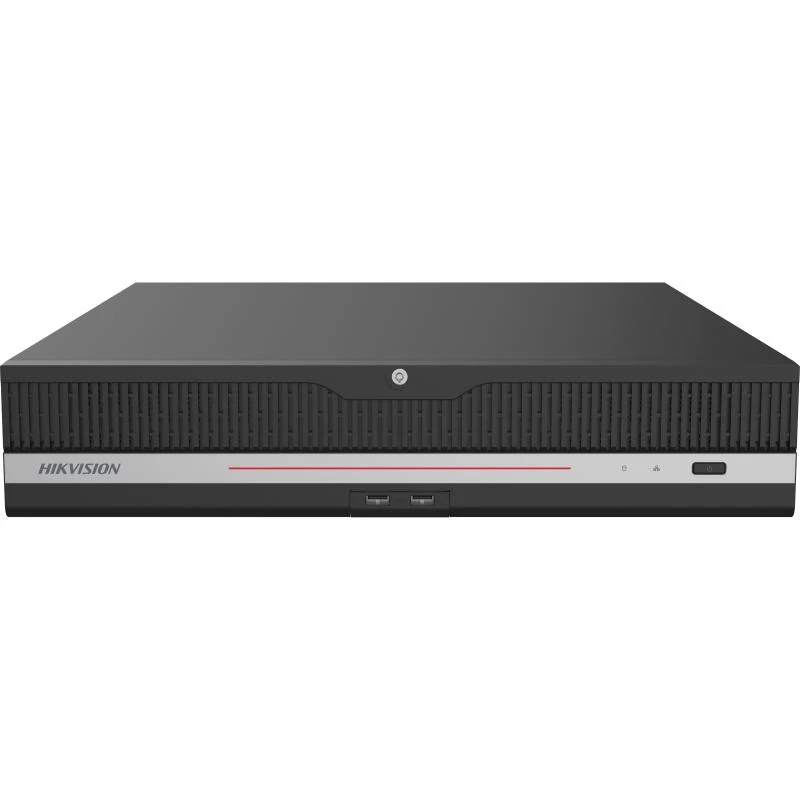
AI Network Video Recorders
Hikvision DeepinMind AIOP (AF series)
AIOP models count their AI capacity in KT5 chips split between small and large models, from two chips in a one bay box to 24 in a 256 channel unit.
Capabilities below are vendor-documented. We have not tested this device or its integrations.
Sources checked:
Also known as: DeepinMind AIOP, AIOP NVR, AIOP NVS, Fusion AI recorder
Suitable projects
- Sites that need large model analysis on the recorder rather than in a central server.
- Behaviour and compliance rules that a single algorithm engine cannot cover at once.
- Deployments that want the AI capacity stated as hardware, so it can be sized before the order.
Before you buy
- The AF datasheets carry no certification row at all, so the approval list has to be requested.
- The KT5 split is a factory default, and the datasheet does not state whether the small and large model pools can be reassigned.
- Power climbs steeply with chip count, from 60 W to 680 W, and the S24R range stops at 50 C rather than 55 C.
- The SDK archive carries the AI Open Platform developer guide but no sample code for it, so there is no reference implementation to start from.
Official resources
- iDS-6716NXI-M1/AF datasheet, July 2026
- iDS-9632NXI-M8/AF datasheet, July 2026
- iDS-96128NXI-S24R/AF datasheet, July 2026
- iDS-96256NXI-S24R/AF datasheet, July 2026
- Device Network SDK (HCNetSDK) V6.1.11.40, Windows 64-bit
- Device Network SDK (HCNetSDK) V6.1.11.40, Linux 64-bit
- WebSDK V3.3.1, browser-side live view and playback
Related guides
- Hikvision DeepinMind (AI super brain): four tiers and how to read the model code
- Hikvision DeepinMind integration: what the SDK package actually contains
- Hikvision AI Open Platform API: model, engine, task, event
- Hikvision HCNetSDK: login, streaming and arming
- Hikvision ISAPI: the 287 URIs and 340 messages behind DeepinMind
- Hikvision integration paths: SDK, ISAPI, AIOP and HEOP
- Channels
- 16 to 256 IP channels
- AI hardware
- 2 to 24 KT5 chips, split between small model and large model analysis, with one large model chip per three chips
- Algorithms per chip
- 4 small models at once, or 1 large model
- Live analysis per chip
- 8 channels at 4 MP, or 4 at 8 MP
- Scheduled and auto switch
- 16 channels per chip, switch interval 10 to 3600 seconds
- Offline pictures per chip
- 4 per second, 1 per second while the large model is loaded
- Drive bays
- 1 plus a built-in 2 TB disk, 8 or 24 SATA
- HDD ceiling
- 16 TB on the M1, 20 TB on M8 and S24R
- RAID
- 0, 1, 5, 6 and 10 from M8 upward
- Bandwidth
- 256 to 1280 Mbps in, 768 Mbps out
- Decoding
- 1 channel at 32 MP down to 32 channels at 1080p
- Power
- 60 W on M1 and M8, 420 W on S24R with 128 channels, 680 W on S24R with 256
- Working temperature
- -10 to 50 C
- Developer interface
- 42 ISAPI request URIs under /ISAPI/Intelligent/AIOpenPlatform, JSON over HTTP, with model packages bindable to a named engine
Choosing a DeepinMind AIOP recorder
This profile is based on official documentation, not our own device testing.
What the series is
The AF models are the only ones in the family whose AI capacity is stated as a chip count rather than an engine count. The datasheet names the chip KT5 and splits the count between small model analysis, which is the default, and large model analysis. The wording on all four sheets is the same: a stated number of chips go to small models as default, a third of the count is reserved for large model secondary analysis, and each chip runs four small models at once or one large model.
| Model | Channels | Bays | KT5 chips | Split | Bandwidth in and out |
|---|---|---|---|---|---|
| iDS-6716NXI-M1/AF | 16 | 1 plus a built-in 2 TB disk | 2 | 1 small, 1 large | 256 / 256 Mbps |
| iDS-9632NXI-M8/AF | 32 | 8 | 3 | 2 small, 1 large | 320 / 256 Mbps |
| iDS-96128NXI-S24R/AF | 128 | 24 | 12 | 8 small, 4 large | 1280 / 768 Mbps |
| iDS-96256NXI-S24R/AF | 256 | 24 | 24 | 16 small, 8 large | 1280 / 768 Mbps |
What one chip carries
The per chip figures repeat across all four sheets, so they can be planned with even though the chip itself is undocumented.
| Workload | Per chip |
|---|---|
| Live video analysis | 8 channels at 4 MP, or 4 at 8 MP |
| Auto switch analysis | 16 channels, switch interval 10 to 3600 seconds |
| Scheduled capture analysis | 16 channels, switch interval 3 to 3600 seconds |
| Offline picture analysis | 4 pictures per second, or 1 per second with the large model |
| Simultaneous algorithms | 4 small models, or 1 large model |
The last two rows are the ones that decide a design. One chip running four small models is four times the throughput of the same chip running one large model, so the large model share is not just a different algorithm, it is a quarter of the picture throughput. The S24R sheets put the large model share at a third of the chips, which is why the split on those models is eight and four rather than eight and eight.
The sizing rule
The four rows follow one arithmetic. Small model chips are one per sixteen channels: 16 channels take one, 32 take two, 128 take eight, 256 take sixteen. Large model chips are half that, rounded up to at least one. The result is two, three, twelve and twenty four chips.
That rule is useful because it lets you size a box before a quote: decide how many channels need large model analysis, divide by sixteen, and halve it. What the datasheet does not say is whether the split can be changed in the field. It calls the small model share the default, which implies the pools are configured in software, but no document we read describes the setting.
Power and heat
Chip count drives the power figure harder than anything else in the family. The one bay unit draws 60 W, the eight bay unit also draws 60 W, and then the 24 bay models jump to 420 W at twelve chips and 680 W at twenty four. Those are without drives, and a fully populated 24 bay chassis adds a few hundred watts of spinning disks on top.
The working range is -10 to 50 °C on the S24R models, five degrees narrower at the top than a mainstream M series recorder. A cabinet that already runs warm in summer has less headroom here.
How a platform integrates with it
The AF series is the only family in the range whose analytics have a published developer interface. The Device Network SDK archive carries a 243 page document called Device Network SDK (AI Open Platform) Developer Guide, and it lists 42 request URIs on the recorder, all under /ISAPI/Intelligent/AIOpenPlatform.
Three things in that guide change how a project is planned.
The engine is addressable. A platform can list engines, read one back, reset it, and bind a model package to it by name. The two chips on the 6716 are therefore two objects a platform can see, not an internal detail hidden behind a channel count.
The interface is HTTP carrying JSON, not a binary call. Every URI ends in ?format=json, and the SDK only transports it through one generic function. A platform that already speaks HTTP with Digest auth can reach these URIs without linking the SDK; the SDK is needed for the alarm push channel and for streaming.
Capacity varies with firmware, and the device says so itself. Before building against the URI table, read /ISAPI/Intelligent/AIOpenPlatform/capabilities, which returns a set of optional booleans describing what this unit and this firmware support.
What the archive does not contain is a sample. The C++ console demo covers alarm, capture, configuration, streaming, voice and playback in 16 files and never touches the AI Open Platform. The guide is documentation only, with no reference implementation beside it. The full ISAPI documents for the other analytics lines are released under a licence agreement and are not in the package.
Where the limits are
The AF datasheets carry no certification row at all. Not a short list, not a list without FCC: no row. For a tender that requires a declaration of conformity, the document to submit has to be requested from the vendor, because it is not in the datasheet.
The one bay model has a built-in 2 TB disk in addition to its single SATA bay, and caps drives at 16 TB rather than the 20 TB used elsewhere in the family. Check the wording before specifying a drive: 16 TB and 20 TB drives are not interchangeable in that slot.
Pick this series when
- Large model analysis has to run on the recorder rather than in a central server.
- Several algorithm types have to coexist, which a two engine unit cannot cover.
- The requirement can be expressed as channels per chip, so the hardware can be sized rather than discovered.
Do not pick it when
- The room runs above 50 °C or the cabinet has no thermal plan.
- The tender requires FCC in the datasheet itself.
- Two algorithms on 32 channels are enough, which an M8 does at 60 W rather than three chips.
What we could not verify
We did not test large model accuracy or the effect of the split on simultaneous algorithms. The split itself is documented, but the KT5 chip is not described anywhere in the documents we read, so we do not know its architecture, its memory or whether the small and large pools are physically separate chips or one pool with two modes. We also could not confirm whether a large model chip can be reassigned to small model work when the large model is not in use.
Getting a DeepinMind AIOP recorder running
This is a bring-up sequence drawn from the Hikvision NVR user manual for firmware V5.05.650, the quick start guide and the product communication matrix. We did not run these steps on a device.
Fit the drives
One bay plus a built-in 2 TB disk on the M1, eight bays on the M8, twenty four on the S24R. The manual states that a newly installed hard disk must be initialized before use, and the initialization is a format.
Watch the drive ceiling: 16 TB on the M1 and 20 TB on the other two. A 20 TB drive in the M1 slot is outside the stated capacity even though it fits physically.
Activate the recorder
No operation is allowed before activation. On first access you set an admin password, and the quick start guide gives three routes: the web browser, SADP, or the client software. The same screen offers a reserved email, a Hik-Connect binding, security questions and an export of the GUID for password recovery.
Record the password somewhere outside the device. Password recovery depends on the email or the GUID you set here, and neither can be added later from a locked-out state.
Find it on the network
SADP listens on UDP 37020 and will list the recorder before it has an address you know. The communication matrix gives the rest of the surface:
| Service | Port |
|---|---|
| Web | TCP 80, enabled by default |
| Web over TLS | TCP 443, TLS 1.1 and 1.2, not enabled by default |
| SDK | TCP 8000, or 8443 over TLS |
| RTSP | TCP 554 |
| ONVIF discovery | UDP 3702 |
| SADP | UDP 37020 |
Turn on HTTPS before the recorder leaves the bench. In the matrix the TLS web row is the one marked as not enabled by default, and the plain row is the one that is on.
Decide which channels get the large model
This is the setting that distinguishes an AF unit from an M unit, and it is the one we could not document. The datasheets give different channel counts with and without the large model on the M8, which proves the switch exists, but the V5.05.650 manual we read never uses the phrase large model, so we cannot describe the menu path or whether the split can be changed after commissioning.
Before the site goes live, confirm with the vendor which channels are on the large model pool, and record the answer. The alternative is discovering it during an incident.
Before you hand it over
Change the admin password, enable HTTPS, set the time source, confirm the array is healthy, and check the load. A 256 channel unit at 680 W without drives needs its own circuit, not a shared one.
Also obtain the certification declaration separately. The AF datasheets have no certification row, so there is nothing in the document to hand to an inspector.
What the manual does not answer
The manual never mentions GB28181 by name. The communication matrix lists a National Standard service on TCP 5061, the port GB/T 28181 platforms normally register on, but no document we read describes the registration procedure. If a platform connection is in scope, ask the vendor for the integration note rather than inferring it from the port list.
For the developer interface behind the AI Open Platform, including the 42 published request URIs and the channel number trap, read Hikvision DeepinMind integration.
For the order the calls have to run in, from a model package with an ID you choose through an engine binding to a task that has to be applied before it detects anything, read the AI Open Platform API guide.
For the login, the stream handle and the alarm channel that carry those results off the device, including the 2048 user ceiling and the three arming modes, read the HCNetSDK connection guide.
FAQ — Hikvision DeepinMind AIOP recorders
Why is AI capacity counted in chips instead of engines?
Because the AF series is built on KT5 chips and the datasheet states the count directly: two on iDS-6716NXI-M1/AF, three on iDS-9632NXI-M8/AF, twelve on the 128 channel S24R and twenty four on the 256 channel S24R. Every other family in the range counts engines or quotes fixed channel figures.
How is the chip count split between small and large models?
Two chips become one and one, three become two and one, twelve become eight and four, twenty four become sixteen and eight. The large model share is a third of the total, rounded up to at least one chip on the two smallest models.
Can one chip run several algorithms at once?
Four small models, or one large model. That is the trade the sheet describes, and it is not a soft limit: a chip loaded with the large model runs a single algorithm.
How much throughput does one chip give?
Eight live channels at 4 MP or four at 8 MP, sixteen channels of auto switch analysis, sixteen channels of scheduled capture analysis, and four offline pictures per second. With the large model loaded the offline figure drops to one picture per second.
Can the small and large model split be changed in the field?
The sheets call the small model share the default, which implies it is configurable, but no document we read describes the setting or says how much of the pool can be moved. Treat the printed split as the planning figure and ask the vendor before designing around a different one.
Why is there no certification row?
The AF datasheets have no approval list at all, not a short list and not a list without FCC. For a tender that requires a declaration of conformity, the document has to be requested from the vendor because it is not in the datasheet.
Why does the one bay model cap drives at 16 TB?
Because it carries a built-in 2 TB disk in addition to its single SATA bay, and that slot is specified to 16 TB rather than the 20 TB used elsewhere in the family. The two capacities are not interchangeable in that model.
Why does power climb so sharply with channel count?
It follows the chip count. The one bay and eight bay units draw 60 W, while the S24R models draw 420 W at twelve chips and 680 W at twenty four, all without drives. A fully populated 24 bay chassis adds several hundred watts of spinning disks on top, so size the circuit for the loaded figure.
Is there sample code for the AI features?
No. The SDK archive ships 17 developer guides and three demo trees, and the C++ console sample covers alarm, capture, configuration, streaming, voice and playback in 16 files. None of them call the AI Open Platform interface. The 243 page AI Open Platform guide is documentation with no reference implementation beside it.
Can we integrate without linking the SDK?
For configuration and task management, yes. The AI functions are HTTP requests carrying JSON under /ISAPI/Intelligent/AIOpenPlatform, and the SDK only transports them through one generic function. The SDK is still needed for alarm push and for streaming, because those use the proprietary protocol and the callback channel.
What has to be enabled before the interface answers?
ISAPI is off until it is enabled in the recorder interface, under System, System Settings, Network, Platform Access, ISAPI. The SDK service sits in the same menu and listens on port 8000, with 8443 for the TLS variant. Enabling ISUP in that menu disables Hik-Connect access automatically.
Does every AF model support every documented function?
No, and the device answers this itself. The capability endpoint at /ISAPI/Intelligent/AIOpenPlatform/capabilities returns optional booleans such as isSupportVideoTask, isSupportPictureTask and isSupportAITargetBP, and all of them are marked optional in the message definition. Read that endpoint per unit before assuming the full 42 URI set applies.
Which identifiers does our platform have to generate?
Three, and all three are 64 byte strings. A model package carries an MPID, a task carries a taskID, and a reference picture carries a PID. The guide states in each case that the value is managed by the platform, so the device stores what it is sent and passes it through unchanged. Nothing is generated for you, which means an ID that changes between the create call and the apply call makes a second object rather than editing the first.
Can the recorder fetch a model package itself?
Yes, when the capability flag isSupportUploadModelwithURL is set. The install message carries a URL of up to 256 bytes, and the guide states that the platform has to guarantee the URL is reachable and that authentication is carried inside the URL rather than in a header. The alternatives are pushing the package as binary packets, or uploading it through the SDK with type 52. Download progress is only reported for the URL route, at the progress endpoint keyed by MPID.
How do we know a task is actually running?
Two conditions. The engine it was applied to has to report status 1, meaning loaded and operating, and the apply response must not name your channel in the channelID array that lists the channels the task failed to start on. Creating a video task does not start it, because the engine and the channel list are only sent on the apply call, so a long task list is no evidence of detections.
What does engine status 12 mean?
That the engine has been claimed by a facial application and cannot run AI Open Platform work. It appears in the same status document as the ordinary states, and it is the interface level version of the split the datasheet describes in prose: part of the compute is reserved before a platform ever binds a model. A unit can answer every call correctly and still offer fewer engines than its chip or engine count suggests.
Can one model package be loaded by several engines?
Yes. The engine field in the stored package list is an array, and the guide notes that one package can be loaded by multiple engines. Raising capacity for a model that is already installed is therefore a binding operation rather than another upload, and a storage list showing one package is not evidence of one engine's worth of capacity.