Development Boards
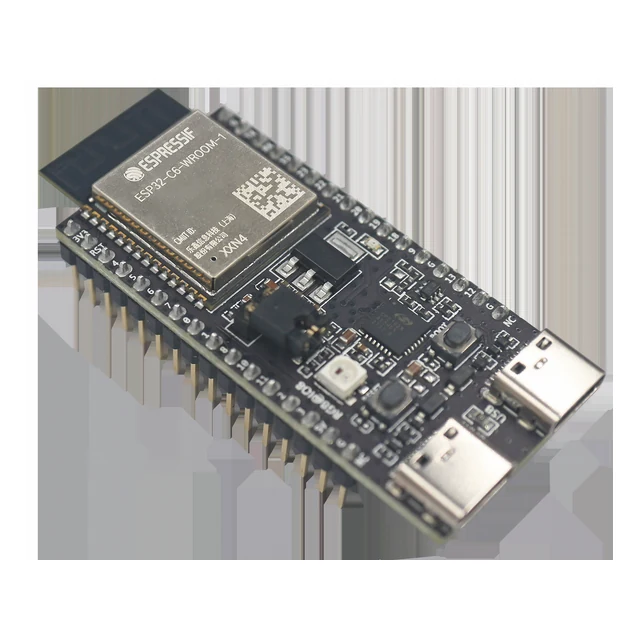
Espressif ESP32-C6-DevKitC-1
Entry-level ESP32-C6 board with Wi-Fi 6, Bluetooth LE and 802.15.4 for Zigbee and Thread builds.
Capabilities below are vendor-documented. We have not tested this device or its integrations.
Sources checked:
Suitable projects
- Thread and Zigbee end devices or border-router work.
- Matter prototypes that need Wi-Fi and 802.15.4 on one board.
- Battery nodes where the low-power core matters more than display memory.
Before you buy
- The chip USB port is full speed only and does not support the 480 Mbps high-speed mode.
- There is 8 MB of flash and no PSRAM, so frame buffers belong on an S3 or P4 board.
Official resources
- ESP32-C6 Series Datasheet, Version 1.5
- ESP32-C6-WROOM-1 and 1U Datasheet, Version 1.4
- ESP32-C6 development board user guide, PDF edition
- ESP32-C6-DevKitC-1 Schematic v1.4
- ESP32-C6-DevKitC-1 PCB layout v1.2
- ESP32-C6-DevKitC-1 user guide
Related guides
- ESP32 chip comparison: C3, C6, H2, S2, S3, P4 and C5
- ESP32 hardware selection: from development board to module to antenna
- ESP32 production readiness: what changes after the prototype works
- ESP32 low-power reality: what the sleep current tables actually say
- ESP32 supply chain: what Espressif's own documents say, and where they stop
- Module
- ESP32-C6-WROOM-1, or -1U for an external antenna
- Flash
- 8 MB SPI flash, no PSRAM
- Wireless
- Wi-Fi 6 in 2.4 GHz, Bluetooth 5, IEEE 802.15.4 with Zigbee 3.0 and Thread 1.3
- USB ports
- Two Type-C ports: chip USB at 12 Mbps and a UART bridge
- RGB LED
- GPIO8
- Current measurement
- J5 jumper
- Part numbers
- N8 only
Choosing Espressif ESP32-C6-DevKitC-1
This profile is based on official documentation, not our own device testing.
What it is
An entry-level board built around the ESP32-C6-WROOM-1 module. Its value is the radio combination: Wi-Fi 6 in the 2.4 GHz band, Bluetooth 5 and IEEE 802.15.4 in one module, which is what Zigbee 3.0 and Thread 1.3 run on.
The board carries 8 MB of SPI flash and no PSRAM. Two Type-C ports are fitted: one wired to the chip itself, one to the USB-to-UART bridge.
Specifications
| Item | Value |
|---|---|
| Module | ESP32-C6-WROOM-1, or -1U with an external antenna connector |
| Flash | 8 MB SPI flash |
| PSRAM | None |
| Wireless | Wi-Fi 6 at 2.4 GHz, Bluetooth 5, IEEE 802.15.4 |
| Protocols | Zigbee 3.0 and Thread 1.3 on the 802.15.4 radio |
| USB ports | Two Type-C, one native to the chip at 12 Mbps, one UART bridge |
| RGB LED | GPIO8 |
| Current measurement | J5 jumper |
The Wi-Fi 6 detail worth reading twice
The chip supports 802.11ax, but the datasheet limits that mode to 20 MHz channels in non-AP operation. Wider channels exist only in the older b, g and n compatibility modes. If your product plan assumes 40 MHz Wi-Fi 6 throughput, the C6 is the wrong part.
Check before ordering
- The native USB port is USB 2.0 full speed and does not support 480 Mbps transfers.
- There is no PSRAM, so camera and display work belongs on an S3 or P4 board.
- One part number is listed, N8. If a seller offers other memory options, ask what is actually on the module.
Next step
Confirm the module variant and the antenna option, then check that your Thread or Zigbee stack version is supported by the ESP-IDF release you plan to use.