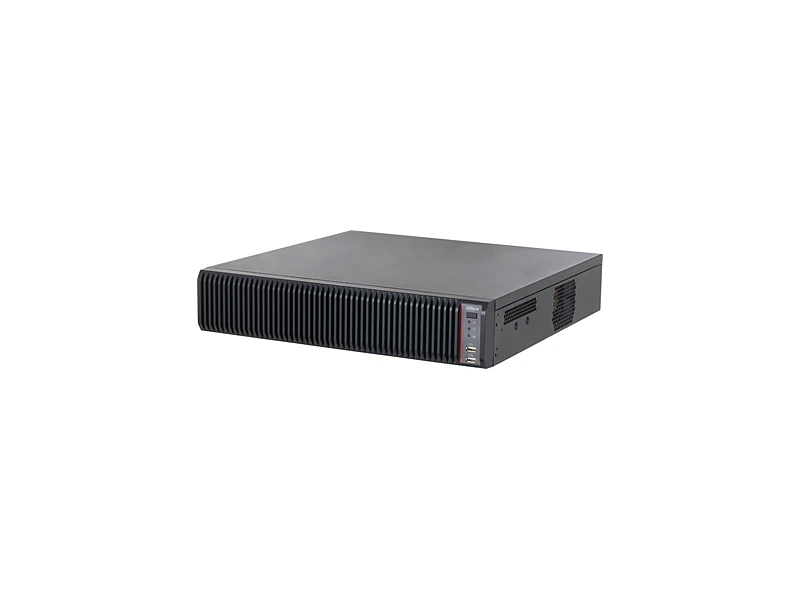
AI Network Video Recorders
Dahua IVSS51 AI surveillance servers
Three 64-channel servers in 2U with eight bays and up to four AI cards, rated to 55 C for rooms without cooling.
Capabilities below are vendor-documented. We have not tested this device or its integrations.
Sources checked:
Also known as: IVSS51, IVSS5108, 64-channel intelligent video surveillance server
Suitable projects
- A building with 64 cameras that needs face lists and metadata search in one box.
- Plant rooms and unventilated cabinets where 55 C is the difference between working and derating.
- Projects that start with one card and add three more as budgets allow, on the same chassis.
Before you buy
- Bandwidth stops at 384 Mbps, a third of what the IVSS71 offers, so 64 high-bitrate 4K streams may not fit even though the channel count allows them.
- The single-card build analyses 16 of its 64 inputs, a quarter of the cameras, which is easy to miss when the model number and the channel count are both quoted.
- The 55 C rating comes with a 64-channel ceiling and a 2U chassis, so there is no high-density version of this tier.
Official resources
- DHI-IVSS5108-4I datasheet, September 2026
- DHI-IVSS5108-1I datasheet, September 2026
- DHI-IVSS5108-2I datasheet, September 2026
- Dahua IVSS User Manual V7.1.0
Related guides
- Channels
- 64 on all three models
- AI cards
- One, two or four; 16, 32 or 64 channels of on-board face, IVS, metadata or AcuPick analysis
- Face by camera
- 32 channels at 2 MP on the single-card model, 64 at 2 MP and 40 at 4 MP on the four-card model
- Bandwidth
- 384 Mbps in, out and to disk
- Storage
- 8 bays in 2U, RAID 0/1/5/6/10/50/60
- Video output
- 2 HDMI and 1 VGA
- Working temperature
- 0 to 55 C, ten degrees wider than the IVSS71
Choosing an IVSS51 server
The IVSS51 is the 64-channel tier: half the bays, half the bandwidth and a wider temperature range than the IVSS71, at a lower price point for the same 16 channels per AI card.
This profile is based on official documentation, not our own device testing.
The three models
| Model | Channels | AI cards | Analysed | Face from AI cameras | Bandwidth |
|---|---|---|---|---|---|
| DHI-IVSS5108-1I | 64 | 1 | 16 | 32 at 2 MP | 384 Mbps |
| DHI-IVSS5108-2I | 64 | 2 | 32 | 64 at 2 MP, 40 at 4 MP | 384 Mbps |
| DHI-IVSS5108-4I | 64 | 4 | 64 | 64 at 2 MP, 40 at 4 MP | 384 Mbps |
All three are 2U, 8 bays, RAID 0/1/5/6/10/50/60, with 2 HDMI and 1 VGA output.
The channel count is not the constraint, the bandwidth is
64 channels at 384 Mbps means 6 Mbps per camera on average. Two or three 4K cameras can consume that on their own. A site with 64 cameras at 8 Mbps needs 512 Mbps and this chassis cannot deliver it, even though it lists 64 inputs.
The IVSS71 offers 512 Mbps at the same 128-channel tier and 768 Mbps above it, so the bandwidth figure rather than the channel figure is what decides between the two families.
One card covers a quarter of the inputs
The 1I analyses 16 of 64 channels. That is the same 16-per-card rule as the rest of the range, applied to a smaller chassis, and it is the single most common miscount on this series: the model reads 64 channels, the buyer assumes 64 analysed channels, and a quarter of the cameras turn out to have no analytics.
The 4I is the only build that covers every input.
Where it wins
The operating range is 0 to 55 C, ten degrees above the IVSS71 and the same as the IVD series. For a comms cupboard next to a plant room, a workshop or an unventilated riser, that is the difference between a supported installation and a derated one.
It is also the smallest chassis that still offers RAID and eight bays, so a 48 to 64 camera site can keep a month of retention and run face lists in one box.
Pick this series when
- The site has up to 64 cameras at moderate bitrate, around 6 Mbps average.
- The room runs between 45 and 55 C.
- Face recognition, metadata search and AcuPick are needed without a server room.
- RAID matters but 24 bays does not.
Do not pick it when
- The camera mix is mostly 4K, where 384 Mbps runs out before channel count does.
- More than 64 channels are needed, which is the IVSS71 tier.
- The requirement is 64 analysed channels and the budget only reaches the 1I, where 48 of them are left unanalysed.
What we could not verify
The IVSS User Manual V7.1.0 that covers this series never uses the word WizSeek. It documents text search and text-defined alarms, which is the same capability, so an installer reading the manual will not find the datasheet term anywhere.
No price is published.
Getting an IVSS51 server running
Same software as the rest of the IVSS family, in a smaller chassis. The procedure below follows the Dahua IVSS User Manual V7.1.0, and we did not run it on a device.
Before power
Eight bays, SATA drives up to 20 TB, 2U chassis. The IVSS51 has no hot swap claim on its datasheet and no enterprise-drive claim, unlike the 16-bay model in the IVSS71 series, so fit the drives before the unit goes into service and treat a failed drive as a maintenance window.
Address and initialization
Four RJ-45 ports default to 192.168.1.108 through 192.168.4.108. Set the laptop to the same subnet as the port in use.
The first visit runs device initialization: region, licence, time, and an admin password of 8 to 32 characters with at least two of uppercase, lowercase, numbers and special characters. There is no shipped login.
Enable the protocols the project needs
Under System, Security, System Service, Basic Services, the CGI and ONVIF switches decide whether a third-party platform or device can connect at all. Private Protocol covers Dahua clients and SDK work, and SSH is off by default. The manual recommends turning off whatever is not in use, which for a closed Dahua-only site means CGI and ONVIF both off.
Port defaults are HTTP 80, RTSP 554 and private protocol 37777, all set under Network, Port.
Assign the cards
Under Algorithm, Algorithm Management, AI Module, choose Use with This Device and then Intelligent Analysis Engine. With four cards the whole 64 channels can be covered; with one card only 16 can.
The A0 CPU switch between AI and General sits on the same page. AI mode gives the CPU to analysis, compression and text search and takes away video quality diagnosis and part of the decoding capability. On a 2U unit with two HDMI outputs, check what happens to the monitor wall before leaving it in AI mode.
Storage
RAID is configured in the initial wizard or under Storage, Storage Resource, RAID, with levels 0, 1, 5, 6, 10, 50 and 60. A hot standby disk can be global or private, and the interface only lists disks of at least 3 TB for the role.
Before handover
Run the security scan, set the digest algorithm, and confirm the login mode is on security rather than compatibility. Check that the recording schedule covers every channel and that the analysed channels are the ones the project specified, not the first sixteen in the list.
What the manual does not answer
The manual does not distinguish between the IVSS51 and the IVSS71 hardware, so the 55 C rating, the absence of hot swap and the 384 Mbps ceiling are datasheet facts rather than documented procedures.
Whether cluster mode is available on this chassis is not stated in either document. The IVSS71/H lists N+M in its specification and the manual says only some models support clustering; the IVSS51 pages carry no cluster line, so assume it is not there until a distributor confirms.
For the search and alarm feature set, read WizSeek, AcuPick and text-defined alarms.
FAQ — Dahua IVSS51 servers
How is this different from the IVSS71?
Channel ceiling, bandwidth and temperature. The IVSS51 stops at 64 channels and 384 Mbps and is rated 0 to 55 C; the IVSS71 goes to 128 or 256 channels at 512 or 768 Mbps and stops at 45 C.
How many channels does the 1I analyse?
Sixteen of its 64. The 2I analyses 32 and the 4I analyses all 64.
Why does face recognition from cameras stop at 40 channels on 4 MP?
The 4I supports 64 channels of face recognition from face-detection cameras at 2 MP and 40 at 4 MP. The higher resolution costs channels on this series and on the IVSS71, where the same model reads 80 at 2 MP and 60 at 4 MP. The IVD series does not show the fall: it lists 32 channels at either resolution.
Does it have RAID?
Yes, levels 0, 1, 5, 6, 10, 50 and 60 across eight bays.
Can it run at 55 C?
The datasheet rates it 0 to 55 C, ten degrees above the IVSS71. That is a specification, not a recommendation, and it does not come with a wider humidity range.
Does it support WizSeek?
The specification lists WizSeek, AcuPick and text-defined alarm features. The IVSS manual that covers the chassis does not use the WizSeek name, so the feature is documented as text search.
Is there a redundant power option?
Not in the published specification. The IVSS51 datasheet lists a single power supply line; redundancy in this tier has to come from the recording platform or a second chassis.
What are the default addresses and ports?
192.168.1.108 to 192.168.4.108 on ports 1 to 4, HTTP 80, RTSP 554, private protocol and SDK 37777.
Can it be clustered?
No cluster line appears on the series pages, and the manual states only some models support clustering. Treat it as unsupported until a distributor says otherwise.
Is there a price?
Dahua publishes none.