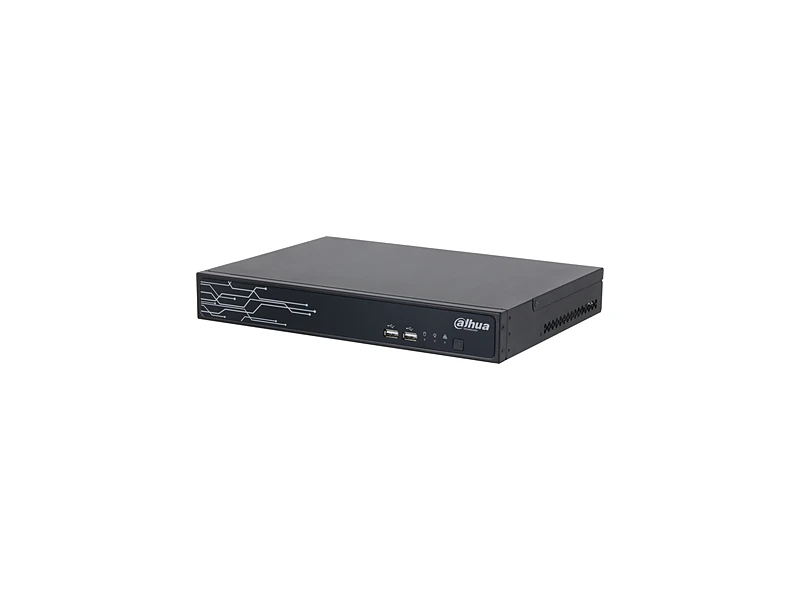
AI Network Video Recorders
Dahua IVD51 AI edge recorders
Three 48-channel 1U recorders with a single bay, up to three AI cards and a 12 V supply, for small sites.
Capabilities below are vendor-documented. We have not tested this device or its integrations.
Sources checked:
Also known as: IVD51, IVD5148, single-bay intelligent video device
Suitable projects
- Shops, clinics and small factories with 16 to 48 cameras and no rack.
- Cabinets where a 1U box on 12 V is easier to fit than a 220 V recorder.
- Sites that need face lists on a handful of entrances and nothing more.
Before you buy
- A single drive bay means no RAID, so the only redundancy is the recording platform or a second box.
- 256 Mbps is two thirds of the IVD53 figure, and 48 channels of 4 MP will exceed it before the channel count does.
- The third card adds analysis channels but work behaviour stops at 24, so the fourth tier of the IVD53 is not available here.
- Power arrives as 12 VDC through one input, so there is no dual-feed variant and no second supply to fail over to.
Official resources
- DHI-IVD5148-3I datasheet, September 2026
- DHI-IVD5148-1I datasheet, September 2026
- Dahua IVD User Manual V2.1.0
- IVD51 series product page
Related guides
- Channels
- 48 on all three models
- AI cards
- One, two or three; 16, 32 or 48 channels of recorder-side analysis
- Bandwidth
- 256 Mbps in, out and to disk
- Storage
- 1 bay, 20 TB, 1U
- Work behaviour
- 8 channels per card, up to 24
- Power
- 12 VDC 5 A, 18 to 28 W without drives and 25 to 35 W with
- Weight
- 1.75 kg
- Working temperature
- -10 to 55 C
Choosing an IVD51 recorder
The smallest member of the intelligent range: 48 channels, one drive bay, 1.75 kg and a 12 V supply. It is the box for a shop, a clinic or a gatehouse that needs face lists without a rack.
This profile is based on official documentation, not our own device testing.
The three models
| Model | Channels | AI cards | Analysed | Work behaviour | Bandwidth |
|---|---|---|---|---|---|
| DHI-IVD5148-1I | 48 | 1 | 16 | 8 | 256 Mbps |
| DHI-IVD5148-2I | 48 | 2 | 32 | 16 | 256 Mbps |
| DHI-IVD5148-3I | 48 | 3 | 48 | 24 | 256 Mbps |
All three are 1U with a single SATA bay up to 20 TB, 2 HDMI and 1 VGA, 4 alarm inputs and 2 alarm outputs, and the same -10 to 55 C range as the larger IVD53.
48 channels at 256 Mbps is 5 Mbps each
That is the tightest bandwidth per channel in the range. A site with 48 cameras averaging 5 Mbps fits; a site with a dozen 4K cameras does not, whatever the channel count says.
The IVD53 offers 384 Mbps in the same 1U footprint for the price of three bays instead of one, so the only reason to accept 256 Mbps is that the retention requirement is small.
One bay means no RAID
The IVD51 datasheet carries no RAID line at all, unlike the IVD53 which lists RAID 0, 1 and 5. A single drive is a single point of failure for the recording.
For a shop that keeps two weeks of video and cares about the analytics more than the archive, that is a reasonable trade. For anything where the recording is evidence, it is not.
Where it fits
- 16 to 48 cameras in a building without a comms room.
- Cabinets with 12 V available and no space for a 2U chassis.
- Sites that need face recognition on a handful of entrances and metadata search on a few more.
Where it does not
- Anywhere the recording has to survive a drive failure.
- Camera estates above 5 Mbps average.
- Sites that need work behaviour on more than 24 channels, which is the ceiling here against 32 on the IVD53.
What we could not verify
The IVD User Manual V2.1.0 covers this chassis and the IVD53 together, so it describes four network ports while the datasheet specifies two. The manual also has no cluster section, which matches the absence of any cluster line on the specification.
Whether the single bay can be paired with external storage for video backup is not resolved by the documents we read. The manual covers configuration backup to a USB device, which is a settings export rather than a recording archive, and the datasheet lists USB 3.0 and no eSATA where the IVD53 lists both.
No price is published.
Getting an IVD51 recorder running
A single-bay box with the same software as the rest of the IVD family. The steps follow the Dahua IVD User Manual V2.1.0; we did not run them on a device.
Before power
One SATA bay, drives up to 20 TB. There is no RAID on this chassis, so whatever is on the drive is the only copy.
Power is 12 VDC at 5 A through a single input, and the unit draws 25 to 35 W with a drive. The datasheet specifies the supply rating, so use one rated for 5 A rather than a generic adapter, and there is no second input to fall back on.
Addresses
Two RJ-45 gigabit ports. The family manual describes four default addresses from 192.168.1.108 to 192.168.4.108, so on this chassis expect only the first two to exist. Confirm on the local interface rather than assuming.
Initialization
First access sets region, time and an admin password of 8 to 32 characters with at least two character classes. No default login ships with the device.
Protocols and ports
CGI, ONVIF and private protocol are switches under System, Security, System Service, Basic Services. HTTP defaults to 80, RTSP to 554 and private protocol to 37777.
For a standalone shop installation, leaving CGI and ONVIF off removes the two interfaces an attacker would use first, and the manual recommends exactly that when they are not needed.
Cards
Algorithm, Algorithm Management, AI Module assigns the analysis engine. With one card, 16 of 48 channels get analytics; with three, all 48.
The A0 CPU switch between AI and General is on the same page. In AI mode decoding falls to 4 channels of 1080p, against 16 in normal mode, so a local monitor and full analytics cannot both run at full width on this box.
Before handover
Run the security scan, set the digest algorithm, check the recording schedule covers all channels, and write down which channels are analysed. On a 48-channel site with one card, that list is the first sixteen by default and moving it later means reconfiguring schedules.
What the manual does not answer
The port-count mismatch is the same one that affects the IVD53: family manual against chassis datasheet.
Nothing in the documents explains what happens to recording when the single drive fills, whether the oldest footage is overwritten by default, or how the device behaves with no drive fitted. Those are questions for a bench test.
For the search features, read WizSeek, AcuPick and text-defined alarms.
FAQ — Dahua IVD51 recorders
What is the difference from the IVD53?
One drive bay instead of three, 256 Mbps instead of 384, three AI cards maximum instead of four, and 1.75 kg instead of 3.4 kg. Both are rated -10 to 55 C and both are 1U.
How many channels does it analyse?
Sixteen per card, up to 48 with three cards.
Does it have RAID?
No. The datasheet has no RAID line and the chassis has one bay, so a drive failure ends the recording.
What power does it need?
12 VDC at 5 A, drawing 18 to 28 W without drives and 25 to 35 W with. There is one input and no redundancy.
Can it run on a monitor?
Two HDMI ports and one VGA, with 4K on port 1. In AI mode local decoding drops to 4 channels of 1080p, so the monitor is a normal-mode convenience rather than something to design a control room around.
Does it support face recognition?
Yes, on both paths: recorder-side at 16 to 48 channels depending on cards, and camera-side at 32 channels with face-detection cameras.
Is the plate library the same as the servers?
No. It holds 50 lists and 300,000 numbers, against 500,000 on the IVSS series. No document explains the difference.
Can it be clustered?
No. The IVD manual has no cluster section and the specification lists no cluster function.
Are the default addresses 192.168.1.108?
The family manual says ports 1 to 4 default to 192.168.1.108 to 192.168.4.108, but this chassis has two RJ-45 ports. Confirm on the device.
Is there a price?
Dahua publishes none.