Autopilot Firmware
ArduSub
Open-source underwater vehicle autopilot firmware for ROVs and submarines, with depth-hold, position and autonomous mission control.
Capabilities below are vendor-documented. We have not tested this device or its integrations.
Sources checked:
Also known as: ArduSub, ArduPilot submarine firmware, ROV autopilot
Suitable projects
- Underwater inspection of hulls, pipelines and infrastructure.
- Scientific sampling and marine habitat surveys.
- Search and recovery in confined or hazardous water.
Before you buy
- Firmware only; a compatible ROV controller and sealed frame must be supplied separately.
- Depth and leak safety depend on correct frame build and pre-dive checks.
Official resources
Related guides
- Vehicle types
- Remotely operated vehicle, submarine, underwater glider
- Flight modes
- Manual, Stabilize, Depth Hold, Position, Circle, Acro, Auto, Guided, RTL
- Sensors
- Depth pressure, heading, attitude, water temperature, leak detection
- Configured via
- QGroundControl (primary), MAVProxy
- Failsafes
- Leak detection, battery low, tether loss, depth ceiling, pilot input timeout
- Licence
- GPL-3.0
Choosing ArduSub
This profile is based on official documentation, not our own device testing.
ArduSub is the underwater-vehicle firmware in the ArduPilot family. Use it for remotely operated vehicles and submarines. For aircraft, ground vehicles or antenna trackers, choose the matching firmware instead.
Choose your frame
| Frame | Best for |
|---|---|
| ROV with thrusters | Inspection, recovery and sampling |
| Submarine | Longer autonomous dives |
| Underwater glider | Low-power survey passes |
Choose your sensors
| Sensor | Why it matters |
|---|---|
| Depth pressure | Depth hold and ceiling limits |
| Leak detection | Early warning before flooding |
| Heading and attitude | Stable manual and auto control |
Choose a ground control station
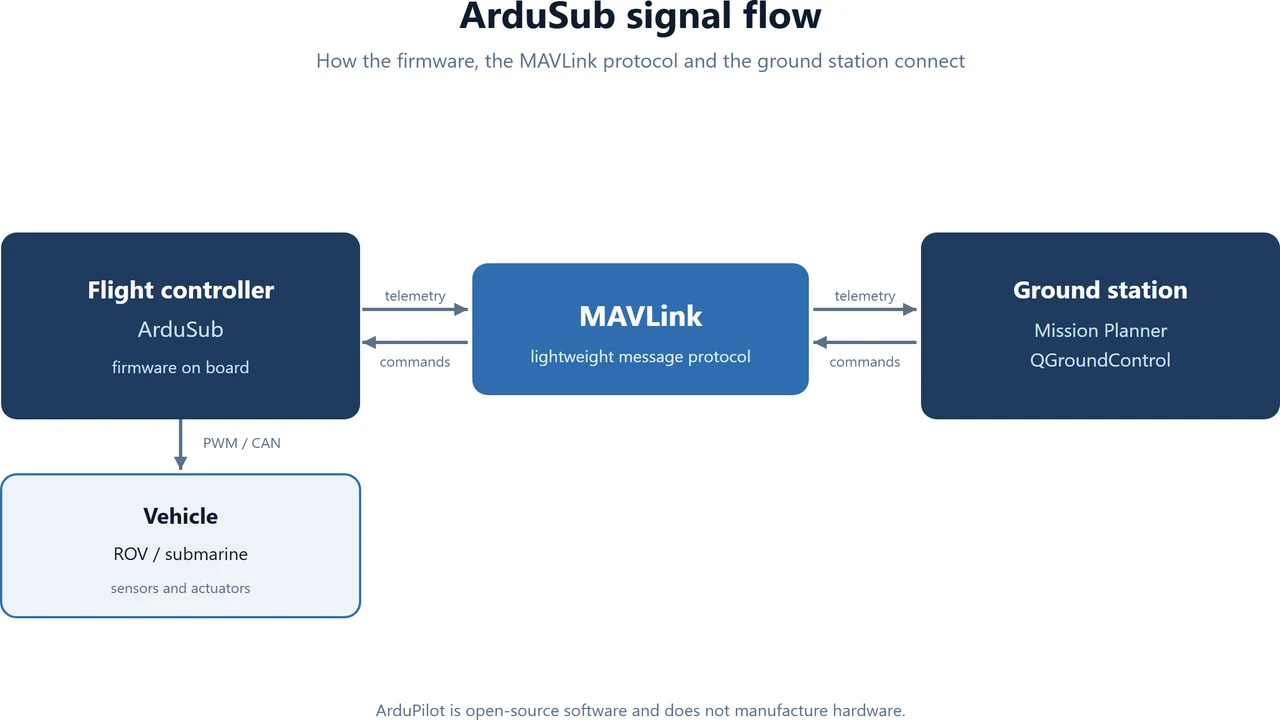
ArduSub is configured primarily through QGroundControl, which exposes the depth, attitude and camera controls an underwater vehicle needs. MAVProxy is available for scripting and advanced use.
Feature checklist
- Manual, stabilise, depth-hold and position modes.
- Autonomous waypoint missions for transects.
- Leak, battery and tether-loss failsafes.
- Heavily used with companion computers for video and sonar.
A sealed frame and pre-dive checks are essential for safe operation.
Getting started with ArduSub
This profile is based on official documentation, not our own device testing.
1. Gather your hardware
- A supported controller in a sealed pressure-rated frame
- A tether interface and surface laptop
- Depth, leak and attitude sensors
- Thrusters, a camera and lighting
2. Install the firmware
Connect the board over USB and use QGroundControl to flash the Sub firmware for your board. Confirm the board family in the board support guide first.
3. Connect and configure
Connect through the tether, select your frame and load the default parameters. QGroundControl is the primary station for ArduSub.
4. Calibrate
Calibrate the accelerometer, compass and pressure sensor. Test leak detection on the bench before sealing the frame.
5. First dive
Start in Manual or Stabilize, then try Depth Hold in a controlled pool or pen. Keep the tether clear and watch the leak and depth warnings at all times.
ArduSub FAQ
This profile is based on official documentation, not our own device testing.
Which station should I use?
QGroundControl is the primary ground control station for ArduSub. MAVProxy is available for scripting and advanced use.
Do I need a depth sensor?
A depth pressure sensor enables depth hold and ceiling limits, which are central to safe underwater operation.
Why is a tether used?
A tether carries power and a reliable data link to the surface laptop, avoiding the range and latency limits of wireless underwater communication.
Does ArduSub need GPS?
Underwater GPS does not work. Position hold instead relies on depth, attitude and sometimes a surface or acoustic reference.
How do I stay safe?
Test leak detection on the bench, keep the tether clear, and watch depth and leak warnings throughout the dive.