Autopilot Firmware
ArduRover
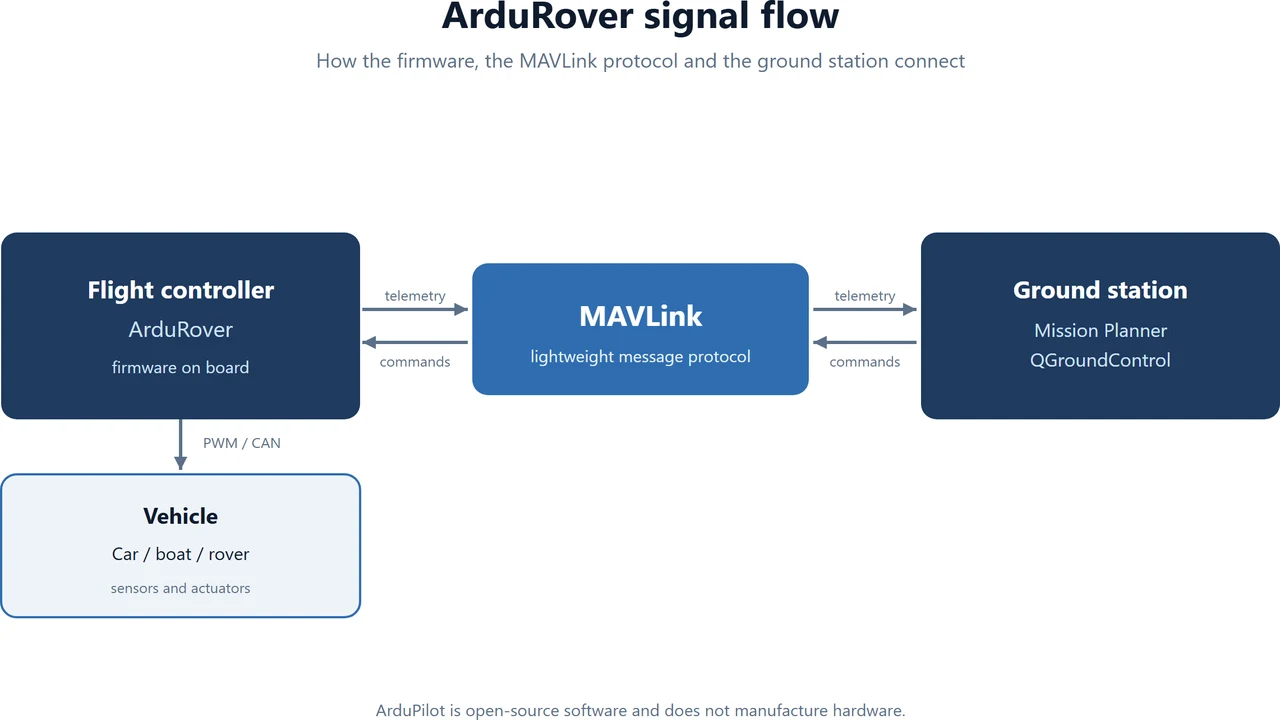
Open-source ground-vehicle autopilot firmware for cars, boats and balance bots, with manual, autonomous and return-to-launch control.
Capabilities below are vendor-documented. We have not tested this device or its integrations.
Sources checked:
Also known as: ArduRover, APM Rover, ArduPilot ground vehicle firmware
Suitable projects
- Autonomous lawn, farm and warehouse ground surveys.
- Marine mapping and inspection with boat and sailboat frames.
- STEM and robotics education using low-cost rover chassis.
Before you buy
- Firmware only; a compatible rover or boat controller must be supplied separately.
- Steering and throttle tuning vary with chassis and surface conditions.
Official resources
Related guides
- Vehicle types
- Car, boat, balance bot, sailboat
- Drive modes
- Manual, Acro, Steering, Hold, Loiter, Follow, Auto, RTL, Guided, Circle, SmartRTL
- Navigation
- GPS, compass, wheel encoders, visual odometry
- Configured via
- Mission Planner, QGroundControl, MAVProxy
- Failsafes
- Radio loss, battery low, GPS loss, fence breach, crash check
- Licence
- GPL-3.0
Choosing ArduRover
This profile is based on official documentation, not our own device testing.
ArduRover is the ground-vehicle firmware in the ArduPilot family. Use it for cars, boats and balance bots that move across land or water. For aircraft, submarines or antenna trackers, choose the matching firmware instead.
Choose your chassis
| Chassis | Best for |
|---|---|
| Car or skid-steer rover | Land survey, inspection and education |
| Boat | Marine mapping and water sampling |
| Sailboat | Wind-powered long-duration missions |
| Balance bot | Single-wheel research platforms |
Choose your drive type
| Drive | Notes |
|---|---|
| Skid steering | Two motors, tank-style turning |
| Ackermann steering | Car-style front-wheel steering |
| Thrust vector | Boats with differential thrust |
Choose a flight controller
ArduRover runs on the same autopilot boards as the other firmware families. Confirm your controller in the board support guide, then load the Rover build. Boats need a waterproof frame and sealed electronics.
Feature checklist
- Manual, steering and hold modes for assisted control.
- Loiter, follow and autonomous waypoint missions.
- Smart return to launch for recovery.
- Wheel encoders and visual odometry for accurate navigation.
Tuning differs with chassis and surface, so validate on the ground first.
Getting started with ArduRover
This profile is based on official documentation, not our own device testing.
1. Gather your hardware
- A supported controller
- A GNSS module, telemetry radio and receiver
- Drive motors or thrusters, an electronic speed controller and a battery
- A computer with Mission Planner or QGroundControl
2. Install the firmware
Connect the board over USB and use the ground control station to flash the Rover firmware for your board. Confirm the board family in the board support guide first.
3. Connect and configure
Connect the board, choose your chassis and drive type, then load the default parameters.
4. Calibrate
Calibrate the accelerometer, compass and radio. For skid-steer and car frames, confirm steering direction on the bench.
5. First drive
Start in Manual or Steering and confirm control, then try Hold and Loiter in a safe area. Boats need a waterproof frame and a clear stretch of water.
ArduRover FAQ
This profile is based on official documentation, not our own device testing.
Which boards run ArduRover?
Most Pixhawk-family boards and many other controllers run it. Confirm the exact build for your board in the board support guide.
Can ArduRover control a boat?
Yes. ArduRover supports car, boat, sailboat and balance-bot frames with the appropriate drive configuration.
Do I need wheel encoders?
Wheel encoders improve distance and heading accuracy on land, but the firmware can navigate with GPS and compass alone.
Can one controller switch between Rover and other firmware?
A board is normally flashed with one firmware at a time. Choose the firmware that matches your vehicle.
Where can I drive or sail?
Use private land or permitted water, and follow local rules for autonomous vehicles.