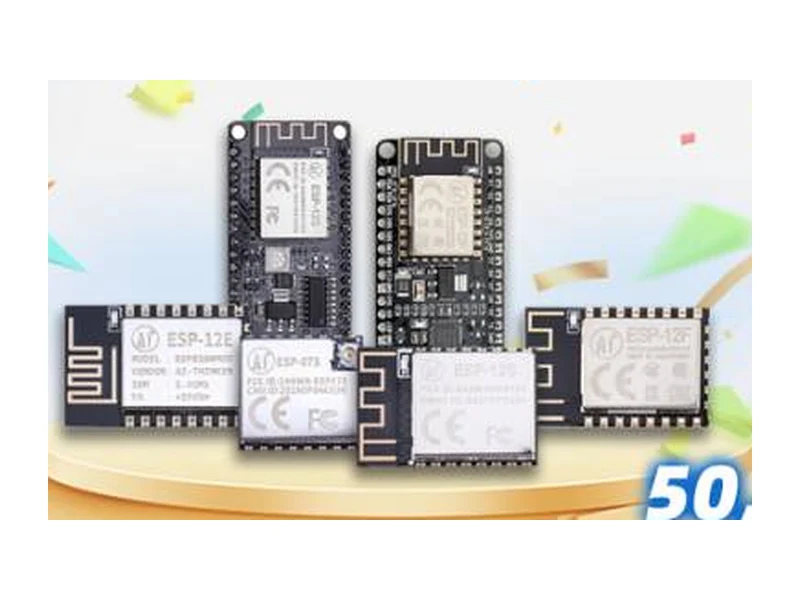
Wireless Modules
ESP8266 Series Wi-Fi Modules
The module family that shipped over fifty million units, still the cheapest way to put Wi-Fi on a board, and one member that is not an ESP8266.
Capabilities below are vendor-documented. We have not tested this device or its integrations.
Sources checked:
Also known as: ESP-01, ESP-01D, ESP-01F, ESP-01M, ESP-01S, ESP-07, ESP-07S, ESP-12E, ESP-12F, ESP-12S, ESP-12K, ESP-15F, Ai-Thinker ESP8266, 安信可 ESP8266 模组
Suitable projects
- Existing ESP8266 designs that need a second source for the same footprint.
- Simple Wi-Fi nodes on a 3.3 V budget where two to eleven GPIO is enough.
- Cost-driven sensor and actuator boards where the radio is one part of the bill of materials rather than the whole product.
- Retrofit and maintenance work on products built around the ESP8266 generation of modules.
Before you buy
- The family is not homogeneous. ESP-01D, ESP-01F and ESP-01M are ESP8285 parts rather than ESP8266, and ESP-12K is an ESP32-S2 module listed inside the ESP8266 documentation topic.
- IO count ranges from 2 on ESP-01 and ESP-01S to 37 on ESP-12K, and from 3 on ESP-01D and ESP-15F to 11 on ESP-01M.
- Supply voltage is not uniform: everything is 3.0 V to 3.6 V except ESP-15F, which is a 5 V part on a PH2.54 connector.
- Certification is per model, not per family, and several entries on the vendor's own table are still marked as in progress.
- The product page lists five modules while the documentation topic lists more than a dozen. The exact order code has to be read from the per-model datasheet.
- There is no Bluetooth on this silicon. A board that needs BLE has to move to the ESP32-C3 family or add a second radio.
- The vendor's own pages disagree on deep sleep current. The topic page states 20 µA, the product page states 10 µA, and the family table shows 10 µA for ESP-12E and 20 µA for the rest.
Official resources
- Ai-Thinker ESP8266 series module documentation topic
- Ai-Thinker ESP8266 and ESP32 module product page
- Ai-Thinker company profile
Related guides
- Silicon
- Espressif ESP8266EX with a Tensilica L106 32-bit core at 80 MHz or 160 MHz
- Wi-Fi
- 802.11 b/g/n on 2.4 GHz, with the full TCP/IP stack on the module
- UART
- 4 Mbps
- Power
- 3.0 V to 3.6 V, 3.3 V typical, on every model except ESP-15F which runs on 5 V
- Flash
- 8 Mbit, 16 Mbit or 32 Mbit depending on model; ESP-01F and ESP-01M are also offered with both 8 Mbit and 16 Mbit
- IO
- 2 to 37 depending on model
- Interfaces
- HSPI, UART, I2C, I2S, IR remote, PWM, GPIO and a 10-bit ADC
- Sleep current
- Modem sleep 15 to 20 mA, light sleep 0.9 to 2 mA, deep sleep 10 to 20 µA depending on model
- Security
- WEP, WPA-PSK and WPA2-PSK
- Provisioning
- SmartConfig by app and AirKiss by WeChat, on Android and iOS
- Firmware
- UART local upgrade and remote OTA; RTOS SDK and a Wi-Fi channel selection guide are published
Choosing an Ai-Thinker ESP8266 Module
This profile is based on official documentation, not our own device testing.
The ESP8266 modules are the oldest thing Ai-Thinker still sells, and they are still the cheapest way to put Wi-Fi on a board. The family is not a single part with a few sizes, though. It contains twelve documented variants running three different chips, and one of them is not an ESP8266 at all.
What the series is for
- Bringing up a Wi-Fi node on a 3.3 V budget, where two to eleven GPIO is enough.
- Second-sourcing a design that already uses an ESP8266 module.
- Maintenance and retrofit work on products built around this generation of hardware.
The documented variants
| Model | Chip | Antenna | Package | Size (mm) | IO | Flash |
|---|---|---|---|---|---|---|
| ESP-01 | ESP8266 | On-board | DIP-8 | 24.7 × 14.4 × 11.0 | 2 | 8 Mbit |
| ESP-01D | ESP8285 | External | DIP-6 | 13.5 × 8.5 × 2.6 | 3 | 16 Mbit |
| ESP-01F | ESP8285 | External | SMD-18 | 11.0 × 10.0 × 2.0 | 9 | 8 Mbit / 16 Mbit |
| ESP-01M | ESP8285 | On-board | DIP-18 | 18.0 × 18.0 × 2.8 | 11 | 8 Mbit / 16 Mbit |
| ESP-01S | ESP8266 | On-board | DIP-8 | 24.4 × 14.4 × 11.2 | 2 | 8 Mbit |
| ESP-07 | ESP8266 | IPEX / ceramic | SMD-16 | 21.2 × 16.0 × 3.0 | 9 | 8 Mbit |
| ESP-07S | ESP8266 | IPEX | SMD-16 | 17.0 × 16.0 × 3.0 | 9 | 32 Mbit |
| ESP-12E | ESP8266 | External | SMD-22 | 24.0 × 16.0 × 3.0 | 9 | 32 Mbit |
| ESP-12F | ESP8266 | On-board | SMD-22 | 24.0 × 16.0 × 3.0 | 9 | 32 Mbit |
| ESP-12S | ESP8266 | On-board | SMD-16 | 24.0 × 16.0 × 3.0 | 9 | 32 Mbit |
| ESP-12K | ESP32-S2 | On-board | SMD-42 | 31.0 × 18.0 × 3.0 | 37 | 32 Mbit |
| ESP-15F | ESP8266 | On-board / IPEX | PH2.54 connector, DIP-8 | 41.3 × 24.1 × 6.6 | 3 | 32 Mbit |
Every model runs the 2.4 GHz 802.11 b/g/n radio with the full TCP/IP stack on the module, a UART rate of 4 Mbps, and the same Tensilica L106 core at 80 MHz or 160 MHz on the ESP8266 parts.
The model that is not an ESP8266
ESP-12K is listed inside the ESP8266 documentation topic, and it carries the widest body in the family, but it is built on an ESP32-S2. It has 37 GPIO against the two to eleven of the real ESP8266 modules, and it is 31.0 × 18.0 mm rather than 24.0 × 16.0 mm.
If you are ordering by family name, this is the one that will surprise you. Check the chip line on the datasheet, not the topic it appears in.
Three different chips under one name
- ESP8266: ESP-01, ESP-01S, ESP-07, ESP-07S, ESP-12E, ESP-12F, ESP-12S and ESP-15F.
- ESP8285: ESP-01D, ESP-01F and ESP-01M. Same Wi-Fi generation, different die.
- ESP32-S2: ESP-12K.
The ESP8285 parts matter because they are the ones with a 2 MB or 4 MB flash rather than 8 Mbit or 32 Mbit, and because their IO counts run to 9 or 11 rather than 2.
Supply voltage is not uniform
Everything runs from 3.0 V to 3.6 V, 3.3 V typical, except ESP-15F, which is a 5 V part on a PH2.54 connector with three IO. That one is designed to be plugged into a breadboard or a header rather than soldered down.
Sleep current differs by model
| Model | Modem sleep | Light sleep | Deep sleep |
|---|---|---|---|
| ESP-01 / ESP-01D / ESP-01F / ESP-01M / ESP-01S | 20 mA | 2 mA | 20 µA |
| ESP-07 / ESP-12F / ESP-12S | 20 mA | 2 mA | 20 µA |
| ESP-12E | 15 mA | 0.9 mA | 10 µA |
| ESP-07S | 20 mA | 2 mA | 20 µA |
| ESP-12K | 20 mA | 1.4 mA | 20 µA |
| ESP-15F | Multiple sleep modes, 1.0 mW standby |
ESP-12E is the low-power outlier in the family, with the lowest modem, light and deep sleep figures of the standard parts.
One figure the vendor does not keep consistent
The deep sleep number is stated three different ways across the vendor's own material. The documentation topic says the deep sleep hold current is 20 µA. The product page says 10 µA. The family table shows 10 µA for ESP-12E and 20 µA for the rest of the modules. Design the power budget against the datasheet for the part you are ordering, not against the headline number.
Certification is per model, and some of it is still in progress
| Model | Published certification |
|---|---|
| ESP-01, ESP-01D, ESP-07 | Not yet |
| ESP-01F | FCC, CE |
| ESP-01M | FCC, CE, SRRC, REACH, RoHS |
| ESP-01S | RoHS |
| ESP-07S | FCC, CE, SRRC, REACH, RoHS |
| ESP-12E, ESP-12K, ESP-15F | FCC, CE, SRRC, with an asterisk |
| ESP-12F | FCC, CE, SRRC, REACH, RoHS, TELEC, ANATEL, RoHS |
| ESP-12S | FCC, CE, SRRC, RoHS, and Alipay Feiniu certification |
The asterisk marks certifications that the vendor states are still being applied for. If a product has to ship into a market where radio approval is mandatory, ESP-12F is the variant with the widest published coverage.
Check before ordering
- Read the per-model datasheet. The product page lists five modules, and the documentation topic lists more than a dozen, so neither is a complete order list on its own.
- Confirm the chip. ESP-01D, ESP-01F and ESP-01M are ESP8285 parts, and ESP-12K is an ESP32-S2 module.
- Confirm the IO count. It runs from 2 to 37 across the family.
- Confirm the supply voltage. ESP-15F is 5 V; everything else is 3.3 V.
- Check the certification row for the exact model, and check whether the entry is marked as in progress.
- Decide whether you need Bluetooth. This silicon has none.
Next step
The buying guide on this page covers the variants. The Wi-Fi module selection guide compares this family with the ESP32-C3 modules that can share its footprint, and the ESP32 chip comparison guide covers the silicon underneath.
The vendor publishes the specification table, the per-model datasheets, the PCB footprints and the module outline drawings for each variant.
Quick Start — Ai-Thinker ESP8266 Modules
This profile is based on official documentation, not our own device testing.
The ESP8266 modules are bare parts. This sequence takes one from the packet to a joined network. The steps that differ between variants are marked where they do.
1. Check what arrived
Read the part marking before anything else. The family contains twelve documented variants running three different chips.
- A module marked ESP-01, ESP-01D, ESP-01F, ESP-01M, ESP-01S, ESP-07, ESP-07S, ESP-12E, ESP-12F, ESP-12S, ESP-12K or ESP-15F.
- Check the chip line, not just the family name. ESP-01D, ESP-01F and ESP-01M are ESP8285 parts, and ESP-12K is an ESP32-S2 module.
- Check whether the model needs an antenna. The DIP-6 and DIP-8 parts with an external antenna, and ESP-07 and ESP-07S, do not ship with one.
2. Lay out the carrier board
Follow the module footprint published by the vendor for your exact part. They are not interchangeable: the outline ranges from 11.0 × 10.0 mm on ESP-01F to 41.3 × 24.1 mm on ESP-15F.
- Keep the RF keep-out area free of copper and of components.
- Route the antenna trace or the IPEX launch per the vendor's antenna design reference.
- Check the module outline drawing published for the part, not the generic family drawing.
3. Bring up the power rail
- Everything except ESP-15F runs from 3.0 V to 3.6 V, 3.3 V typical. ESP-15F is a 5 V part.
- Give the rail enough headroom for the transmit burst. The modules draw significantly more when transmitting than the sleep figures suggest.
4. Wire the serial lines and the boot pins
- The UART rate is 4 Mbps, and 115200 bps is the usual working speed for the log.
- Boot into the download mode by pulling the boot pins as the vendor's ESP8266 development guide describes, rather than guessing from a board you have not looked at.
5. Flash the firmware
The vendor publishes the AT command firmware, the MQTT firmware and the RTOS SDK, plus a Wi-Fi channel selection guide and a throughput test document.
- For first contact, use the AT firmware over the serial port. It answers without a toolchain.
- The AT firmware and the MQTT firmware are published as separate builds with their own version numbers, so confirm which one is on the module before configuring it.
6. Join a network
The modules support SmartConfig by app and AirKiss by WeChat, on both Android and iOS, and the classic STA, AP and STA+AP modes.
- Join one network as a station first. AP mode is a second step, not a first one.
- If SmartConfig or AirKiss fails, move the board away from the router and try again. It is the most common first-contact failure and it is usually the radio environment, not the module.
7. Check the radio
802.11 b/g/n on 2.4 GHz, with the TCP/IP stack on the module.
- Verify data rate and RSSI with the antenna that will be fitted in the product.
- The published transmission distances in the family table are 40 m to 100 m. Treat them as a bench figure, not a field figure.
8. Move to deep sleep
- Measure the current draw on the finished board in each sleep state.
- The published figures differ by model: 20 µA deep sleep on most parts, 10 µA on ESP-12E, and 1.0 mW standby on ESP-15F.
- The vendor's own pages disagree on the headline deep sleep number. Measure the part you actually shipped.
Mistakes that ruin a module
- Ordering ESP-12K as an ESP8266. It is an ESP32-S2 with 37 GPIO and a different footprint.
- Assuming the whole family is 3.3 V. ESP-15F is 5 V.
- Treating the family table's transmission distance as a design guarantee.
- Ordering a variant whose certification is still marked as in progress when the target market requires approval.
- Forgetting that this silicon has no Bluetooth.
- Reading the headline deep sleep figure off a product page rather than the datasheet for the part in hand.
FAQ — Ai-Thinker ESP8266 Modules
This profile is based on official documentation, not our own device testing.
Which model should I pick?
It depends on three things. The IO count ranges from 2 to 37 across the family. The supply voltage is 3.0 V to 3.6 V on every model except ESP-15F, which is 5 V. And the certification row differs per model, with several entries still marked as in progress. The buying guide on this page has the full table.
Is ESP-12K really an ESP8266?
No. It is an ESP32-S2 module, listed inside the ESP8266 documentation topic. It has 37 GPIO against the two to eleven of the real ESP8266 parts, and a 31.0 × 18.0 mm outline against 24.0 × 16.0 mm. Check the chip on the datasheet, not the topic the model appears in.
Which models use the ESP8285 instead?
ESP-01D, ESP-01F and ESP-01M. They are the same Wi-Fi generation on a different die, and they carry a different flash size and a different IO count from the ESP8266 parts.
How much flash do they have?
It depends on the model. ESP-01 and ESP-01S carry 8 Mbit. ESP-01D carries 16 Mbit. ESP-01F and ESP-01M are offered with 8 Mbit or 16 Mbit. The rest of the family carries 32 Mbit.
How many GPIO do I get?
Between 2 and 37. ESP-01 and ESP-01S have 2. ESP-01D and ESP-15F have 3. ESP-01F, ESP-07, ESP-07S, ESP-12E, ESP-12F and ESP-12S have 9. ESP-01M has 11. ESP-12K has 37.
Does it support Bluetooth?
No. This family is Wi-Fi only, 802.11 b/g/n on 2.4 GHz, with the TCP/IP stack on the module. A design that needs BLE has to move to a different silicon.
What is the deep sleep current?
It depends on the model and on which page you read. The family table gives 20 µA for most modules and 10 µA for ESP-12E. The documentation topic states 20 µA as the family figure, and the product page states 10 µA. The vendor's own material is not consistent on this point, so design against the datasheet for the part you order and measure the finished board.
Do any models run on 5 V?
Only ESP-15F, which is a 5 V part on a PH2.54 connector with three IO. Everything else runs from 3.0 V to 3.6 V, 3.3 V typical.
Which models have an external antenna?
ESP-01D and ESP-01F take an external antenna. ESP-07 carries an IPEX or ceramic antenna, and ESP-07S an IPEX antenna. ESP-15F is published as on-board antenna with an IPEX option. The rest are on-board.
Is the certification the same for every model?
No, and this is the detail most often missed. ESP-12F has the widest published coverage: FCC, CE, SRRC, REACH, RoHS, TELEC and ANATEL. ESP-01, ESP-01D and ESP-07 are marked as not yet certified. ESP-12E, ESP-12K and ESP-15F carry entries with an asterisk, which the vendor states means the certification is still being applied for.
Is the product page list complete?
No. The product page lists five modules. The documentation topic lists more than a dozen, including the NodeMCU development boards. The per-model datasheet is the authoritative source for the part you are ordering.
How do I get onto the network?
SmartConfig by app and AirKiss by WeChat, on Android and iOS, plus the classic STA, AP and STA+AP modes. The vendor also publishes the AT and MQTT firmware, the RTOS SDK and a Wi-Fi channel selection guide.
Where are the official figures published?
The specification table, the per-model datasheets, the PCB footprints and the module outline drawings are all linked from the ESP8266 documentation topic. The company profile and the product page are listed under Official resources on the overview tab of this device page.