Duke Nukem 3D now runs on the RP2350 and loads from an SD card
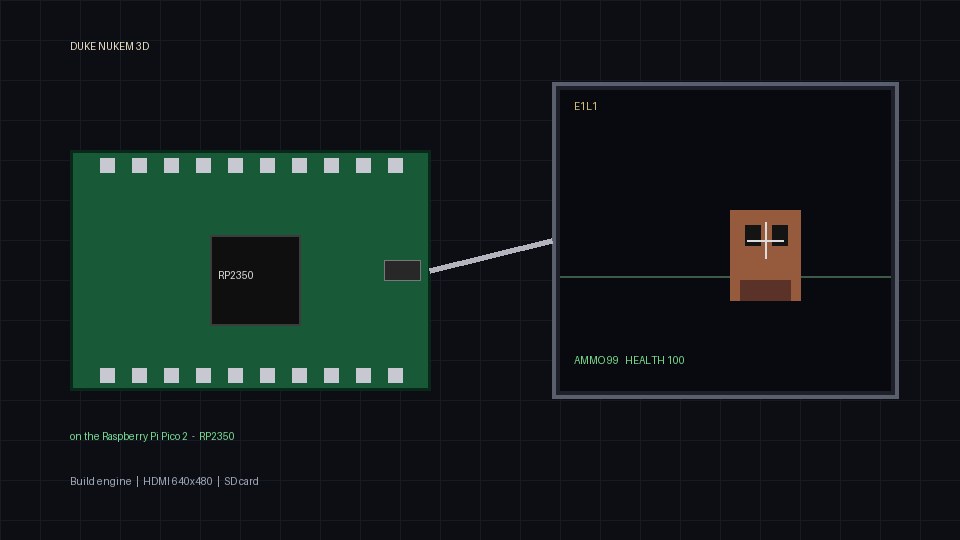
A port of Duke Nukem 3D to the Raspberry Pi Pico 2 class of boards has landed, and it is more than a tech demo. PicoPlus-devel built pico-duke3D around Ken Silverman's BUILD engine and runs the full 1996 first-person shooter from a micro SD card, with HDMI video, period-correct audio, and real gamepads. The shareware episode works, and so does the full Atomic Edition if you supply your own data file.
What makes it notable is the hardware target. Duke Nukem 3D shipped in 1996 asking for at least a 486DX2 with 8 MB of memory, a step up from DOOM's 386 and 4 MB from three years earlier. Seeing that same game draw frames on a five-dollar microcontroller board with no operating system underneath is the kind of milestone retro-computing readers enjoy tracing.
What it runs on
Four RP2350 hobby boards are tested and working on real hardware. All output HDMI at 640 by 480, and all read the game from an SD card.
| Board | Video | Audio | Pads | Notes |
|---|---|---|---|---|
| Fruit Jam | HDMI 640x480 | Headphones or HDMI | USB, 2x NES or SNES, SNES Mouse | Five LEDs act as a sound meter |
| Murmulator M2 | HDMI 640x480 | Headphones or HDMI | USB, 2x NES or SNES, SNES Mouse | Onboard LED blinks while drawing |
| Adafruit DVI + SD | HDMI 640x480 | Headphones or HDMI | USB via OTG, 2x NES or SNES | Self-built Pico Plus 2 + breakouts |
| Olimex RP2040-PICO-PC | HDMI 640x480 | Audio jack or HDMI | USB via OTG, 1x NES or SNES, Wii Classic | PSRAM must be fitted to GPIO 8 |
On the boards with controller sockets, a real NES pad is auto-detected and its two buttons map to the same A and B as any other pad. A genuine NES pad opens the menu with SELECT and START instead of the shoulder buttons, since it has none.
How the game loads
The game data stays on the card, so moving between the shareware episode and the full version means swapping one file. You need a micro SD card formatted FAT or exFAT, the DUKE3D.GRP data file placed in roms/duke3d, and an HDMI screen plus any one controller.
Savegames, settings and screenshots are written back to the card as you play. F12 captures a PNG, and the configuration file keeps your key bindings. The port can boot standalone or be picked from the pico-bootLoader menu alongside other emulators.
The memory catch
This is the one detail that trips up builders. The port needs the extra memory that only the Pimoroni Pico Plus 2 carries. A stock Pico 2 or Pico 2 W will not start: it prints the reason on screen and halts rather than crashing silently. On the Olimex board a plain Pico 2 must have a PSRAM chip fitted with its chip select on GPIO 8, or the same on-screen message appears. The Adafruit DVI plus SD build is a self-made option around a Pico Plus 2, not a bare Pico 2.
So a five-dollar board is the wrong assumption. The working combination is a Pico Plus 2 module, which costs more than the base Pico 2, paired with one of the supporting boards above.
Input and feel
USB gamepads, keyboards and mice plug straight in on the boards that have a USB socket, and up to two USB pads are supported. The D-pad and the left thumbstick both steer. Connect everything before switching on, because USB controllers are not detected after boot. On the Adafruit and Murmulator boards the NES or SNES sockets behave exactly like a USB pad, and a SNES Mouse works too.
Sound effects and Adlib or Sound Blaster music play through headphones or HDMI. Plug headphones and HDMI in at once and the board switches automatically. Errors are reported on screen, so no serial cable or second computer is needed to find out what went wrong.
Where it came from
The port is built on Chocolate Duke3D and Ken Silverman's BUILD engine, with Duke Nukem 3D itself remaining the property of 3D Realms. No game data is bundled, which is why the SD card step is mandatory. The README credits the port to Frank Hoedemakers with most of the code written using Claude Code, and testing by Gavin Knight.
Why it matters
Ports like this are a useful signal for the maker and integrator audience the site serves. They show, concretely, what the RP2350 can do when someone writes close to the metal: a 1996 3D engine, HDMI output driven through the chip's programmable I/O, audio synthesis, and USB host stack, all on a piece of hardware that fits in a pocket. For anyone evaluating the Pico 2 family for a product, that is a more honest benchmark than a vendor datasheet row.